


Document Checklist for Australian Student Visa for 2026
You’ve spent months researching universities, preparing for IELTS, and dreaming about studying in Australia. You finally submit your visa application, only to receive a rejection email because you missed one important document.
But here’s the truth: one missing document can delay or even reject your visa application.
Every year, thousands of students see their Australian education dreams put on hold, not because they weren’t qualified, but because their documentation wasn’t complete. Don’t let that be you.
But don’t worry! This document checklist for Australian student visa applications ensures you’re fully prepared with everything the Department of Home Affairs (DHA) requires.
Ready to get it right the first time? Let’s dive in.
Before we begin with the checklist, keep in mind that criteria may differ significantly depending on your unique circumstances, such as your place of origin or course level. Always double-check the official Department of Home Affairs website for the most recent changes, since policies may change by 2026. This list covers the core documents you’ll need to gather and submit via ImmiAccount. Organize them neatly in a folder to avoid last-minute scrambles.
- Valid Passport
- Academic Transcripts & Certificates
- English Language Test Results(IELTS, PTE, TOEFL)
- Confirmation of Enrolment(CoE)
- Genuine Student(GS) Statement
- Overseas Student Health Cover(OSHC)
- Proof of Financial Capacity
- Health Examination Reports
- Character Certificate/ Police Clearance
- Visa Application Form(Subclass 500- form 157A)
Want to study in Australia? Westford Education provides you full support from start to end. From test preparation to smooth visa process, we take care of you and your dreams.
Westford Education Location
Essential Documents for Australian Student Visa
Let’s go over each required document. Your application may be stopped in its tracks if you miss even one. Here’s a complete Australian student visa checklist for Nepali students based on DHA’s Subclass 500 requirements.
1. Valid Passport
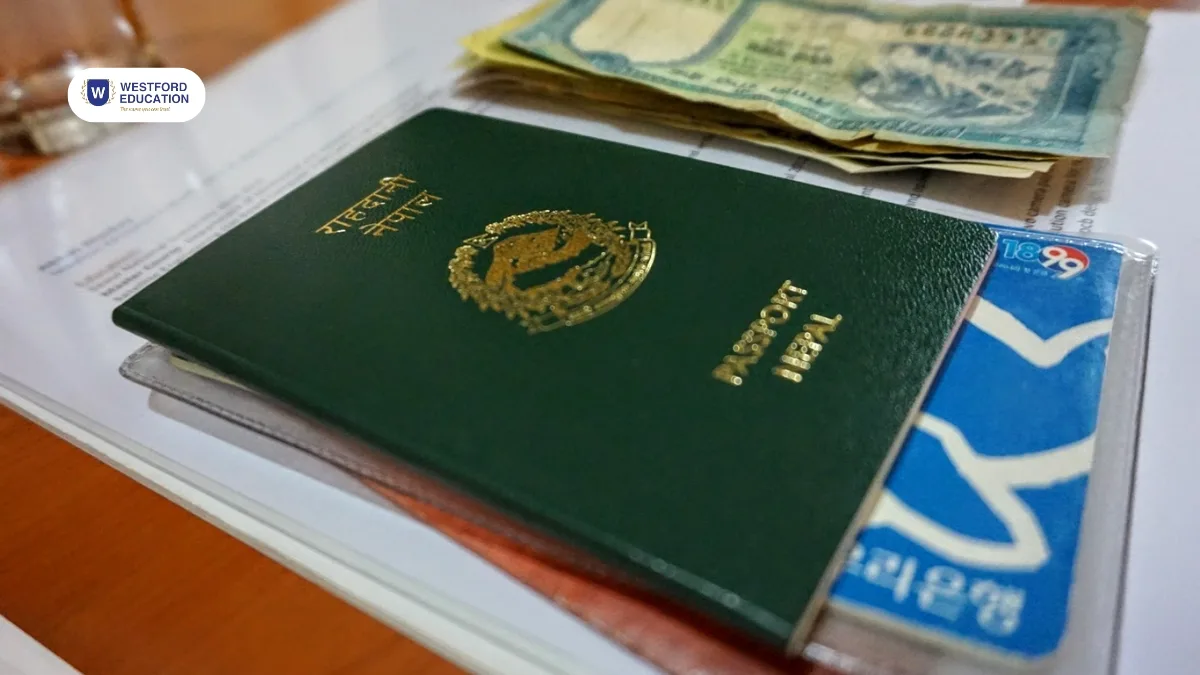
Your passport is your primary identity document for international travel.
Requirements:
- Must be valid for at least 6 months beyond your intended stay in Australia
- Should have blank pages for visa stamps
- Must show clear personal details and a photo
Where to get it: Apply through the Department of Passports in Kathmandu or regional offices. The processing takes 2-7 business days for normal service.
Pro tip: Submit high-quality scanned copies (color, 300 DPI) of the bio-data page. Make sure every corner is visible and text is readable.
Recommended Read: Why Study in Australia?
2. Academic Transcripts & Certificates
These prove you’ve completed the education required for your chosen Australian course.
What you need:
- High school certificates (Class 10 and 12)
- Bachelor’s degree certificates (if applying for postgraduate)
- Mark sheets from all years of study
- Transcripts showing subjects and grades
Important: You must get your documents professionally translated and validated by an NAATI-qualified translator if they are not in English. Have both the English and the original language copies on hand.
3. English Language Test Results (IELTS, PTE, TOEFL)
Australia wants to ensure you can succeed academically and communicate effectively.
Tests that are accepted:
- IELTS Academic: A minimum score of 5.5 to 7.0 overall, depending on the course
- PTE Academic: 42–79 scores minimum
- TOEFL iBT: 46–94 points minimum
- Cambridge English: Accepted at different levels
Important prerequisites:
- The test needs to be taken within the previous two years.
- Results are delivered straight to DHA from the testing agency.
- Scores must fulfil the minimal requirements set by your institution.
Exemptions: You may skip this if you’ve completed at least 5 years of study in English at an Australian or equivalent institution.
Explore the test preparation classes of Westford Education – available both online and offline classes.
4. Confirmation of Enrolment (CoE)
This is your golden ticket, proof that an Australian institution has accepted you.
What it is: An official electronic document with a unique code that confirms:
- You’ve been accepted into a course
- You’ve paid tuition fees or a deposit
- Your course is registered with CRICOS
How to get it: Your education provider issues the CoE after you accept their offer and make payment. This is mandatory for subclass 500 visa applications; you literally cannot apply without it.
Keep it safe: You’ll need the CoE number when filling out your visa application form.
5. Genuine Student (GS) Statement

Many Nepali students face refusal due to weak GTE statements. Clearly explain your career goals, reasons for choosing Australia, and how your study aligns with your future plans. Your GS statement (formerly called GTE) is your personal story that convinces visa officers you’re a genuine student.
What to include:
- Why did you choose this specific course and university
- How does it connect to your previous education and career goals
- Why Australia instead of studying in Nepal or other countries
- Your future plans after graduation (be honest, returning home is often viewed positively)
- Your family, financial, and employment situation in Nepal
Why it matters: A weak or generic statement is one of the top refusal reasons. Don’t copy-paste templates from the internet. Make it personal, specific, and true to your story.
Westford Education‘s expert team will guide you to write a proper Genuine Student Statement for visa success.
6. Overseas Student Health Cover (OSHC)
Every student must purchase Overseas Student Health Cover (OSHC) before applying. This covers medical expenses during your stay. Compare OSHC providers like BUPA, Allianz, NIB and Medibank to choose the right plan.
Cost: Approximately AUD $500-700 per year for a single student.
Must attach: Receipt or confirmation of OSHC purchase with your visa application.
7. Proof of Financial Capacity
This is the “show me the money” part of your application. You need to prove you can afford:
- Tuition fees for your entire course
- Living expenses (currently AUD $29,710 per year)
- Travel costs (flights to and from Australia)
- OSHC
Expense Type | Minimum Amount (AUD) | Equivalent (NPR approx.) |
Tuition Fee (1 year) | 25,000 | 2.2 million |
Living Cost | 24,505 | 2.1 million |
Travel | 2,000 | 170,000 |
Acceptable proof includes:
- Bank statements (last 6 months, showing consistent funds)
- Fixed deposit certificates
- Education loan approval letters
- Scholarship award letters
- Sponsorship letters from parents (with their income proof, tax returns, and property documents)
You can also include your parents’ income tax clearance certificates, property valuation certificates, and business registration documents if applicable.
8. Health Examination Reports
You’ll need medical checkups by DHA-approved panel doctors. In Nepal, visit authorized clinics in Kathmandu.
The medical tests typically include:
- Chest X-ray
- General physical examination
- Blood tests (if required)
Good news: Results are sent electronically to the Department of Home Affairs, so you don’t need to worry about carrying reports.
Important: Get your medical examination done only after you receive the referral letter from the immigration department (usually after you submit your initial application).
9. Character Certificate / Police Clearance
This proves you have no criminal record and are of good character.
In Nepal, you can get this from:
- Nepal Police Headquarters, Naxal, Kathmandu
- District Police Office in your district
Validity: Only 12 months from the issue date. Don’t get it too early!
What if you’ve lived in other countries? You’ll need police clearance from every country where you’ve lived for 12 months or more in the past 10 years.
10. Visa Application Form (Subclass 500 – Form 157A)
This is your main application form, lodged online through ImmiAccount (the official Australian immigration portal).
Rules:
- Every section must be complete and accurate
- Double-check spelling, dates, and passport numbers
- Any mistakes can cause processing delays
- Answer all questions honestly (lying on your application is grounds for immediate rejection and possible ban)
Create your ImmiAccount here: immi.homeaffairs.gov.au
Quick Recap: You’ll need a valid passport, Letter of Offer, CoE, GTE statement, English test results (IELTS/PTE), and OSHC health cover before applying.
Recommended Read: Best Consultancy For Australia in Nepal
Additional Supporting Australian Visa Documents You May Need
Some of the other additional document you may need are:
1. SOP (Statement of Purpose) for Visa Application
A Statement of Purpose (SOP) is a short essay, about 1-2 pages or 500-1000 words. In it, you talk about your school and college journey and what you have achieved so far. You also explain your future career goals and how the course you want to take will help you reach those goals.
The SOP shows why you think Australia is the best place for your studies. It should sound professional but also personal, so the visa officer can understand who you are and why you chose this path. This essay helps the visa officer see that you genuinely want to study abroad.
2. Scholarship Award Letters (if applicable)
If you have received a scholarship, it makes your visa application stronger. Scholarships reduce the amount of money you need to prove you can pay for your studies. They also show that you have been recognized for your academic merit and that you truly intend to study.
You should attach official scholarship award letters from your university or any other organizations giving the scholarship when submitting your visa application. This helps the officials see your commitment and support your financial situation clearly.
Got a scholarship? Attach the letter and highlight it in your GS statement — or [ask our experts how].
3. Biometric Requirements
In some cases, you may be asked to provide biometric information (fingerprints and a facial recognition photo).
You’ll receive instructions to visit the Australian Visa Application Centre (AVAC) in Kathmandu if biometrics are required.
When required: Usually for students from certain countries or if there are specific security concerns.
4. Embassy-Specific Requests (Nepal, India, etc.)
Sometimes the Australian embassy in your country has additional requirements:
- Additional financial evidence from Nepali students
- Certified translations of all documents
- Parents’ consent letters (if you’re under 18)
- Property valuation documents
Westford Education guides you if there are country-specific requirements for Nepali applicants and supports you throughout the visa processing.
Not only Australia, Westford will guide you for other popular countries for abroad studies.
Step-by-Step: Prepare and Submit

Follow these exact steps to organize and upload your documents correctly:
Step 1: Make Your Digital Folders
Create folders on your computer to keep your documents organized:
- Folder 1: Personal documents (like passport and photos)
- Folder 2: School documents (like certificates and transcripts)
- Folder 3: Money papers (like bank statements and sponsorship letters)
- Folder 4: Health and character papers (like medical reports and police clearance)
- Folder 5: Course papers (like Confirmation of Enrolment and health insurance)
- Folder 6: Statements (like Genuine Student statement and Statement of Purpose)
Step 2: Scan Your Documents Correctly
- Save your scanned files as PDFs (best) or JPEGs
- Each file should be no bigger than 60 MB
- Scan at a clear quality (300 DPI or higher)
- Use color scans for important papers like your passport and certificates
Step 3: Name Your Files Clearly
- Use easy-to-understand names such as “Passport_RamPrasadShrestha.pdf” or “BankStatement_Jan2026pdf”
- Avoid vague names like “Document1.pdf” or random numbers
Step 4: Get All Certifications Done
Visit a notary public or your consultancy to get:
- True certified copies of academic certificates
- Certified translations (if original documents are in Nepali)
- Notarized sponsorship letters
Step 5: Create Your ImmiAccount
- Go to immi.homeaffairs.gov.au
- Click “Create ImmiAccount”
- Verify your email address
- Log in and select “New Application”
- Choose “Student Visa (Subclass 500)”
Step 6: Fill Out the Online Application Form
Take your time. It can take 1-2 hours to complete properly:
- Personal details
- Course and institution details
- Financial information
- Health and character declarations
- Previous visa history
Save your progress frequently, as the system can time out.
Step 7: Upload Documents in Correct Categories
The ImmiAccount system has specific categories:
- Evidence of Identity
- Evidence of Financial Capacity
- Evidence of Enrolment
- Health Insurance
- English Language Results
- Character Documents
Upload each document to its correct category. Misfiled documents can confuse visa officers.
Step 8: Pay the Visa Application Charge and Submit
- Current fee: AUD $710 (approximately NPR 60,000-65,000)
- Payment methods: Credit card, debit card
- Get your receipt – save it!
- Click “Submit Application”
You’ll receive a Transaction Reference Number (TRN). Save this number, you’ll need it to track your application status.
Need help organizing your visa documents?
Our certified counsellors can help you prepare every document correctly. Book Free Document Review Today
What to Expect After Submission?
Once you submit your visa application, here is what happens:
- Initial Confirmation: You will get an email within 1-2 days (24-48 hours) confirming that your application has been received.
- Processing Time: Usually, it takes about 4 to 6 weeks to process an Australian student visa. In 2024, half of the Subclass 500 student visas were approved in around 22 days.
- Extra Information Requests: Sometimes, visa officers may ask you to provide:
- More proof of your finances
- A more detailed Genuine Student statement
- Updated health check reports
- Other documents to explain your situation better
When they request more information, respond immediately. Delays in responding can push your processing time by weeks.
The Decision: You’ll receive either:
- Visa Grant Notice (congratulations!)
- Request for Additional Information
- Visa Refusal Notice (with reasons explained)
Check your ImmiAccount daily for updates and messages from the department.
Common Mistakes & Visa Refusal Reasons
Even well-prepared students can make errors that lead to student visa refusals. Based on our counselling experience, these are the most common reasons for Australian student visa refusal.
According to DHA data (2024), over 12% of Nepali student visa applications were refused mainly for missing financial proof or weak GS statements.
- Using Expired Documents
If your police clearance is older than 12 months or your IELTS is from years ago, it will not be accepted. Always check dates before sending. - Weak or General Genuine Student Statement
Saying just “I want to study in Australia because it has good education” is not enough. You must explain:- Why did you choose this exact course and university?
- How does this fit your career plans?
- What connects you to Nepal?
- Weak or Suspicious Financial Proof
Visa officers look for:- Big deposits appear suddenly before applying
- Money amounts that don’t match your family’s real income
- Unclear source of money
- Be honest and show a steady income over time.
- Missing Health or Police Documents
You cannot skip medical checks or police clearance. These are required with no exceptions. - Wrong or Incomplete Forms
Wrong passport numbers, birth dates, or inconsistent information in your documents can lead to refusal. Check everything carefully. - Not Meeting English Requirements
If your course needs IELTS 6.5 but you only have 6.0, your visa will be refused. Meet the minimum requirements before applying. - Illogical Course Choices
If you have completed a master’s in engineering but want to do a diploma in hospitality, visa officers may doubt your true study intention. Your course choices should make sense in your education path.
Avoid these mistakes get your document checklist verified by our experts before you submit! [Book Free Document Review]
How to Organize Your Australian Student Visa Documents?
Step 1: Make a Checklist
Create a list with document names and their status (Not Started / In Progress / Done). Print it and tick off items as you finish.
Step 2: Keep Physical and Digital Copies
- Physical folder: Store original papers and certified copies with labeled sections.
- Digital backup: Save scans in Google Drive or Dropbox, keep a copy on an external hard drive, and email important files to yourself.
Step 3: Make a Timeline
Work backwards from your course start date to plan:
- Course starts February 2026
- Visa processing takes 4-6 weeks, so submit application by mid-December 2026
- Collect documents from October to November 2026
- Take IELTS/PTE in September 2026
- Apply to university from June to August 2026
Start early, as gathering papers can take longer than you think.
Step 4: Color-Code Your Documents
Use stickers or folders:
- Red for urgent (police clearance, medical exam)
- Yellow for in progress
- Green for done and ready
- Blue for optional papers
Step 5: Use Consultant Help Wisely
Make sure they:
- Give you a full checklist and templates
- Help review your Genuine Student statement
- Guide financial docs and ImmiAccount setup
You should:
- Reply quickly to their requests
- Give correct info
- Ask questions when unsure
- Keep them updated
Avoid consultants who:
- Ask you to lie
- Promise visa guarantees
- Don’t explain clearly
- Are not registered or have bad reviews
Tip from registered migration counsellors: Always keep certified digital and hard copies of every visa document.
Final Checklist Before Submission
- Make sure all documents are up to date and valid
- Check your passport is valid
- Bank statements are recent (last 3 months)
- English test results are within 2 years
- Police clearance is less than 12 months old
- CoE and health insurance (OSHC) are valid and cover your whole course
- University name matches on all documents
- Health and police reports are current and medical done with approved doctor
- All documents scanned clearly and saved as PDFs under 60MB
- Files named properly and easy to identify
- Financial documents complete (6 months bank statements, sponsorship, tax, property if any)
- Application form filled correctly with no errors
- A Genuine Student statement is personal and strong, no copy-paste
- Backup copies saved online and offline
- Payment ready, card has enough funds, and it works internationally
- Keep the payment receipt safe
Once checked, take a deep breath and submit your application!
Make sure you tick off each document before your submission. This guide is perfect for Nepali students applying for Student Visa Subclass 500 in 2026.
Final Thoughts
Thousands of Nepali students successfully received their Australian student visa in 2024 after following this checklist. You can too just stay organized and apply early.
Applying for an Australian student visa might feel overwhelming, but here’s what you need to remember: Preparation beats panic every single time.
Thousands of Nepali students successfully get their Australian student visa every year. The difference between acceptance and rejection often comes down to documentation. The students who succeed are those who:
- Start the process early (at least 3-4 months before the course start)
- Gather every required document carefully
- Double-check everything before submission
- Provide honest, complete information
- Work with reputable education consultancies
Your dream of studying in Australia is absolutely achievable. This document checklist for an Australian student visa gives you everything you need to submit a strong, complete application.
Remember: One missing document can cost you months of delay or even a refusal. But with careful preparation and attention to detail, you’re setting yourself up for success.
Need expert help with your visa application?
Our certified counsellors can review your documents and guide you through every step of your Australian Student Visa (Subclass 500) process.
FAQs on Australian Student Visa Document Checklist
What are the mandatory documents for Australian student visa (subclass 500)?
The mandatory documents for Australian student visa(subclass 500) are:
- Valid passport
- Academic certificates and transcripts
- English language test results (IELTS/PTE/TOEFL)
- Confirmation of Enrolment (CoE)
- Genuine Student statement
- Overseas Student Health Cover (OSHC)
- Proof of financial capacity
- Health examination reports
- Police clearance certificate
- Completed visa application form (157A)
Every single document is mandatory missing even one can result in processing delays or visa refusal.
Is OSHC compulsory for international students?
Yes, OSHC for Australian student visa is absolutely compulsory. You cannot get a subclass 500 visa without proof of health insurance coverage for your entire stay in Australia.
OSHC must be purchased from approved providers and must cover you from the day you arrive until your visa expires. Costs typically range from AUD $500-600 per year for single coverage.
How much financial proof is required for an Australian student visa?
For 2026, you need to prove you have:
- AUD $29,710 per year for your living costs
- Full tuition fees for your course
- Return airfare costs (approximately AUD $2,000)
- Additional amounts if bringing family members
These are minimum requirements. It’s smart to show more than the minimum to strengthen your application. Financial documents for Australian student visa should include bank statements from the last 3-6 months showing consistent balances, not sudden large deposits.
Do Nepali/Indian students need extra documents?
Yes, students from Nepal and India may need additional documents:
- Nepali students: No Objection Certificate (NOC) from previous institution, relationship certificates for sponsored applications, and potentially property ownership documents.
- Indian students: Form 16 (Income Tax), parents’ employment verification letters, and affidavit of support if being sponsored.
Check the DHA website or consult with Australia study visa checklist for Nepali students resources for country-specific requirements.
Can I apply without IELTS or PTE?
No, you cannot apply to Australia without IELTS or PTE. English language fluency is an essential criteria for Australian student visas.
Exemptions exist if:
- You completed at least 5 years of study in English at an Australian institution or equivalent
- You hold a passport from UK, USA, Canada, New Zealand, or Ireland
- Your course specifically doesn’t require English proficiency
Most students will need IELTS Academic, PTE Academic, TOEFL iBT, or another accepted English test. Alternative tests like Duolingo are generally not accepted for visa purposes.
How recent should health and police clearance documents be?
Health examination reports for Australian student visas must be completed within 12 months before applying and remain valid for 12 months afterward. Police clearance certificates should be no older than 12 months and cover all countries lived in for 12+ months since age 16, including a fresh one from Nepal’s District Administration Office. Consult our experts to time these correctly and avoid delays.
What happens if I miss a document in my visa application?
If you miss a document, it can cause processing delays of weeks or months, or even visa refusal, forcing you to restart and risk losing your CoE. You should use our consultancy’s checklist review to ensure everything is complete for a smoother application.
What is the most common reason for Australian student visa rejection?
The most common reason is a failure to meet the Genuine Student (GS) requirements, which is typically caused by a lack of verification of transitory intent and ties to Nepal. Insufficient finances or insufficient papers are common reasons for Australian student visa rejections.