
What to Bring on PTE Test Day: Essential Checklist
After weeks or even months of preparing for the PTE Academic exam, the last thing you want is to face problems at the test center because you forgot an important document. On test day, you only need to bring a valid physical passport. Photos, scanned copies, or photocopies are not accepted. It’s also a good idea to carry a printed or digital copy of your test booking confirmation, although it may not always be required.
Unlike some other English language tests, PTE generally does not accept national ID cards as identification for most test takers. You also cannot bring personal items such as pens, notebooks, bags, phones, or other belongings into the testing room. Everything except your passport must be stored in a secure locker before the exam begins.
This often surprises first-time candidates. Since PTE is a fully computer-based exam, Pearson follows strict security procedures, and the list of permitted items is much shorter than many people expect. Many students in Nepal spend weeks preparing for the speaking, writing, reading, and listening sections but don’t realize what to expect during the check-in process at the test center.
In this guide, you’ll learn exactly what to bring, what the test center provides, and what happens during check-in, so you can arrive fully prepared and avoid any last-minute surprises.
Quick Checklist: What to Bring on PTE Test Day
Here’s the short version. You need almost nothing.
- Your valid, physical passport (same one used during registration)
- Printed or digital copy of your booking confirmation email
That’s genuinely the entire list. No pens, notebooks, phones, watches, or bags come inside with you; everything else stays in a locker at check-in. This is one of the shortest test day checklists you’ll find, because PTE test center rules are built around keeping personal items out entirely. Let’s go through the details, since a few of them catch people off guard.
What ID and Documents You Need for PTE
The documents required for PTE exam come down to one non-negotiable item and one optional-but-useful one. Pearson does update its policies from time to time, so it’s worth a quick check of the latest changes in PTE before you finalize your test day plan, especially if you registered a while back.
Passport: The Only Accepted ID
Your passport is the primary form of ID for PTE, and for most Nepali test takers, it’s the only one accepted. A national ID card, citizenship certificate, or driver’s license generally won’t work, even if you’ve used it for other exams before. Your name, date of birth, and photo must match your test booking exactly.
Even a small mismatch, a spelling difference or an outdated photo, can get you turned away at check-in. This is one of the most important PTE ID requirements to sort out weeks before test day, not the night before.
Are There Any Exceptions to the Passport Rule?
In a small number of countries, Pearson accepts a national ID card instead of a passport. Nepal isn’t one of them, so if you’re testing locally, your passport is mandatory. If you’re testing from outside Nepal, it’s worth checking your specific test center’s accepted ID list rather than assuming your citizenship document will be enough.
Booking Confirmation Email
Your PTE registration confirmation email isn’t mandatory to show, but it’s useful to have on hand, either printed or saved on your phone, since it lists your exact test time, center address, and booking reference. It can help resolve any confusion quickly if there’s an issue at the front desk.
Looking for expert PTE preparation from start to finish? See how Westford Education’s PTE course helps students succeed in their exams and study abroad journey.
EXCELLENT Based on 276 reviews Posted on Google Anil MagarTrustindex verifies that the original source of the review is Google. If you're planning to join GRE class please visit Westford education they provide best study materials and high qualified teachers.Posted on Google neesan kceyTrustindex verifies that the original source of the review is Google. Best place to study Gre and IELTSPosted on Google Kushal ChhetriTrustindex verifies that the original source of the review is Google. Highly recommended for SAT and IELTSPosted on Google DivyaadhikariTrustindex verifies that the original source of the review is Google. I’m preparing for IELTS and SAT at Westford Education, and the experience has been great. The teachers are supportive, the materials are helpful, and regular practice tests really boosted my confidence. Highly recommended!Posted on Google Nirmal KhadkaTrustindex verifies that the original source of the review is Google. If you are planning to apply abroad you can fully trust westford education.Posted on Google Adam OperatTrustindex verifies that the original source of the review is Google. Best consultancyPosted on Google Irshan MaharjanTrustindex verifies that the original source of the review is Google. I took gre prep classes here and the class environment, teachers and staffs were very helpful.Posted on Google bristina prajapatiTrustindex verifies that the original source of the review is Google. I took IELTS class here. They provided both online and physical classes which was very helpful. I am very grateful for the support and guidance I received.Posted on Google Deleena RanaTrustindex verifies that the original source of the review is Google. They're very helpful and coordinate all your needs accordingly. The IELTS classes and instructor are also very welcoming and teach according to the students requirements.Posted on Google Shikshya MaharjanTrustindex verifies that the original source of the review is Google. Westford Education has been very amazing for my IELTS preparation. Instructors are very helpful and supportive. Highly recommended.Verified by TrustindexTrustindex verified badge is the Universal Symbol of Trust. Only the greatest companies can get the verified badge who has a review score above 4.5, based on customer reviews over the past 12 months. Read more
What You're Allowed to Bring in the PTE Exam
Since PTE doesn’t let you bring in personal items, this section is less about packing and more about knowing what’s already there and what stays outside.
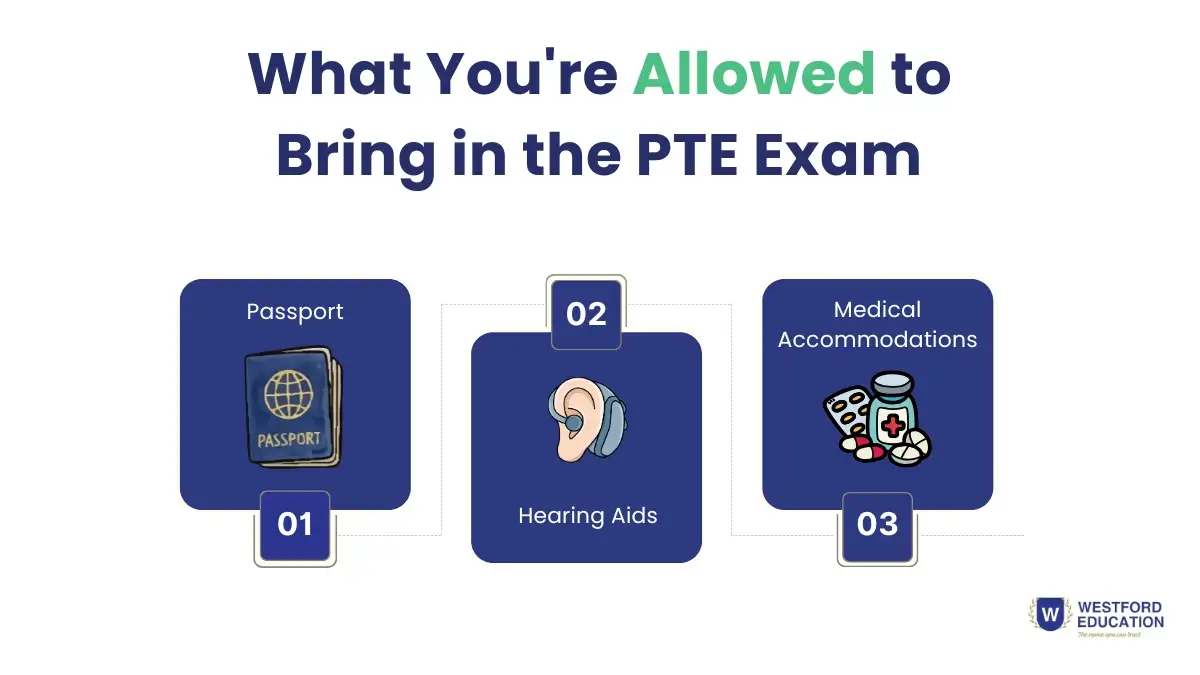
- Passport: The only item you’ll actually carry to your seat, and even that gets checked in before you sit down.
- Allowed Comfort Aids (Visual Inspection Required): Standard prescription eyeglasses, hearing aids, mobility devices (such as crutches or canes), and basic tissues are permitted inside the testing room. The test administrator will visually inspect glasses and tissue packets during the security check.
- Approved Medical Accommodations: If you need essential medication, an insulin pump, or a continuous glucose monitor during the exam, you may bring these inside provided you requested and received official accommodation approval prior to test day.
Since the center supplies everything you need for rough notes, there’s genuinely nothing to prepare here beyond your ID.
What Happens During PTE Exam Check-In?
Check-in involves your passport being verified against your booking, a digital photo and signature, and, at some centers, a palm vein scan as an added identity check. The whole process typically takes just a few minutes before you’re guided to your seat.
Once your identity is confirmed, a test center administrator walks you to a private booth with a computer, a headset, and the noteboard mentioned earlier. From there, the test begins on its own timer.
What's Not Allowed to Bring in the PTE Exam
Knowing the prohibited items PTE exam rules cover in advance means one less thing to think about on the actual day.
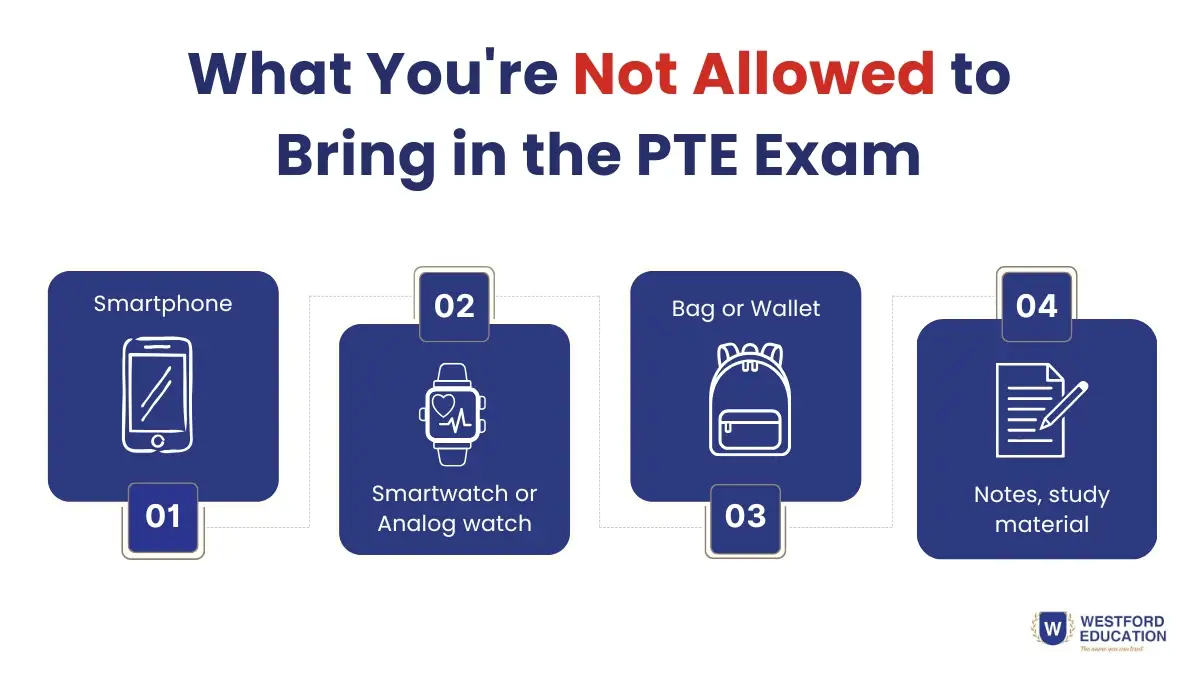
- Mobile phones, smartwatches, and any wearable electronics
- Bags, wallets, and loose personal belongings
- Your own pens, pencils, or paper
- Food or drinks of any kind, including water, in most centres
- Notes, study material, or printed documents beyond your confirmation email
Everything on this list goes into a locker at check-in, not your desk or bag. These rules exist because the test is entirely computer-monitored, and even small items can trigger a security flag.
Are you are In Kathmandu? Join our PTE classes in Kathmandu for in-person, structured prep.
PTE Test Day Checklist: Test Center vs. PTE (At Home)
Your checklist changes depending on whether you’re testing at a Pearson test center or taking PTE Home from your own space. Here are the PTE test day requirements broken down by format.
PTE Test Centre Checklist
If you’re taking your exam at a test center, your checklist is surprisingly simple. Most of what you might normally carry to an exam isn’t allowed inside the testing room, so arriving with the correct ID and knowing the test centre rules will make the check-in process much smoother.
- Valid passport: The exact one used during registration, no exceptions.
- Booking confirmation email: Printed or saved digitally, useful but not always mandatory.
- Nothing else: No pens, notes, phones, or bags. Everything is provided at your desk or stored in a locker.
PTE Academic Online (At-Home) Checklist
If you are taking the test remotely for study abroad purposes, you will be taking PTE Academic Online. You’re tested remotely through your own computer, so the “checklist” looks completely different; it’s mostly about your setup rather than what’s in your hands.
- Valid passport: Shown to the camera during online ID verification before the test starts.
- A quiet, private room: No other people and no one else allowed to enter during the test.
- A working webcam and microphone: Used throughout for remote proctoring.
- A computer that meets Pearson’s system requirements: Checked in advance through their online readiness tool.
- A stable internet connection: Disconnections during the test can affect your session.
- A completely clear desk: No papers, phones, or a second monitor in view of the camera.
Either way, your passport is the one constant. What changes is everything around it: a test center handles the environment for you, while PTE Home puts that responsibility on your setup at home.
Testing from outside the valley? Our online PTE and IELTS classes in Itahari give you the same guidance remotely.
PTE Test Day Tips to Stay Calm and Prepared
A short checklist doesn’t mean test day itself feels short. Here are a few PTE test day anxiety tips that actually help once you’re in the booth.
- Practice typing on a standard QWERTY keyboard beforehand if you’re not used to one. PTE’s Writing section, along with some Listening and Reading tasks, requires typed answers.
- Do a mock test under real-time conditions in the days before, not just topic-by-topic practice.
- Get a proper night’s sleep. PTE runs about two hours straight, and fatigue affects Speaking accuracy is more than most students expect.
- Remember that other test takers may be audible near your booth. The microphones are calibrated to pick up your voice only, so this doesn’t affect your score, but it can be distracting if you’re not expecting it.
- Trust your preparation. Reviewing more vocabulary the morning of rarely changes your score at this point.
None of these take extra effort to plan for, but knowing them ahead of time takes away a lot of the test day nerves.
Why Prepare for PTE with Westford Education
Getting your documents and logistics right is only half the picture. The other half is walking in with a format you’ve already practiced under real conditions, which is exactly what Westford Education is built around.
- Structured PTE classes covering Speaking, Writing, Reading, and Listening, built around the exact question types Pearson uses
- Full-length mock tests on a real keyboard setup, so test day doesn’t feel unfamiliar
- Guidance on the check-in process, ID rules, and centre-specific expectations before your booking
- Both online and offline class options, depending on what fits your schedule
- Support that continues past your PTE score, into your university applications and visa process
If you’re still weighing your options between English tests, our comparisons on PTE vs IELTS and whether PTE is easier than IELTS are worth reading before you lock in your registration.
Final Thoughts
PTE test day rewards preparation more than packing. Whether you’re testing at a center or through PTE Home, your only real job is showing up with a valid passport, on time, and ready for a format you already know. Most of the stress students feel isn’t about the test content; it’s the uncertainty around what to expect at check-in, and that’s easy to remove once you know the process.
Once your test is done, it’s worth knowing how long your PTE score stays valid so you can plan your applications around it.
If you’re preparing for PTE as part of your study abroad plans, it helps to have guidance through both the test and what comes next. Feel free to reach out to Westford Education if you’d like support with your PTE preparation or your next steps toward studying abroad.
Ready to take the next step toward studying abroad? Contact Westford Education today for expert PTE and admission support.
Frequently Asked Questions
What should I bring on the day of my PTE test?
Just your valid passport and, ideally, your booking confirmation email. That’s genuinely the entire list.
Is a mobile phone allowed in the PTE exam?
No. Phones must be stored in a locker at check-in and stay there for the entire test.
Can I bring notes or my own pen into the PTE exam?
No. An erasable noteboard and marker are provided at your desk, so there’s no need to bring your own.
Are watches allowed in the PTE exam room?
No. Watches and other wearable electronics stay in your locker along with your other belongings.
What happens if I'm late or forget my ID for PTE?
You won’t be allowed to sit the test without a valid passport, and there’s usually no exception. The same applies to late arrivals, so aim to reach the centre at least 30 minutes early.
Do I need a passport for the PTE exam?
Yes. For most international test takers, a valid passport is the only accepted ID, even if a national ID card has worked for other exams before.
What happens during PTE check-in?
Your passport is verified against your booking, followed by a digital photo and signature, and sometimes a palm vein scan. The whole process usually takes just a few minutes before you’re seated.