

Nepal Goes Back to Assessment Level 3 for Australian Student Visa (2026)
Nepali students who want to study in Australia, listen up! From January 8, 2026, Nepal’s Australian student visa assessment level has gone back from Level 2 to Level 3. This means you’ll need to show more documents, your application will be checked more carefully, and it might take longer to get your visa.
Before this, Nepal had moved up from Assessment Level 3 to Level 2 on March 31, 2025, after staying in Level 3 for seven years. Knowing about this change is really important so you don’t run into delays and your application goes smoothly.
In this guide, we explain what SSVF country assessment levels are, how these levels affect student visa processing, and what Nepali students should do to get ready.
What Is the Simplified Student Visa Framework (SSVF)?
Australia’s SSVF was made to make student visa processing easier. Instead of the old complicated rules, SSVF uses a system based on risk:
- Country Assessment Level: Level 1, 2, or 3 depending on how well the country has followed visa rules and how past applications went.
- Education Provider Level: Level 1, 2, or 3 depending on how good the school or college has been with student visas.
These two scores decide what documents you need to show, like proof of money, English test results, and proof that you are a real student.
Assessment Levels in Australia
Level | Risk | Requirements | Notes |
Level 1 | Low | Only a few documents | Fast processing, countries that follow visa rules well |
Level 2 | Medium | Some documents, might need proof of funds and English test | Nepal was at this level until March 31, 2025 |
Level 3 | High | Most documents are needed | Checked carefully, takes longer, higher chance of refusal |
Knowing how these assessment levels work can help you plan better and avoid delays if you want to study in Australia.
What Does Assessment Level 3 Mean for Nepali Applicants?
Returning to Level 3 merely indicates that the days of “easy” or “minimal document” applications are over and that applications are now subject to the highest level of examination. This does not suggest that Australia is shutting out Nepali students.
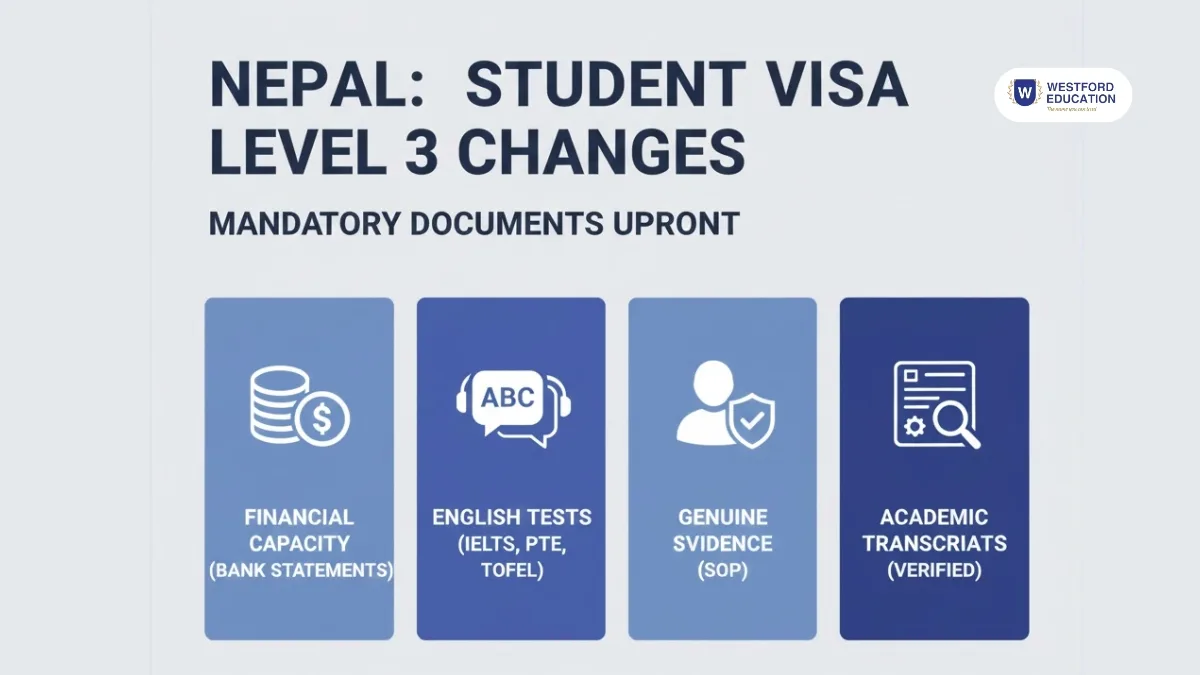
Under Level 3, documents that were optional or submitted later under Level 2 are now mandatory upfront, including proof of financial capacity, English language test results (IELTS, PTE, TOEFL), genuine student evidence, and verified academic transcripts.
Students should always check their Document Checklist Tool in ImmiAccount and prepare their applications as Level 3 compliant, even if no official announcement has been made.
What this means:
- Stricter document requirements
- Check your Document Checklist Tool in ImmiAccount
- Treat your application as Level 3 even if no official announcement is made
How Does the Assessment Level Change in Australia Impact Nepali Students?
With Nepal now being treated as Assessment Level 3 in 2026, your student visa application may face stricter requirements. Here’s what this means for Nepali applicants:
Mandatory Upfront Financial Evidence
Certain candidates were exempt from having to present complete bank information under Level 2 unless expressly asked. When you apply for a visa under Level 3, you must provide comprehensive, verifiable financial documentation.
- Total Benchmark: You must show that you have enough cash on hand to pay one year’s worth of tuition, living expenses (AUD 29,710 for a single candidate), travel costs (~AUD 2,000–4,000), and overseas student health coverage (OSHC). This often comes to about NPR 60 to 65 lakh for a single student.
- Acceptable Proof: Consistently kept liquid bank deposits for at least three to six months, or sanction letters for school loans from reputable A-Class commercial banks in Nepal.
- Not Accepted: You now need to provide actual accessible cash as primary liquid evidence instead of relying just on property appraisal. One of the main reasons for rejection is unexplained “sudden large deposits” made just before applying.
Mandatory English Language Proficiency
Under Level 3, waivers of the English test are practically prohibited. An official test result from the previous two years must be attached:
- Undergraduate: Usually needs a PTE Academic score of 50 (no section below 42) or an overall IELTS Academic score of 6.0 (no band below 5.5).
- Postgraduate: Usually requires a PTE score of 58 or an IELTS score of 6.5 (no band lower than 6.0).
Stricter Genuine Student (GS) Evaluation
The Genuine Student (GS) criterion, which took the place of the previous GTE, is closely examined. Rejections are likely to result from generic statements of purpose (SOPs). In particular, officers search for:
- Strong, rational connections to Nepal (family, property, or employment opportunities) that demonstrate your desire to return.
- A compelling professional argument outlining why this particular Australian course is more cost-effective than local alternatives.
- Sincere justifications for any study gaps longer than two months.
Level 3 applications are checked more thoroughly, which may lead to:
- Longer processing times
- Follow-up requests for missing or unclear documents
- Additional evidence requirements
Understanding these changes helps Nepali students prepare stronger, more complete applications and reduce the risk of delays or refusals.
Recommended Read: Find the Right Consultancy in Nepal for Australia
Why Choosing the Right Provider Matters for Your Visa Application
Under Australia’s Simplified Student Visa Framework (SSVF), your visa requirements are determined by two factors: your country’s assessment level and the education provider’s evidence level. Each is ranked from Level 1 (low risk) to Level 3 (high risk).
How the Combined Score Works?
Australia combines the risk ratings from your country and your chosen education provider to decide how much documentation you must submit:
Country Level + Provider Level = Total Risk Score
- Total Score ≤ 4 → Fewer documents may be required
- Total Score ≥ 5 → Additional evidence is generally mandatory
Example Scenarios
- Nepal Level 3 + Level 1 Provider = 4
In this case, the total score is at the lower end, which may reduce the number of default documents you must submit.
- Nepal Level 3 + Level 2 Provider = 5
With a higher provider level, you will likely need most documents, including detailed financial and English evidence.
Want a smoother visa process? Choose the right education provider with Westford Education and make your visa journey easier
Who Is Most Affected by Nepal Level 3 Assessment?
Nepal’s Level 3 assessment can have a significant impact on both new applicants and students already in Australia. The level of scrutiny largely depends on the student’s circumstances and visa pathway.
Offshore Students (Applying from Nepal)
For Nepali students applying from Nepal, being at Level 3 means that documents like proof of funds, English language test results, and genuine student evidence are more likely to be mandatory right from the start.
Even though Nepal had been at Level 2 in the mid‑2025 evidence updates, being treated as Level 3 in early 2026 means stricter documentation for new applications and compliance checks.
Onshore Students (Already in Australia)
Students already in Australia hoping to:
- Change courses
- Convert a visitor or bridging visa to a student visa
- Upgrade from short courses to longer programs
Students will now need full documentation upfront, rather than submitting some later in the process. Stricter checks can also affect visa extensions and other changes of status.
How to Prepare Effectively for Level 3?
Prepping early and thoroughly is key if Nepal is treated as Level 3. Here are the best strategies:
- Start Early: Gather all required documents well before your visa application date.
- Be Honest and Consistent: Submit accurate and consistent information to build trust with immigration officers.
- Check ImmiAccount Often: Your specific documentary requirements can change, so always use the latest Document Checklist Tool.
- Consider Professional Guidance: A certified migration consultant or education agent can help review your application details and evidence.
- Choose Providers Carefully: Opting for low‑risk or reputable institutions can reduce documentation pressure and make processing smoother.
Final Thoughts
The Australian student visa assessment level Nepal may seem stricter in 2026, but it’s manageable with preparation. Level 3 doesn’t block visas, it only ensures applicants are genuine.
For Nepali students:
- Follow the checklist
- Prepare all documents
- Stay updated on assessment level changes Australia
- Consult experts if unsure
This way, you’ll maximize your chances of a smooth visa application and start your Australian study journey confidently. Consult with Westford Education for your further query and guidance.
Frequently Asked Questions
What is the Australian student visa assessment level Nepal?
Nepal is in Level 3 visa assessment level. It’s the risk level assigned to Nepali students under SSVF, which determines the documents required and application scrutiny.
How often do assessment levels change?
Australia reviews risk metrics twice a year, usually in March and September, based on visa refusal rates and compliance.
What documents do Nepalese students need under Level 3?
Proof of funds, English test results, academic transcripts, personal statement, and any additional evidence requested in ImmiAccount.
Can choosing a lower-risk university help?
Yes. Partnering with Level 1 or Level 2 providers can reduce document requirements even if your country is Level 3.
Where can I check my exact requirements?
Use the Document Checklist Tool in ImmiAccount for the most current and personalized instructions.