
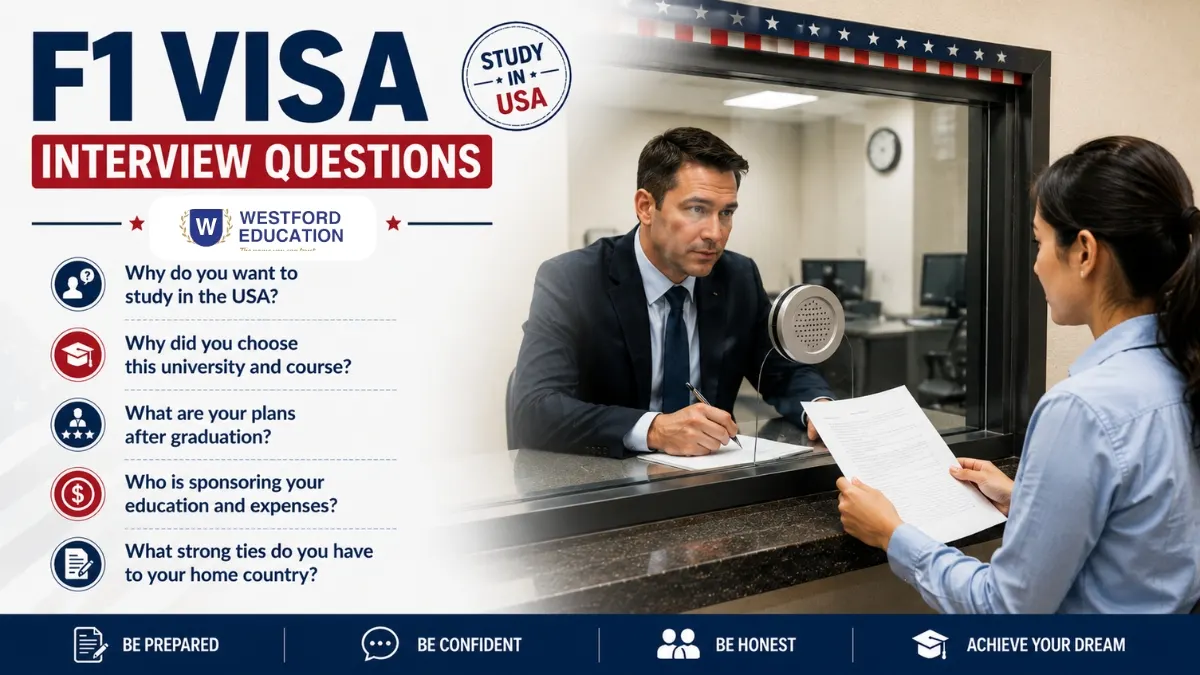

F1 Visa Interview Questions Nepal: Common Questions With Sample Answers
Thousands of Nepalese students get their US admission letter every year. And then the panic sets in.
The F1 visa interview at the US Embassy in Kathmandu is short, sometimes just two or three minutes. But those minutes matter more than your GPA, your test scores, or how good your university is. Officers aren’t sitting there checking boxes. They’re watching how you talk about your plan, whether your story holds together, and whether you seem like someone who’s actually going to come back to Nepal.
This guide gives you the real questions, honest sample answers, and prep strategies that work, not the recycled tips you’ve already read five times.
Getting ready for your F1 visa interview? Join Westford Education for a smooth and stress-free USA study journey with expert guidance, visa interview preparation, university support, and personalized counseling.
Quick Overview
- The F1 visa interview at the U.S. Embassy Kathmandu usually lasts only 2 to 5 minutes, so answers should be short, clear, and confident.
- Visa officers mainly check four things: genuine student intent, financial capability, communication skills, and strong ties to Nepal.
- Common interview questions focus on your university choice, course, sponsor, finances, career goals, and plans after graduation.
- Memorized or overly long answers are one of the biggest reasons Nepalese students get rejected.
- Strong applicants explain their study plan naturally and give answers that match their documents and DS-160 form.
- Students should understand their tuition fees, living expenses, sponsor income, and university details before the interview.
- Arriving 30–45 minutes early helps reduce stress and gives enough time for security checks and document verification.
- The embassy interview area can be noisy and crowded, so staying calm and focused is important.
- Mock interviews and answer practice can greatly improve confidence and interview performance.
Westford Education offers mock interview preparation, university counseling, and visa support for Nepalese students applying to study in the USA.
What Is an F1 Visa Interview?
An F1 visa interview is a short, in-person conversation at the US Embassy in Kathmandu where a consular officer decides whether to approve your student visa. The officer reviews your intent to study, your ability to fund your education, and your plans to return to Nepal after graduation.
It’s not a test of your academic intelligence. It’s a check of whether you’re a genuine student with a real plan.
Your grades don’t speak for you here. You do.
Why the F1 Visa Interview Is Important?
Even strong applicants with high GPAs and good test scores get rejected. Rejection often has nothing to do with grades. It comes down to how clearly you communicate your goals, how consistent your answers are with your documents, and whether the officer believes you’ll return to Nepal after your studies.
A five-minute conversation can undo months of preparation if you’re not ready for it.
How Long Does the F1 Visa Interview Take?
Most F1 visa interviews at the US Embassy in Kathmandu last between 2 and 5 minutes. That’s it. The officer asks focused questions and moves fast. Your answers need to be short, direct, and confident, not long explanations that raise more questions. Every extra sentence is a risk.
Even though the actual interview is short, you should expect to spend around 2 to 3 hours at the embassy for security checks, document verification, waiting time, and fingerprinting.
F1 Visa Interview Questions by Category
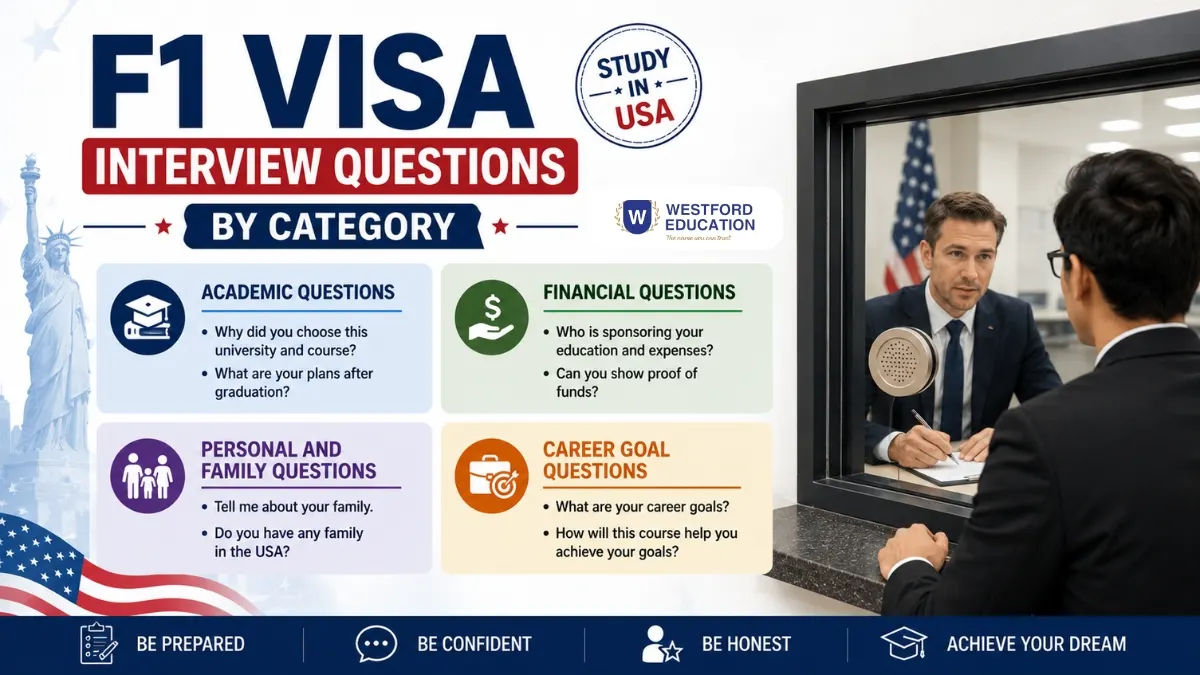
Questions in the F1 visa interview follow a pattern. Understanding the categories helps you prepare targeted answers instead of memorizing a random list.
Academic Questions
These questions check whether you genuinely understand what you’re going to study and why you chose that program.
- Why do you want to study in the USA?
- Why did you choose this university?
- Why did you choose this course?
- What was your GPA or academic performance?
- Do you have any study gaps? Why?
Financial Questions
Financial questions are where many Nepalese students struggle. Officers want to know the money is real, the source is legitimate, and the amount is enough.
- Who is sponsoring your education?
- What is your sponsor’s income or occupation?
- How much does your university cost per year?
- How will you manage living expenses in the USA?
- How much money is in your bank account?
Personal and Family Questions
These questions check your ties to Nepal and whether you have reasons to return after graduation.
- Do you have any relatives in the USA?
- What does your family do in Nepal?
- Who is your sponsor and how are they related to you?
Career Goal Questions
Officers want to confirm you have a plan and that it connects logically to studying in the USA.
- What are your plans after graduation?
- How will this course help your career in Nepal?
- What job do you plan to do when you return?
Top F1 Visa Interview Questions With Sample Answers
Here are the questions Nepalese students face most often, along with sample answers that are natural, honest, and concise.
Tell Me About Yourself
Start with a short introduction, then briefly explain your education background, chosen course, and future goals.
“My name is [Your Name], and I’m from [Your City]. I completed my higher secondary education with a strong academic record, and I have been admitted to [University Name] to study [Course Name]. My goal is to gain international knowledge and practical skills in [Course] and return to Nepal to build my career in the growing private sector.”
Why Do You Want to Study in the USA?
Don’t say “because it’s the best.” Be specific.
“The USA offers research opportunities and industry exposure in my field that aren’t available at the same scale elsewhere. The university I’ve chosen also has strong career placement support, which matters for my long-term goals.”
Why Did You Choose This University?
Reference something specific about the university, a department, a program structure, or a career resource.
“I chose [University Name] because of its specialized curriculum in [subject] and because it has strong ties with companies I want to work with. It also offered me a competitive tuition package.”
Why Not Study in Nepal?
Be respectful. Don’t criticize Nepal’s education system.
“I appreciate Nepali universities, but the specific program I need with hands-on lab access and internship connections is only available at this level in the US. It’s about the right fit for my career plan.”
Why Did You Choose This Course?
Connect your past studies to your future career.
“I’ve always been interested in data and problem-solving. My background in science built a strong foundation, and a degree in Computer Science at this level gives me the skills I need to work in tech when I return to Nepal.”
Who Is Sponsoring Your Education?
Name the sponsor, the relationship, and the source of income.
“My father is my sponsor. He owns a small business in Kathmandu and has been saving for my education. We have sufficient funds documented in our bank statements to cover the full program costs.”
Recommended Read: USA Scholarships For Nepali Students
What Are Your Plans After Graduation?
Show a real plan. Officers want to see you intend to return.
“After finishing my degree, I plan to return to Nepal and work in the IT sector. There are more opportunities opening in Nepal’s tech industry, and my family and future are here.”
Have You Been Refused a Visa Before?
If yes, be honest. Lying gets you permanently barred.
“Yes, I was refused once because my bank statements weren’t sufficient at the time. I’ve since secured stronger financial documentation and completed all requirements properly.”
How Will This Course Help Your Career Goals?
Be specific; name your industry and what skill gap the course fills.
“A degree in [course] gives me advanced technical skills in [specific area] that are directly needed in Nepal’s growing [industry]. I’ve researched job opportunities at home, and this course makes me more competitive.”
Why Should We Approve Your F1 Visa?
Don’t be arrogant. Be clear, confident, and grounded.
“I am a genuine student with a clear academic plan and a strong reason for choosing this course in the USA. My education is fully supported by my family, and I have complete financial documents to show that I can manage my studies and living expenses. After graduation, I plan to return to Nepal and use the skills and knowledge I gain to build my career here with my family and future goals in mind.”
How Will You Manage Living Expenses in the USA?
Show you understand the real cost of living in the US.
“My I-20 shows the estimated yearly cost including tuition and living expenses. My father has savings that cover at least the first year fully, and we’ve planned for the full program duration.”
Not sure how to answer these questions in an interview setting? Book a free F1 visa mock interview session with Westford Education; Contact us today.
Common Reasons Nepalese Students Get Rejected
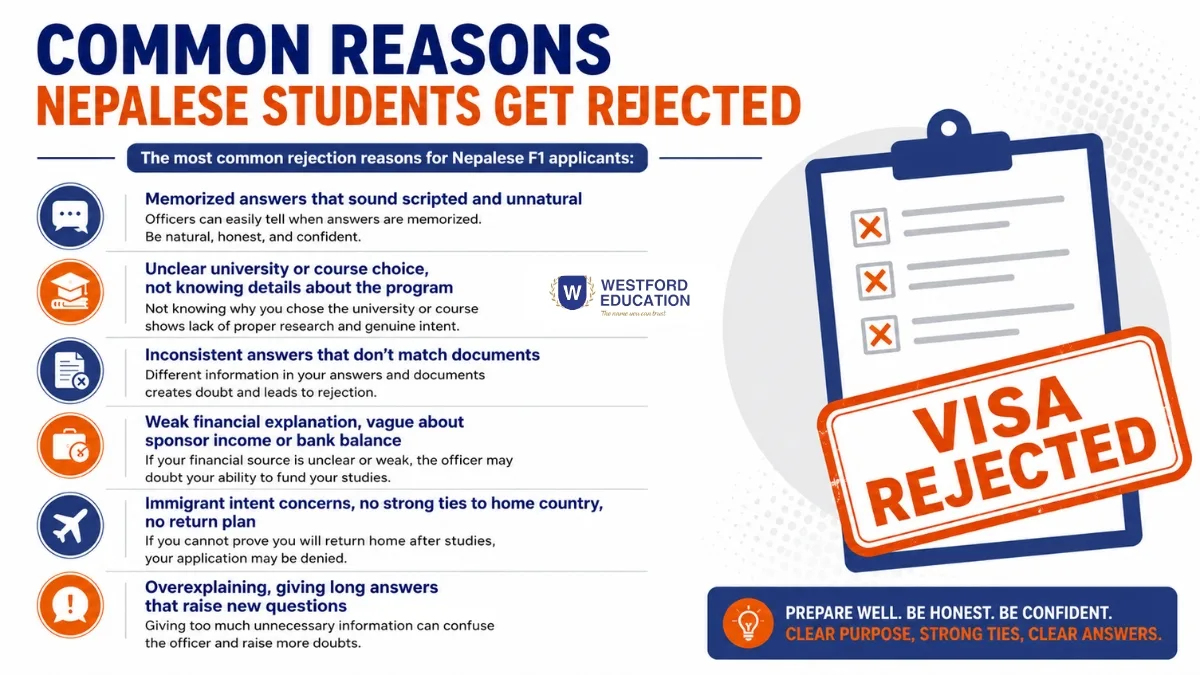
Rejection doesn’t always mean your application was weak. Sometimes it comes down to how you answered one question.
The most common rejection reasons for Nepalese F1 applicants:
- Memorized answers that sound scripted and unnatural
- Unclear university or course choice, not knowing details about the program
- Inconsistent answers that don’t match documents
- Weak financial explanation, vague about sponsor income or bank balance
- Immigrant intent concerns, no strong ties to Nepal, no return plan
- Overexplaining, giving long answers that raise new questions
Why Good Students Still Fail the Interview?
Here’s something nobody tells you before your interview: being a good student doesn’t make you a good interviewee.
Some of the most qualified applicants get rejected. Not because their documents were weak. Because they panicked at the window, rushed through their answers, or gave responses that sounded like they’d been copied off a prep website, because they had been.
Officers have heard every perfect answer. What they haven’t heard enough of is someone speaking naturally about something they actually know. That’s what gets you approved.
How US Visa Officers Evaluate Nepalese Students?
Officers at the US Embassy Kathmandu evaluate students based on a set of core factors, not just documents.
What they look at:
- Genuine student intent: Do you clearly understand what you’re studying and why?
- Financial credibility: Can your sponsor realistically afford it, and is the money documented?
- Ties to Nepal: Do you have family, property, or a career reason to return?
- Communication: Can you explain your plan clearly in English?
- Consistency: Do your answers match what’s in your DS-160 and other documents?
What Helps Students Get Approved?
Students who get approved usually share these qualities:
- Clear, specific study goals tied to a real career plan
- A sponsor with documented, verifiable income
- Strong family ties in Nepal
- Honest, confident communication, even with imperfect English
- Solid understanding of tuition costs and living expenses
Recommended Read: Best Consultancy to Apply to the USA from Nepal?



 Trustindex verifies that the original source of the review is Google.
  Trustindex verifies that the original source of the review is Google.
  Trustindex verifies that the original source of the review is Google.
  Trustindex verifies that the original source of the review is Google.
  Trustindex verifies that the original source of the review is Google.
  Trustindex verifies that the original source of the review is Google.
  Trustindex verifies that the original source of the review is Google.
  Trustindex verifies that the original source of the review is Google.
  Trustindex verifies that the original source of the review is Google.
  Trustindex verifies that the original source of the review is Google.
 How to Answer F1 Visa Questions Confidently?
Confidence in a visa interview isn’t about being loud or impressive. It’s about being clear, calm, and consistent.
Follow these steps:
- Pause before answering. A one-second pause shows you’re thinking, not reciting.
- Keep answers under 30 seconds. Short answers invite follow-up; long ones invite doubt.
- Maintain eye contact. Look at the officer, not the floor or your documents.
- Speak at a natural pace. Nervousness speeds people up; consciously slow down.
- Don’t correct yourself mid-sentence. If you stumble, keep going naturally.
- Use simple English. Officers aren’t judging your vocabulary; they’re judging your clarity.
- Never argue or push back. If an officer asks the same question twice, they’re testing your consistency, not accusing you.
Want to practice your answers with an expert before your embassy appointment? Westford Education offers personalized mock interview sessions for Nepalese students. Book your session today.
Quick Tips to Pass an F1 Visa Interview
Here are a few quick tips to help you pass an F1 visa interview.
Top Things You Should Do Before the Interview
- Read your I-20 carefully; know your tuition and program start date
- Review your DS-160 answers; your interview must be consistent with them.
- Know your sponsor’s exact income and occupation
- Practice answering out loud, not just in your head
- Sleep well the night before; fatigue kills confidence
Mistakes You Must Avoid
- Don’t memorize scripts. Officers can tell immediately.
- Don’t exaggerate finances. If caught, it’s permanent rejection.
- Don’t fake an accent. Speak naturally in whatever English you have.
- Don’t bring a stack of documents and reference them constantly; know your key facts.
- Don’t give inconsistent answers. If your answer changes across questions, it raises red flags.
Mock F1 Visa Interview for Nepalese Students
Westford Education has helped students navigate the US visa process from Kathmandu since 2013. The team offers structured interview preparation designed specifically for Nepalese students applying for F1 visas.
Personalized Visa Interview Preparation
Westford offers one-on-one mock interview sessions where counselors simulate real embassy-style questions. You’ll get specific feedback on your answers, your body language, and the areas where you’re most likely to struggle.
Expert USA Study Counseling
Beyond interview prep, Westford’s counselors help students choose the right university, match programs to career goals, and build a complete application that holds up under embassy scrutiny. A strong application makes the interview easier.
Support Beyond Admission
Westford stays with students after the offer letter arrives. Pre-departure orientation, visa document checklists, and ongoing student support make the transition from Nepal to the US smoother and less stressful.
Final Thoughts
The F1 visa interview in Nepal isn’t something to fear; it’s something to prepare for. Officers are looking for genuine students who know why they’re going, how they’ll pay for it, and why they’ll come back. If you can answer those three things clearly and honestly, you’re most of the way there.
Practice out loud. Know your numbers. Keep your answers short. And go in confident, not because you memorized a script, but because you actually know your plan.
Ready to prepare with an expert? Book a personalized F1 visa interview preparation session with Westford Education. Our team offers mock interviews, document review, and complete USA study counseling to give you the best chance of approval. Contact Westford Education today.
Frequently Asked Questions
How can I pass my F1 visa interview confidently?
Practice answering clearly and honestly. Keep answers short, natural, and consistent with your documents. Mock interviews, good body language, and understanding your study plan can improve your confidence greatly.
How much bank balance is needed for an F1 visa interview?
Students usually need enough funds to cover at least one year of tuition fees and living expenses mentioned on the I-20 form. The amount depends on the university, location, and course costs.
Is the F1 visa interview difficult for Nepalese students?
The interview is not difficult if you prepare properly. Most problems happen when students give memorized answers, fail to explain finances, or cannot clearly explain their study goals.
What documents are required for an F1 visa interview?
Important documents include your passport, I-20 form, DS-160 confirmation page, SEVIS fee receipt, visa appointment letter, bank statements, academic transcripts, and English test scores like IELTS or PTE.
What should I wear for an F1 visa interview?
Wear clean and professional clothes that make you look confident and respectful. Formal or smart casual clothing is usually recommended for US embassy interviews.
What happens if my F1 visa gets rejected?
If your visa is rejected, you can reapply after improving the weak areas in your application or interview. Understanding the rejection reason and preparing better answers is very important before reapplying.
Can education consultancies help with F1 visa interviews?
Yes. Professional consultancies like Westford can help students with mock interviews, document preparation, answer practice, and confidence-building strategies before the embassy interview.