


GMAT for MBA Abroad: Everything You Need to Know
If you’re planning to pursue an MBA abroad, you’ve probably come across the GMAT. It helps business schools assess your quantitative skills, problem-solving ability, and data analysis skills to determine whether you’re prepared for the demands of an MBA program. However, not every school requires it. Some accept the GRE instead, others offer test waivers based on specific criteria, and a few don’t require standardized test scores at all. So, it’s important to check the admission requirements of your shortlisted universities before deciding which test to take.
Before booking your GMAT, make sure you understand the basic requirements, including eligibility, current exam fees, and retake policies. Knowing who can take the test, how much it costs, and how many times you can attempt it will help you plan your preparation, manage your budget, and schedule your exam around important MBA application deadlines.
Quick Summary
- The exam runs 2 hours and 15 minutes across three sections: Quantitative Reasoning, Verbal Reasoning, and Data Insights.
- Total scores fall between 205 and 805.
- Whether you need one at all depends entirely on the school; requirements range from mandatory to fully optional.
- A score is valid for five years.
- The registration fee sits around USD 275-300, depending on whether you sign it up at a center or online.
- Most people give themselves two to four months to prepare, plus a bit of slack for a retake.
What Is the GMAT for an MBA Abroad?
The GMAT (Graduate Management Admission Test) is designed and administered by the Graduate Management Admission Council (GMAC) to help business schools assess whether applicants have the skills needed for an MBA program. It also provides a standardized way to compare candidates from different countries, where university grading systems and academic standards may vary.
- Key skills assessed: Quantitative reasoning, verbal reasoning, and data interpretation.
- Why it matters: Helps schools compare applicants from different academic backgrounds fairly.
- Other admission factors: Work experience, undergraduate grades, essays, recommendation letters, and interviews.
- Keep in mind: A high GMAT score cannot compensate for every weakness in an application, and an average score does not necessarily hurt an otherwise strong profile.
If you want structured support while preparing for the current GMAT format, Westford Education offers online and in-person GMAT preparation classes in Kathmandu, with practice tests and guidance based on your preparation needs.
What Is the Current GMAT Exam Format?
The current exam runs for 2 hours and 15 minutes and has 64 questions split across three sections.
Section | Questions | Time | On-Screen Calculator |
Quantitative Reasoning | 21 | 45 minutes | No |
Verbal Reasoning | 23 | 45 minutes | No |
Data Insights | 20 | 45 minutes | Yes. |
Quantitative Reasoning
Algebra, arithmetic, and problem-solving. Data sufficiency questions used to sit here but have moved to Data Insights, so Quant is now purely about solving. A scratchpad is available, but there’s no calculator.
Verbal Reasoning
Two question types: reading comprehension and critical reasoning. Sentence correction, a big part of the older GMAT, has been dropped entirely, so verbal is now about understanding passages and picking apart arguments rather than fixing grammar.
Data Insights
The newest section blends five formats: Data Sufficiency, Multi-Source Reasoning, Table Analysis, Graphics Interpretation, and Two-Part Analysis. It’s the only section with a calculator, which fits the point here: reading data, not mental arithmetic.
A few other things shape test day:
- Scoring is computer-adaptive, so difficulty shifts with your performance.
- You choose which section to start with.
- One optional 10-minute break is built in.
- You can flag and revisit up to three answers per section, something the old GMAT never allowed.
How Is the GMAT Scored?
Your score gives schools a clear picture of your performance across all three sections. Understanding how the scoring works can help you set a realistic target and interpret your results.
How the Score Works
- Total score: 205–805
- Three sections: Each section is scored from 60–90
- Equal weighting: All three sections now contribute equally to your total score.
- What changed: In the older exam, only Quant and Verbal contributed to the total.
You’ll also receive section-level and overall percentiles. Near the top of the scoring range, even a small score difference can represent a much larger percentile gap.
Score validity: Your score remains valid for five years from your test date.
Recommended Read: GMAT Score Requirements for Top Business Schools
What Is a Good GMAT Score for MBA Abroad?
There’s no single “good” number; it depends on where you’re applying. Schools usually publish a minimum, an average, and a median for their incoming class. People tend to treat the minimum as a cutoff, but it rarely works that way; it’s usually just the lowest score among students admitted for other strong reasons. The average and median tell you more about where the class actually sits.
Worth Knowing: GMAC’s own guidance is not to line up a total score from the old 200-800 scale against one on the current 205-805 scale, since the exams aren’t built the same way underneath. Percentile rankings do a better job of comparing performance across the two than the raw totals do.
How Does GMAT Superscore Work?
GMAC introduced the GMAT Superscore in 2026. It takes your best quantitative, verbal, and data insight scores across however many times you’ve sat the current exam and combines them into one composite total, automatically and at no extra cost.
It only works across attempts on the current GMAT; anything from the retired 10th Edition doesn’t count. Your official report shows both the Superscore and your individual attempts side by side, but how much weight a program gives it is up to that program, so ask your target schools directly rather than assume.
Is GMAT Mandatory for MBA Abroad Programs?
GMAT requirements vary from one business school to another, so there is no single rule for every MBA abroad program. Some schools require a GMAT score, while others make it optional or accept alternative tests. Check which of these five categories your target school falls into:
- Required: no application review happens without a score.
- GMAT or GRE: either test works, with no stated preference.
- Test-optional: you can apply without submitting a score.
- Waiver-eligible: the requirement can be dropped for candidates who meet certain conditions, often a set number of years of relevant work experience or a quantitative professional certification.
- No test required: some programs, particularly executive and part-time MBAs, skip standardized testing entirely.
The only way to know for sure is to look at the admissions page for each school you’re actually considering. Two programs in the same city can run entirely different policies.
GMAT vs. GRE for MBA Admissions
The GRE is the main alternative, and plenty of MBA programs now say outright that they have no preference between the two exams.
Factor | GMAT | GRE |
Built for | Business school admissions specifically | General graduate admissions |
Quantitative | No calculator; Data Sufficiency sits in Data Insights | Calculator available on-screen |
Verbal | Reading Comprehension, Critical Reasoning | Vocabulary-heavy, text completion |
Data section | Dedicated Data Insights section | No direct equivalent |
Score scale | 205-805 | 260-340 |
Duration | 2 hours 15 minutes | Roughly 1 hour 58 minutes |
Each school decides for itself which of the two it accepts, and since the scoring scales don’t convert cleanly into each other, the only real way to choose is to sit a free official practice test of both and see which one you actually do better on.
GMAT Scores for Top MBA Programs by Country
Numbers below come from each school’s own published class profile, where one exists. Some schools haven’t put out a clean current-scale figure yet; where that’s true, it’s flagged rather than guessed at.
School | Country | Test Policy | Recent Reported GMAT |
Harvard Business School | USA | GMAT, no stated preference | Current-scale median 685 (Class of 2027) |
Stanford GSB | USA | GMAT, no stated preference | Current-scale average: 689 (Class of 2027) |
Wharton | USA | GMAT, no stated preference | Current-scale average: 676 |
London Business School | UK | GMAT accepted | Average 702 on the old 200-800 scale; the current-scale figure is not yet published. |
INSEAD | France/ | GMAT accepted, no set minimum | No published average; the school looks for roughly 60th percentile-plus performance per section. |
Rotman (Toronto) | Canada | GMAT accepted | Average in the mid-670s on the old scale; current-scale figure not yet published. |
Melbourne Business School | Australia | Check the current admissions page. | Not publicly disclosed in the sources checked here. |
Treat this as a rough map, not a target class; profiles shift every year, and a school’s own page always beats an outside summary.
GMAT Eligibility, Fees, and Test Attempts
Before booking your GMAT, it helps to know who can take the test, how much it costs, and how often you can sit for it. These rules can affect when you book your test and how you plan your preparation.
Who Can Take the GMAT?
You must be at least 18 to register for the GMAT independently; candidates aged 13–17 need written parental or guardian consent. Bring an original, valid photo ID that exactly matches your registration details. A passport is required when testing outside your home country. Since ID rules vary by location, check the latest requirements on mba.com before your exam. Note that exam eligibility is separate from the requirements for admission to business school.
How Much Does the GMAT Cost?
A test-center attempt costs USD 275; the online version runs for USD 300. Taxes and currency conversion can push that number up depending on where you’re registering from, and rescheduling or ordering extra score reports beyond the free ones both cost extra. Check the exact figure mba.com shows at the point of registration rather than going by a fixed number.
How Many Times Can You Take the GMAT?
You can take the GMAT five times within any rolling 12-month period, with a required 16-day gap between each attempt; both online and in-person attempts share this limit. Schedule your first attempt early enough that you can still retake it if needed.
How to Register for the GMAT
- Set up an account on mba.com.
- Fill in your details exactly as they appear on your ID.
- Pick online or test-center format.
- Choose a date and a location if going in person.
- Pay the fee.
- Confirm the appointment.
- Read the test-day requirements in your confirmation email.
How to Prepare for the GMAT
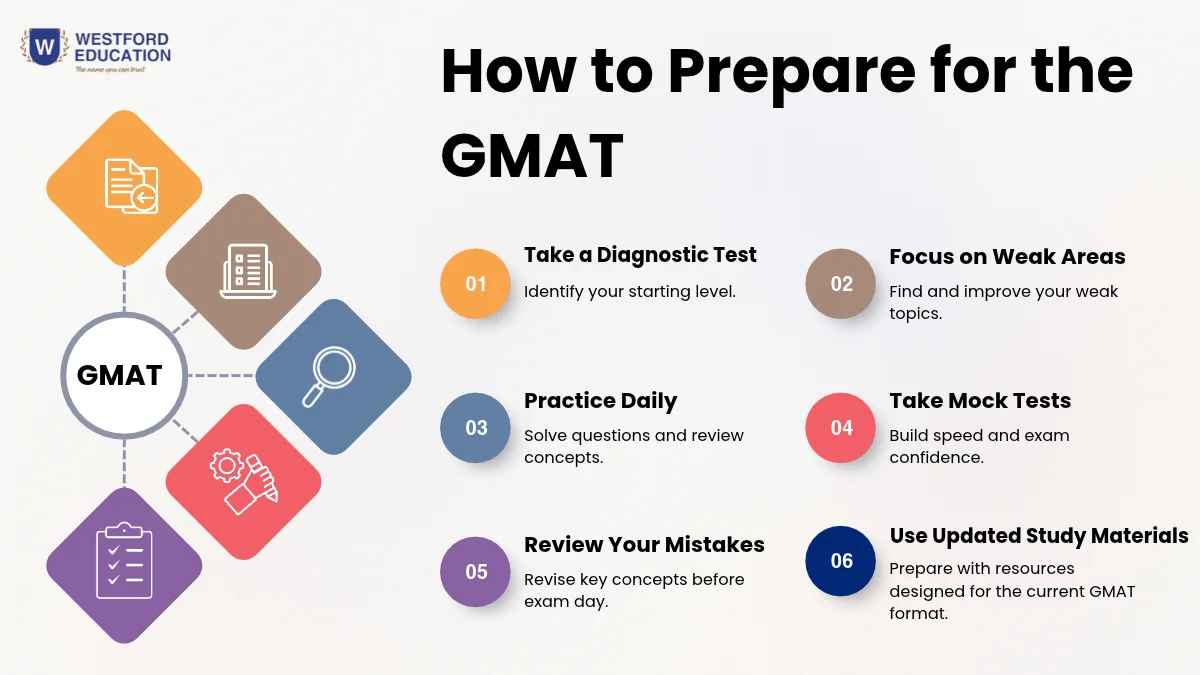
Most people who prepare well follow roughly the same sequence:
- Start with a full diagnostic test so you know where you actually stand.
- Pick out your weakest question types from that result.
- Review the concepts behind those weak spots.
- Practice one question type at a time instead of mixing everything.
- Add a timer once your accuracy improves.
- Sit full-length mocks under real conditions, including the break.
- Keep a running log of mistakes so they stop repeating.
- Spend the final stretch revising, not learning new material.
Whatever material you use, make sure it reflects the current exam; anything written for the old 10th Edition won’t match the section structure you’ll actually sit in.
How Long Should You Prepare for the GMAT?
It depends on your starting point, target score, and how many hours a week you can put in. A month can work for a retake, just tightening one or two areas. Two to three months is typical for a first attempt with a decent academic base. Four to six months makes sense if you’re starting close to zero or chasing a score well above your diagnostic.
When Should You Take the GMAT for MBA Applications?
Plan your timeline based on your deadline. Research your target schools first, build in real preparation time, and don’t leave yourself without room for a second attempt.
Stage | Suggested Timing |
Research schools and their requirements | 8-12 months before your deadline |
Prepare for the exam. | 2-4 months |
Sit your first attempt. | Around 3-4 months before the deadline |
Retake, if needed. | Leave a real buffer before the deadline. |
Submit your application. | Ahead of the official round deadline |
Sitting your first attempt right up against the deadline is one of the more common regrets applicants mention afterwards, mostly because it removes any chance of a retake.
How to Submit Your GMAT Scores to MBA Programs
Your GMAT registration includes up to five free official score reports, which you can send within 48 hours of your official score appearing on mba.com. After this window, or if you need additional reports, extra fees apply. Some business schools accept self-reported scores for the initial review and request official reports later. Since requirements vary by school, check each university’s instructions carefully before sending your scores.
Once your GMAT score is ready, the next steps include choosing suitable MBA programs and preparing the rest of your application. If you need support with that process, Westford Education also provides guidance beyond GMAT preparation.
Why Choose Westford Education for GMAT Preparation?
Studying the topics is only half the battle with the GMAT. You also need to actually sit down and solve questions, learn to manage your time under pressure, and figure out where you keep slipping up. That’s where a proper preparation course makes a difference, and it’s what Westford Education offers here in Kathmandu, with classes available both online and in person.
Here’s what’s included:
- Flexible class formats: Show up at the Kathmandu center or join from wherever you are online, whichever fits your schedule better.
- Coverage of all three sections: Quantitative Reasoning, Verbal Reasoning, and Data Insights are all part of the course, so nothing gets left out.
- Practice questions and mock tests: You’ll work through practice sets throughout the course and take full-length mock tests to get a real feel for the exam before you sit for it.
- Support on your weak spots: If there’s a topic you keep struggling with, trainers work with you directly on it instead of moving on and hoping it sorts itself out.
- Help beyond the GMAT: Once you’ve wrapped up your GMAT preparation, Westford also helps guide you through the rest of your MBA application.
Final Thoughts
There’s no single rulebook for the GMAT for MBA abroad requirements; it comes down to the individual school, so check its current admissions page rather than assume it matches a similar-sounding program elsewhere. Once you know what’s expected, measure your practice scores against that school’s most recent class profile, not an outdated ranking. Build in enough time to prepare properly, with something left over for a retake if the first attempt doesn’t land where you hoped. And keep some perspective: the test is one part of an application, not the whole thing.
Need help with the GMAT for an MBA abroad? Contact Westford Education for guidance on GMAT preparation, score requirements, and the next steps for your university application.
Frequently Asked Questions
Is the GMAT compulsory for an MBA abroad?
No. Some schools require it, some accept the GRE instead, some don’t ask for a test at all, and a few offer waivers for eligible candidates.
What is the current GMAT score range?
205 to 805 overall, with each of the three sections scored from 60 to 90.
What is a good GMAT score for an MBA abroad?
Whatever’s competitive for your target school. Compare your score against their published average and median, and remember it’s only one part of the application.
What GMAT score do top business schools require?
Most don’t set a hard requirement. Recent class profiles at leading US schools show current-scale averages and medians in the mid-to-high 600s, but figures shift yearly, so check each school’s page directly.
Can I take the GMAT test online in Nepal?
Yes, as a remotely proctored online exam or at a test center. Confirm center availability and pricing when you register on mba.com.
How long is the GMAT exam?
2 hours 15 minutes, 64 questions across three sections.