


SAT Exam Day Checklist 2026: Complete Guide for Test Day
The SAT is now fully digital, and test day for 2026 works differently than it did even a year or two ago, which means outdated advice can genuinely cost you your test date. Between the Bluebook app, updated ID rules, and a stricter device setup process, a lot has changed since the paper-based SAT most parents remember.
This SAT exam day checklist covers exactly what you need: your ID, your Bluebook-ready device, the timeline for test morning, and the small mistakes that trip up even well-prepared students. It also includes specific notes for Nepali students testing in Kathmandu or traveling abroad for their test date, since a few rules work a little differently depending on where you sit for the exam.
Whether this is your first SAT or a retake, here’s everything you and your family need to have ready before you walk into that exam hall.
Quick Checklist: Everything You Need for SAT Test Day
Item | Note |
Printed admission ticket | Print from your College Board account |
Valid passport (or other acceptable photo ID) | Recommended for Nepali students |
Fully charged laptop or tablet with Bluebook installed | No device, no test |
Bluebook exam setup completed | Do this 1–5 days before, not test morning |
Device charged to 100% | Night before |
Phone fully switched off, not just silent | Silent mode isn’t enough |
Arrive at the test center | By 7:30 AM doors close at 8:00 AM |
What to Bring on SAT Test Day
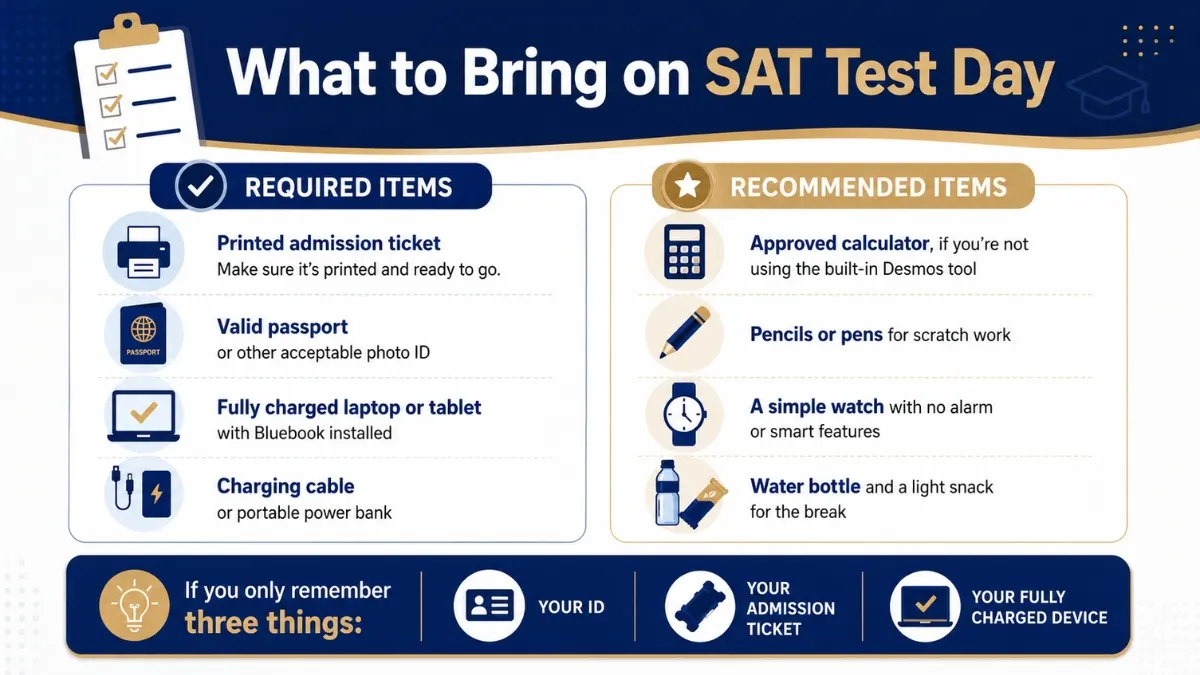
A complete, updated Digital SAT Test Day Checklist for 2026 is split into what you must carry and what genuinely helps.
Required Items
- Printed admission ticket
- Valid passport (or other acceptable photo ID)
- Fully charged laptop or tablet with Bluebook installed
- Charging cable or portable power bank
Recommended Items
- Approved calculator, if you’re not using the built-in Desmos tool
- Pencils or pens for scratch work
- A simple watch with no alarm or smart features
- Water bottle and a light snack for the break
If you only remember three things: your ID, your admission ticket, and your fully charged device.
SAT ID Requirements: What ID Can You Use?
This is the single most critical rule for students in Nepal, and getting it wrong will mean you are turned away at the door without exception. The College Board enforces strict country-specific policies, and their rule for Nepal leaves no room for error.
Mandatory ID for Testing in Nepal
A Valid, Original Passport: Your passport must be physical (not a photocopy or digital version), unexpired, and feature your legal name, photograph, and signature.
For most Nepali students, the passport is the safest choice; many international test centers do not accept a Nepali citizenship card or driving license.
Unacceptable IDs in Nepal
Unlike test centers in the U.S., international test centers in Nepal do not accept the following forms of identification under any circumstances:
- Nepalese Citizenship Cards (Nagarikta)
- Smart Driving Licenses
- Local School or College ID cards
- College Board Student ID Forms
Important Note: The name on your passport must match your SAT registration exactly, down to the letter. If your passport reads “Sujan Shrestha” and your registration dashboard reads “Sujan K. Shrestha,” this mismatch will cause you to be denied entry at check-in. Double-check this spelling when registering, not the night before.
What Happens If You Forget Your ID?
If you arrive without a valid physical passport, test center staff will not let you sit for the exam. There are no on-the-spot exceptions, and staff will not hold your seat while you go back to get it. Because many students travel across Kathmandu or take domestic flights from other cities just to reach their assigned test center, this mistake will cost you both your registration fee and your test date. Keep your passport in your main gear bag the moment you finish your night-before checklist.
SAT Digital Device Requirements: Preparing Your Laptop or Tablet
Since the SAT moved fully digital, your testing device matters as much as your ID, and getting it ready isn’t something to leave for the morning of your test. Whether you’re using a personal laptop, an iPad, or a school-managed Chromebook, it needs to meet the College Board’s approved device standards with the Bluebook application installed and set up in advance.
Here’s what matters most:
- Complete your Bluebook exam setup 1 to 5 days before your test, not on the morning itself
- Charge your device to 100% the night before
- Turn off automatic software updates so your laptop doesn’t restart mid-exam
- Close background apps that could interfere with Bluebook running in secure mode
If your device can’t hold a charge for the full test duration, a portable power bank is a smart backup, especially at centers with limited outlets.
Getting your SAT prep sorted goes beyond just your device. See how Westford Education can help you to study for the digital SAT.
Prohibited Items for SAT Test Day
Bringing a prohibited item into the test room even by accident can get your score cancelled. The College Board enforces this strictly, so it’s worth reading closely rather than assuming common sense will cover it.
Prohibited Items
- Mobile phones, smartwatches, or fitness trackers
- Textbooks, notes, or study material of any kind
- Highlighters, rulers, or mechanical pencils
- Food or drinks inside the actual testing room (only allowed during breaks)
- Any unapproved electronic device, including Bluetooth headphones
Can You Bring Your Phone?
You can technically carry your phone to the test center, but it must be completely switched off and stored away, not just kept on silent. If your phone makes any sound, even a single vibration, during the test, this can lead to immediate dismissal and cancellation of your score. Given how easy it is to forget a phone is even on, the safer option is to simply leave it at home or in the car if someone is dropping you off.
What to Do the Night Before Your SAT
The evening before your test is not the time to cram formulas. It’s the time to prepare calmly, so your morning feels easy rather than rushed.
- Pack your bag with your ID and printed admission ticket
- Charge your testing device to 100% and pack its cord
- Pack an approved calculator, if you’re not relying on Desmos
- Pack a quiet watch with no alarms or smart features
- Pack water and a high-energy snack for your 10-minute break
- Lay out comfortable, layered clothing, since test room temperatures vary
- Keep your admission ticket and photo ID near the door so you can’t forget them
A light review of formulas is fine, but a good night’s sleep will help your score far more than one extra hour of studying.
SAT Test Day Timeline: What Time Should You Arrive?
Knowing your SAT test day schedule in advance removes unnecessary morning panic. Before leaving home, eat a proper breakfast and verify your exact test center location on your admission ticket.
Time | Activity |
7:15 AM | Students borrowing a College Board-provided device must arrive at the test center. |
7:45 AM | Standard check-in begins. Staff will verify your passport and admission ticket. |
8:00 AM | Test center doors close strictly. Late arrivals are not admitted under any circumstances. |
8:15–8:30 AM | Testing room proctors read instructions, and digital SAT testing begins. |
10:45–11:00 AM | Standard testing concludes. |
12:00–12:15 PM | Time-and-a-half accommodation testing concludes. |
1:00–1:15 PM | Double-time accommodation testing concludes. |
Arriving early gives you time to find your room, complete check-in, and settle your nerves before the exam begins. This buffer matters more than most students realize, especially if you’re testing at an unfamiliar center. If you haven’t locked in your test date yet, check the upcoming SAT dates in Nepal before planning around this timeline.
How to Stay Calm on SAT Test Day
It’s completely normal to feel nervous, especially when so much feels like it’s riding on one test. These tips can genuinely help:
- Remember the SAT doesn’t penalize wrong answers; an educated guess beats the anxiety of leaving a question blank
- If you feel stuck, flag the question and move on. Dwelling on one question is often what spirals into panic, more than the question itself
- During your break, step away from the screen, stretch, and avoid discussing questions with other students; comparing notes mid-test usually adds stress, not clarity
- Trust the preparation you’ve already done. One test does not define your entire future, even though it may feel that way right now
None of these tips work if you try them for the first time on test day itself. Practice staying calm during your mock tests, so it feels familiar rather than forced when it actually counts.
Common SAT Test Day Mistakes to Avoid
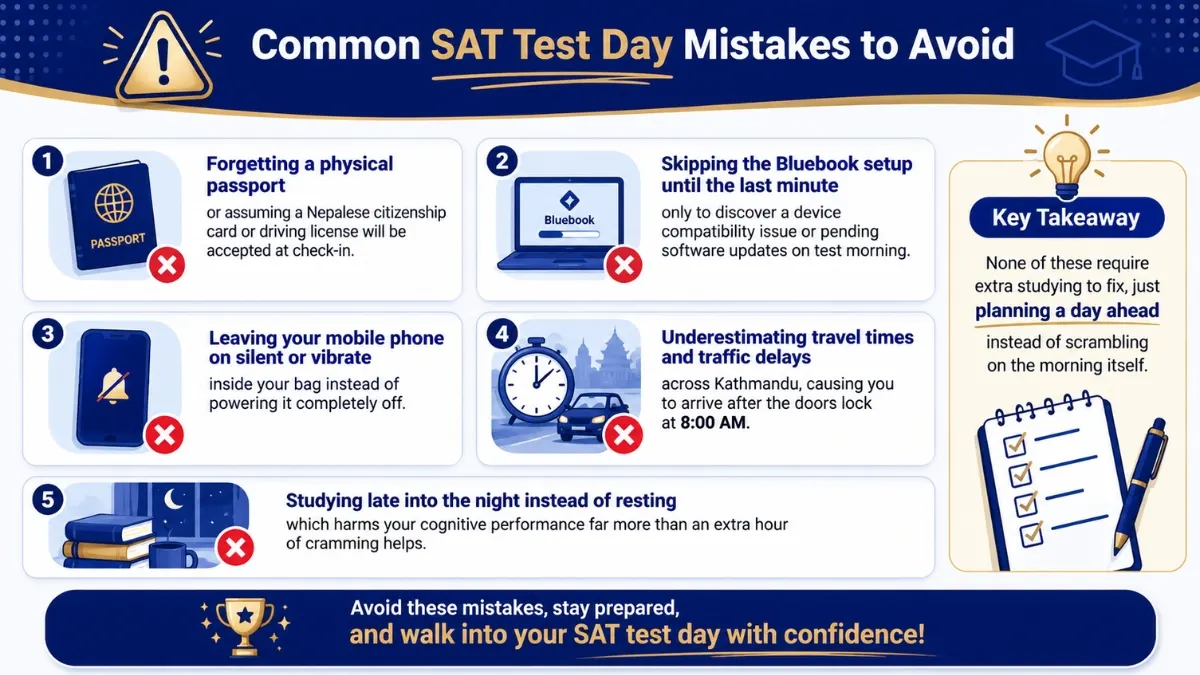
A few small errors are responsible for most of the stress students face on test day, and nearly all of them are completely avoidable:
- Forgetting a physical passport or assuming a Nepalese citizenship card or driving license will be accepted at check-in.
- Skipping the Bluebook setup until the last minute, only to discover a device compatibility issue or pending software updates on test morning.
- Leaving your mobile phone on silent or vibrate inside your bag instead of powering it completely off.
- Underestimating travel times and traffic delays across Kathmandu, causing you to arrive after the doors lock at 8:00 AM.
- Studying late into the night instead of resting, which harms your cognitive performance far more than an extra hour of cramming helps.
None of these require extra studying to fix, just planning a day ahead instead of scrambling on the morning itself.
How Westford Education Helps With Your SAT Journey
Since 2013, Westford Education has been helping Nepali students prepare for exams like the SAT and navigate their study abroad journey from Kathmandu. Beyond test-day logistics, getting the score itself takes the right preparation, and that’s where a lot of students need support most.
Westford’s SAT program includes:
- Certified instructors and personalized coaching for the Digital SAT
- Full-length mock tests that mirror the real Bluebook testing experience
- Strategic exam techniques for both timing and accuracy
- Guidance that connects your SAT score directly to your study abroad plans course selection, university shortlisting, and visa support
If you’re preparing for the SAT in Kathmandu or planning to study abroad afterward, Westford Education’s SAT preparation program covers both so your test-day checklist is only one part of a plan that’s already sorted.
Final Thoughts
The SAT itself is only one part of a much bigger journey, but everything about test day is within your control. A charged device, the right ID, a bag packed the night before, and a calm morning routine can prevent almost every last-minute problem students face. Most test-day panic comes from small things left until the last minute, not from the exam itself.
If you’ve gone through this checklist, you already know more about test day than most students walking in cold. The ID rules, the device setup, the timeline, the small mistakes to avoid none of it requires extra studying. It just requires a little planning the day before, so your morning is calm instead of rushed.
That’s really the whole point of test day preparation: it’s the one part of the SAT you can fully control, so use it. Once your test is done, you can check where to find your SAT scores and start planning your next step.
Still have questions about your SAT prep or study abroad plans? Talk to a Westford Education counselor; we’ll walk you through it, no pressure, just guidance.
Frequently Asked Questions
What should I bring to the SAT in 2026?
Your printed admission ticket, a valid photo ID (passport recommended for Nepali students), and a fully charged device with Bluebook installed. Everything else, the calculator, pencils, and snacks, is optional but helpful.
Can I use my Nepali citizenship card as ID for the SAT?
No, most international test centers do not accept a Nepali citizenship card or driving license. A valid passport is the safest option.
What time should I arrive at the SAT test center?
Aim to arrive by 7:30 AM. Doors close at 8:00 AM, and late arrivals are not admitted, no exceptions.
Can I bring my phone into the SAT test center?
You can carry it, but it must be fully switched off and stored away, not just on silent. Any sound during the test can lead to score cancellation.
What happens if I forget my ID on test day?
You will not be allowed to sit for the exam, even with your admission ticket. You lose both your test date and your registration.
Do I need to set up Bluebook on the morning of the test?
No, complete your Bluebook exam setup 1 to 5 days in advance. Leaving it until test morning risks discovering a device issue too late.
Is a calculator required for the digital SAT?
No, the Digital SAT has a built-in Desmos calculator inside Bluebook. Bring your own approved calculator only if you prefer using it.