


Study in UK from Nepal: Visa, Cost & Universities
The UK is one of the most popular study destinations for Nepali students, and the reasons are straightforward. Every year, thousands of students from Nepal make the move to pursue their bachelor’s or master’s degree, and it is easy to understand why. Shorter degrees, the right to work while you study, and a 2-year graduate route visa after graduation that lets you stay and build your career without needing employer sponsorship.
But knowing the UK is a good option is one thing. Actually getting there is another. The visa process, financial requirements, university selection, and document preparation can feel overwhelming, especially if you are navigating this for the first time.
Your UK study journey starts here, and Westford Education walks every step with you. From university selection to visa approval, we make the process clear, simple, and stress-free for Nepali students.
Why the UK is a Top Study Destination for Nepali Students
The UK offers shorter degrees, more work rights, and better post-study visa options than most other countries, making it the most practical choice for Nepali students studying abroad.
- Shorter degree duration. A bachelor’s takes 3 years, and a master’s just 1 year, saving you a full year of tuition and living costs.
- Work while you study. Work up to 20 hours per week during term time and full-time during holidays to cover your living expenses.
- Post-study work rights. The Graduate Route Visa lets you stay and work in the UK for 2 years (3 years for a PhD) after graduation; no employer sponsorship is needed.
- Globally recognized degrees. A UK degree carries weight worldwide, whether you stay in the UK, return to Nepal, or move elsewhere.
- No IELTS route available. Over 25 UK universities accept a Medium of Instruction (MOI) letter instead of IELTS, a practical option for students from English-medium schools.
For Nepali students weighing their options, studying in the UK consistently stands out not just for the quality of education but also for the real, practical benefits it offers before, during, and after their studies. If you are also exploring other destinations, you can compare study abroad options by country.
Entry Requirements to Study in UK from Nepal
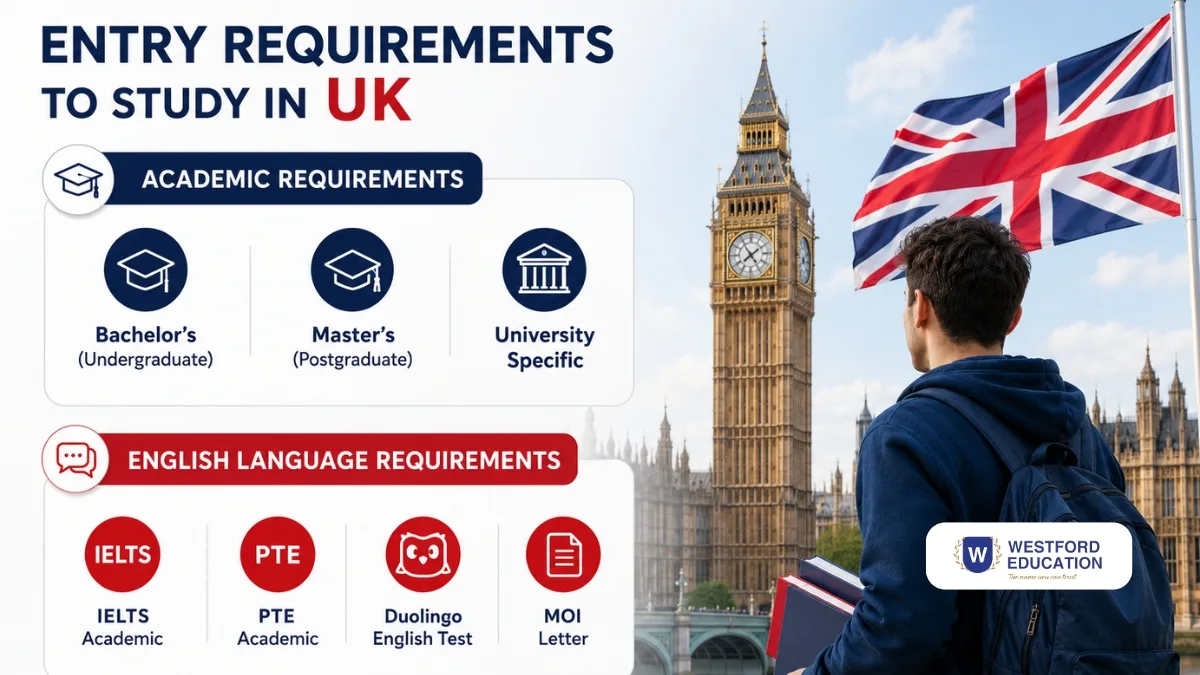
UK universities have straightforward entry requirements for Nepali students. Here is what you need to qualify:
Academic Requirements
- For Bachelor’s (Undergraduate): Completion of NEB +2 or A-Levels with a minimum CGPA of 2.0–2.4 (usually 55–60 percent).
- For Master’s (Postgraduate): A recognized Bachelor’s degree with a minimum second division or 50–60% overall.
Each university sets its own cut-off, so always check the specific requirements of your target institution.
English Language Requirements
- IELTS Academic: Minimum 6.0 overall (no band below 5.5). Some universities require 6.5.
- PTE Academic: Minimum 51–58 depending on the university.
- Duolingo English Test: Accepted by a growing number of UK universities.
- MOI Letter: Students from English-medium schools can submit a Medium of Instruction letter instead of IELTS.
If you studied in a Nepali government or non-English-medium institution, IELTS or PTE is required.
Cost of Studying in UK from Nepal
Understanding the cost of studying in UK from Nepal is essential before you start your application. Here is a full breakdown of tuition, living costs, and everything in between.
Tuition Fees
Level | Annual Tuition Fees |
Bachelor’s (Undergraduate) | £10,000 – £20,000 |
Master’s (Postgraduate) | £10,000 – £25,000 |
MBA | £15,000 – £35,000 |
Fees vary by university and course. Business, law, and medicine tend to be on the higher end. Many mid-range universities offer quality programs in the £10,000–£14,000 range.
Living Costs
Location | Required Maintenance Funds (9 months) | Estimated Monthly Spend |
Outside London | £10,539 | £800 – £1,200/month |
Inside London | £13,761 | £1,200 – £1,800/month |
Other Key Costs
Expense | Estimated Cost |
UK Student Visa Fee | £558 |
Immigration Health Surcharge (IHS) | £776/year |
TB Test (IOM, Kathmandu) | NPR ~5,000 |
IELTS Exam | NPR ~28,000 |
Pre-departure Expenses | NPR 50,000 – 80,000 |
The Immigration Health Surcharge gives you full access to the NHS, so you do not pay separately for most medical treatment during your stay.
UK Universities for Nepali Students
The UK has over 160 universities. Choosing the right one depends on your academic background, budget, course preference, and location. While institutions like Oxford, Cambridge, and UCL are globally recognized, most Nepali students opt for mid-range universities that offer strong academics, reasonable tuition fees, and higher acceptance rates.
Popular UK Universities for Nepali Students
University | Location | Approx. Tuition/Year |
Coventry University | Coventry | £13,000 – £16,000 |
University of Hertfordshire | Hatfield | £13,000 – £15,000 |
Leeds Beckett University | Leeds | £12,000 – £14,000 |
University of Greenwich | London | £14,000 – £16,000 |
University of Wolverhampton | Wolverhampton | £11,500 – £13,500 |
University of Chester | Chester | £11,000 – £13,000 |
Teesside University | Middlesbrough | £12,000 – £14,000 |
University of Central Lancashire | Preston | £11,500 – £14,000 |
Most of these universities accept MOI letters, have dedicated international student support teams, and are listed on the UKVI Student Sponsor Register.
Before You Finalise a University, Check These
- Is it listed on the UKVI Student Sponsor Register? If not, you cannot get a student visa through it.
- Does it accept your English test score or MOI letter?
- What scholarships are available for Nepali or international students?
Intake Windows
Intake | Start Month | Application Deadline |
September (Main) | September | January – May |
January (Winter) | January | August – October |
May (Summer) | May | December – February |
September is the main intake with the widest course availability. January and May intakes exist but offer fewer course options.
Not sure which UK university is right for you? Explore our UK study programs and find the right university, course, and scholarship for your profile all in one place.
Scholarships for Nepali Students in UK
Studying in the UK is a significant financial commitment. The good news is that several scholarships for Nepali students in UK are available both from the UK government and from individual universities.
Scholarship | Level | Funding | Key Requirement |
Chevening Scholarship | Master’s only | Full tuition, living allowance, flights | Minimum 2 years’ work experience |
Commonwealth Scholarship | Master’s & PhD | Full tuition, living stipend, flights, thesis grant | Development-related fields |
GREAT Scholarship | Master’s only | Min. £10,000 partial scholarship | Available at select UK universities |
University Scholarships | All levels | £1,000 – £5,000 tuition waiver | Merit or need-based varies by university |
The Chevening and Commonwealth scholarships are fully funded and highly competitive. Apply early; Chevening typically opens in August and closes in November each year. For university-specific scholarships, always check the international scholarships page of your target university at the time of applying.
UK Student Visa from Nepal: Step-by-Step Process
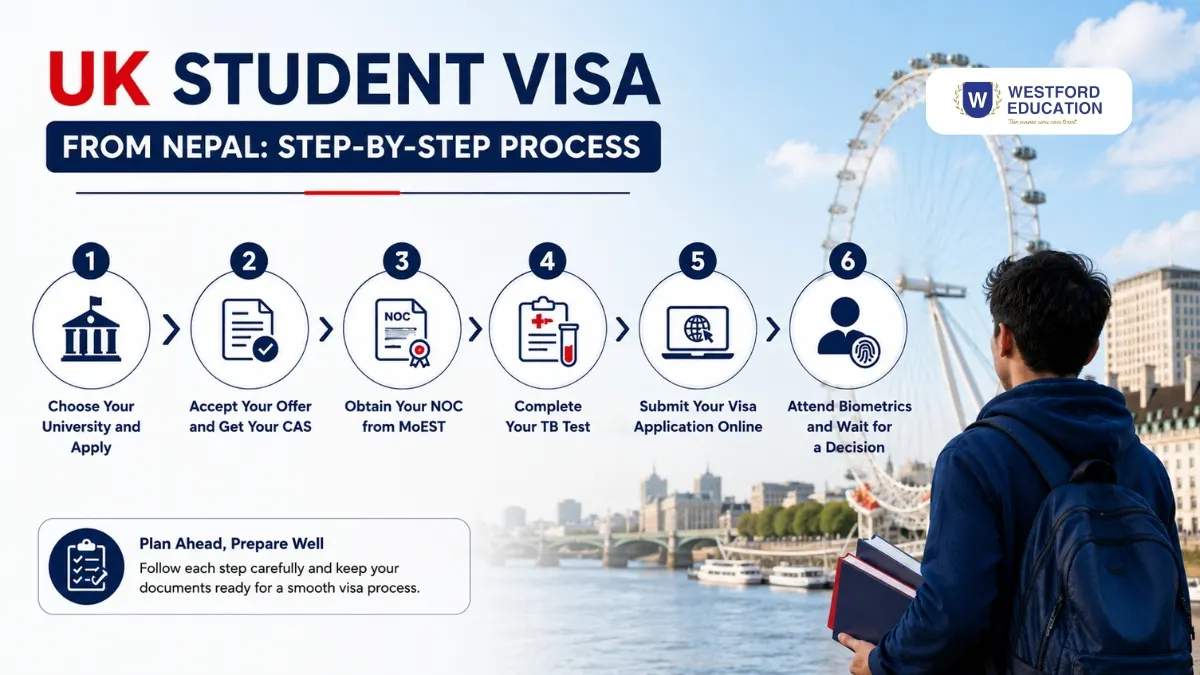
The UK student visa (formerly called the Tier 4 visa) is officially called the Student Visa. Here is how to apply for UK student visa from Nepal.
Step 1: Choose Your University and Apply
Research and shortlist universities based on your academic profile, budget, and course preference. For undergraduate programs, apply through UCAS, and for postgraduate, apply directly through the university website.
Step 2: Accept Your Offer and Get Your CAS
Once you accept your unconditional offer, your university will issue a Confirmation of Acceptance for Studies (CAS), a unique reference number you need to start your visa application. Do not begin the visa process without it.
Step 3: Obtain Your NOC from MoEST
Nepali students must obtain a No Objection Certificate (NOC) from the Ministry of Education, Science, and Technology before applying for the visa. Apply through the MoEST online portal at moest.gov.np after receiving your CAS. The process typically takes 5–10 working days.
Step 4: Complete Your TB Test
All applicants from Nepal must complete a tuberculosis (TB) test at an approved clinic before applying. In Nepal, this is done at the IOM center in Kathmandu. Book your appointment early, as slots can fill up. The result is valid for 6 months.
Step 5: Submit Your Visa Application Online
Fill out the UK Student Visa application on the UKVI website. During this step you will pay the visa application fee (£558) and the Immigration Health Surcharge (£776/year), upload all your required documents, and book your biometrics appointment at VFS Global in Kathmandu.
Step 6: Attend Biometrics and Wait for a Decision
Attend your biometrics appointment at VFS Global in Kathmandu with all required documents. Your fingerprints and photograph will be taken here. The UKVI typically processes applications within 3 weeks. Apply at least 6–8 weeks before your course start date and avoid booking non-refundable flights until your visa is approved.
Not sure if your documents are ready for a UK student visa? Get a free document checklist review from our best consultancy in Kathmandu for abroad study. Speak to a counselor before you apply.
Documents Required to Study in UK from Nepal
Having the right documents ready before applying saves time and reduces the chance of delays. Use this checklist of documents required to study in UK from Nepal before you submit your application.
Academic Documents
- NEB +2 or A-Level transcripts and certificates
- Bachelor’s degree transcripts and certificate (for Master’s applicants)
- Academic reference letters (if required by the university)
English Proficiency
- IELTS, PTE, or Duolingo score report
- Or MOI letter from your previous institution (if applicable)
Financial Documents
- Bank statements (minimum 28 days) showing required maintenance funds
- The bank should be on the UKVI-approved list
- Sponsor letter (if funds are from parents or guardians)
Visa-Specific Documents
- Valid passport (minimum 6 months validity beyond your course end date)
- CAS letter from your UK university
- NOC from MoEST
- TB test clearance certificate from IOM Kathmandu
- Proof of visa fee and IHS payment
- Passport-size photographs
Additional Documents
- Statement of Purpose (SOP)
- Updated CV (for postgraduate applicants)
- Acceptance letter from the university
UKVI RAG System: What Nepali Students Must Know Before Choosing a University
Since 1 June 2026, the UK Home Office has rated every UKVI-licensed university as Green, Amber, or Red under its Sponsor Compliance framework. This rating directly affects whether a university can issue a CAS letter, the document every Nepali student needs to apply for a UK student visa.
Choosing a university without checking its RAG band is one of the most common and costly mistakes Nepali students make. Before shortlisting any university, make sure you are working with a registered and trusted consultancy in Nepal that monitors RAG status for you.
How the RAG Rating Works
Metric | Green | Amber | Red |
Visa Refusal Rate | Below 4% | 4%–5% | Above 5% |
Student Enrolment Rate | Above 96% | 95%–96% | Below 95% |
Course Completion Rate | Above 92% | Below 92% | The worst-metric rule applies |
A university only needs to fail one metric to be rated Amber or Red.
What Each Band Means for You
Green: Safe to apply. The university meets all UKVI compliance thresholds and can issue CAS letters without restriction. Always aim to apply to green-band universities.
Amber: CAS completely frozen. The university cannot issue any new CAS letters until its compliance improves. If you have already accepted an offer at an amber-band university, your visa application cannot move forward.
Red: CAS allocation cut by minimum 10%. Some students with accepted offers may not receive a CAS at all. There is no guaranteed cap on how many CAS letters are withheld.
How to Check a University's RAG Band
UKVI does not publish a live public RAG register, but you can verify a university’s status in two ways:
- Ask the university’s international admissions office to confirm in writing that they are currently issuing CAS letters without restriction.
- Check the UKVI Licensed Sponsor Register at gov.uk to confirm the university is still an active licensed sponsor.
When shortlisting universities, always confirm RAG band status before accepting any offer, not after.
Final Thoughts
Studying in the UK from Nepal is absolutely achievable and more straightforward than most students expect once you understand the process. The UK offers shorter degrees, work rights during study, and strong post-graduation options that very few other countries can match.
The key is starting early. Give yourself enough time to prepare your documents, get your NOC, complete your TB test, and apply for your visa without last-minute pressure.
If you want guidance on university selection, scholarship applications, or visa documentation, our counselors at Westford Education are here to help. Reach out to us, and we will walk you through the process at your own pace no pressure, just clear and honest advice.
Ready to start your UK study journey from Nepal? Book a free consultation with Westford Education today and get personalized guidance from application to visa approval.
Frequently Asked Questions
Can Nepali students study in the UK without IELTS?
Yes. Over 25 UK universities accept a Medium of Instruction (MOI) letter from your previous institution instead of IELTS, provided you studied in an English-medium school.
How much does it cost to study in the UK from Nepal?
Tuition fees range from £10,000 to £25,000 per year depending on the university and course. Living costs add approximately £800–£1,200 per month outside London.
How long does the UK student visa take to process from Nepal?
The UKVI typically processes student visa applications within 3 weeks from the date of your biometrics appointment at VFS Global in Kathmandu.
Can Nepali students work while studying in the UK?
Yes. You can work up to 20 hours per week during term time and full-time during holidays as an international student in the UK.
What is a CAS letter and why do I need it?
A Confirmation of Acceptance for Studies (CAS) is issued by your UK university after you accept an unconditional offer. Without it, you cannot apply for a UK student visa.
What is the NOC, and do all Nepali students need it?
Yes, all Nepali students must obtain a No Objection Certificate (NOC) from the Ministry of Education, Science, and Technology (MOEST) before applying for the UK student visa.
What is the Graduate Route Visa, and how long can I stay after graduation?
The Graduate Route Visa allows you to stay and work in the UK for 2 years after completing a bachelor’s or master’s degree and 3 years after a PhD, without needing employer sponsorship.
What is the UKVI RAG system and why does it matter for Nepali students?
Since June 2026, the UK Home Office rates every licensed university as green, amber, or red. Amber and Red-rated universities cannot issue CAS letters, meaning your visa application cannot proceed even if you hold an offer.