

TOEFL Exam Format 2026: Complete Guide for Nepali Students
Are you a recent graduate dreaming of studying in the USA, Canada, the UK, or Australia? The TOEFL (Test of English as a Foreign Language) is your golden ticket to international universities. Over 11,500 universities worldwide accept TOEFL scores, making it one of the most trusted English proficiency tests globally.
Understanding the TOEFL exam format is the first step toward achieving your dream score. This complete guide breaks down everything you need to know about the TOEFL test pattern, sections, timing, and scoring, specifically designed for students in Nepal.
Good news! The TOEFL iBT is now shorter! You’ll finish in just 2 hours, not 3. That means less stress and more focus.
The test still keeps the same high quality and is accepted everywhere. In Nepal, the TOEFL iBT is the only version offered and is held at official test centers in Kathmandu, Lalitpur, Pokhara, and Chitwan, with additional locations in Butwal.
Ready to study abroad? Let Westford’s TOEFL experts turn your dream into a 100+ score.
TOEFL Exam Structure Overview
The TOEFL exam structure includes four main sections. They are:
- Reading
- Listening
- Speaking
- Writing
This examination tests your English skills in real academic situations. You can think of it as a proof showing universities that you can understand lectures, participate in discussions, read textbooks, and write research papers all in English.
In the TOEFL Exams, you will read academic texts, listen to university talks, speak clearly about your ideas, and write essays that prove you’re ready for college. The total test time is approximately 2 hours.
Summary of TOEFL Exam Format
Section | No. of Questions | Duration | Skills Tested |
Reading | 20 | 35 minutes | Comprehension |
Listening | 28 | 36 minutes | Understanding key ideas |
Speaking | 4 tasks | 16 minutes | Spoken communication |
Writing | 2 tasks | 29 minutes | Academic writing |
Pro Tip: Always start your TOEFL preparation with a clear understanding of the exam structure. Knowing what to expect in each section helps you plan your study hours efficiently.
Planning to take the TOEFL soon? Join Westford Education’s TOEFL Prep Program expert instructors, small batches, and full mock tests every week.



 Trustindex verifies that the original source of the review is Google.
  Trustindex verifies that the original source of the review is Google.
  Trustindex verifies that the original source of the review is Google.
  Trustindex verifies that the original source of the review is Google.
  Trustindex verifies that the original source of the review is Google.
  Trustindex verifies that the original source of the review is Google.
  Trustindex verifies that the original source of the review is Google.
  Trustindex verifies that the original source of the review is Google.
  Trustindex verifies that the original source of the review is Google.
  Trustindex verifies that the original source of the review is Google.
 TOEFL Reading Section Format
The TOEFL reading section presents 2 academic passages from university textbooks. You’ll have 35 minutes to answer 20 questions testing your comprehension skills.
Types of Questions You'll Face:
- Factual Questions: These ask for specific facts that are clearly stated in the passage. You just find the exact information.
- Inference Questions: You read between the lines to understand ideas that are not directly said.
- Vocabulary Questions: You figure out the meaning of words based on how they are used in the passage.
- Sentence Insertion: You decide where a new sentence best fits in the passage to keep the meaning clear.
Common Challenges Faced by Nepali Students:
- Difficult academic vocabulary
- Losing focus after 15–20 minutes
- Trouble managing time on inference questions
Westford’s Tips for the Reading Section
- Spend 2-3 minutes skimming the passage to get the main idea before starting questions.
- Manage time by spending about 17-18 minutes on each passage. If a question is too hard, skip it and come back later.
- Build your reading stamina by practicing with academic articles from sources like National Geographic or university websites. Start with 15 minutes daily and increase gradually.
Need help understanding the TOEFL reading section? Join Westford’s Reading Practice Session every weekend limited seats available!
TOEFL Listening Section Format
In the TOEFL listening section, you’ll hear authentic university situations: 3 lectures (like real college classes) and 2 campus conversations (student-professor or student-staff discussions). You’ll answer 28 questions in 36 minutes.
Here’s what makes it challenging: you can only listen once. No rewind button! That’s why note-taking becomes your best friend.
Question Types:
- Gist Questions: The question asks about the main idea. Example: “What is the lecture mainly about?”
- Detail Questions: It ask about specific facts from the audio. Example: “What does the professor say about photosynthesis?”
- Inference Questions: This one ask what the speaker means indirectly. Example: “What does the professor imply when she says…?”
- Attitude Questions: This asks about the speaker’s feelings or opinion.
Westford’s Tips for the Listening Section
- Take notes by writing important words, not full sentences.
- Listen for special phrases like “The important thing is…”, “However…”, and “Let me emphasize…” because they show key points.
- Practice by listening to real talks like TED Talks, university lectures on YouTube, or BBC podcasts like “6 Minute English”.
- Train your ears to understand different English accents such as American, British, and Australian.
Recommended Read: How to Prepare TOEFL in Nepal?
TOEFL Speaking Section Format

The TOEFL speaking section has 4 tasks completed in just 16 minutes. You’ll speak into a microphone, and your responses are recorded and evaluated by certified raters.
Task Breakdown:
Task 1 – Independent Speaking (Preparation: 15 seconds | Speaking: 45 seconds)
You’ll have 15 seconds to prepare before you speak and speak for 45 seconds non-stop on the topic you’re provided. Here, you need to express your personal opinion on familiar topics.
Tasks 2-4 – Integrated Speaking
In this tasks, you will
- Read a short passage or listen to a conversation
- Then listen to a lecture or discussion
- Finally, speak about how the information connects
Westford’s Tips for the Speaking Section
- Speak clearly and naturally. It’s better to be easy to understand than use hard words you can’t say well.
- Use your 15 seconds to quickly write 2-3 main points: say your point, give an example, then finish.
- Don’t memorize answers, speak naturally, even if you pause to think.
- Practice every day by recording yourself. Listen for any hesitations or unclear parts and improve them.
Join our weekly Speaking Practice Workshop at Westford Education!
TOEFL Writing Section Format
The TOEFL writing section includes 2 tasks in 29 minutes. Both require academic writing skills that you’ll use throughout your university life.
Task 1: Integrated Writing (20 minutes)
- Read a short academic passage (3 minutes)
- Listen to a lecture on the same topic (2 minutes)
- Write a response (20 minutes, 150-225 words recommended)
You’ll summarize how the lecture challenges or supports the reading. You’ll just report the objectives but no personal opinions.
Task 2: Academic Discussion (10 minutes)
Read an online discussion between a professor and students, then contribute your own opinion. Write at least 100 words presenting your perspective with clear reasons and examples.
Westford’s Tips for the Writing Section
- Plan your essay for 2-3 minutes before you write. Use a simple structure: introduction, body, conclusion.
- Use common academic words and linking phrases like “Furthermore,” “For example,” and “Therefore.”
- Save 2 minutes to check spelling, grammar, and sentence variety. Small errors can lower your score.
- Practice typing often since the test is on a computer. Try typing games or write daily.
Westford Education offers IELTS, PTE, TOEFLS, GRE, GMAT, and SAT preparation too! Our test prep programs help you choose the right exam for your goals. Explore All Test Prep Courses
TOEFL Scoring System Explained
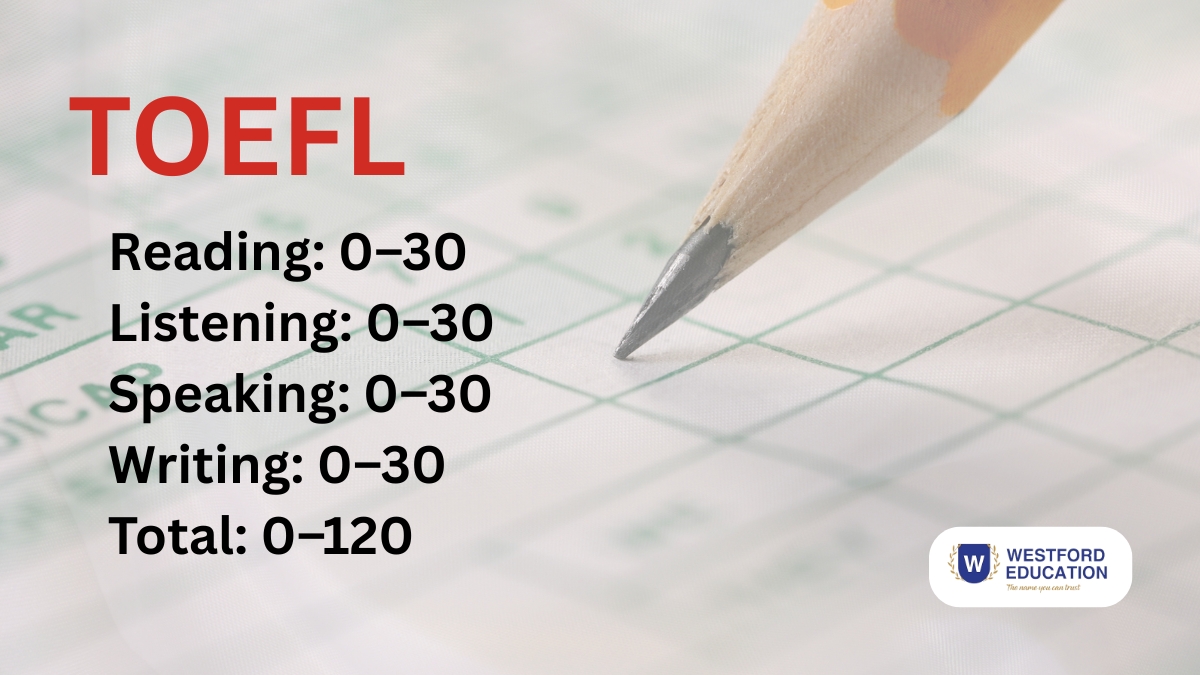
The TOEFL scoring system helps you set realistic goals. Each section is scored separately, then combined for your total score.
How TOEFL Scoring Works?
Here is a simple explanation of what your TOEFL score means and how scoring works:
- Score 110-120: Advanced level, ready for any English university.
- Score 90-109: High-Intermediate, strong English, accepted by most schools.
- Score 70-89: Intermediate, a good base, but some schools want higher scores.
- Below 70: Need more language practice.
Your Reading and Listening answers are scored by computers right away. Speaking and Writing are checked by people for how clear, fluent, and organized you are. You get your official scores online 4-8 days after the test.
TOEFL Score Distribution
Section | Score Range |
Reading | 0–30 |
Listening | 0–30 |
Speaking | 0–30 |
Writing | 0–30 |
Total | 0–120 |
University Requirements (Typical):
- USA: 80–100+
- Canada: 90+
- Australia: 79–95
- UK: 88+
(Always confirm with your target university.)
Know where you stand, take a free mock test at Westford Education and get your predicted TOEFL score today.
Duration and Timing of the TOEFL Exam
The TOEFL exam time is now just about 2 hours, a huge improvement from the previous 3-hour format! Here’s exactly how your test day flows:
Section-by-Section Breakdown:
- Reading: 35 minutes (no break)
- Listening: 36 minutes (no break)
- 10-Minute Break (Use restroom, eat snacks, relax)
- Speaking: 16 minutes (no break)
- Writing: 29 minutes (no break)
Total Active Test Time: 1 hour 56 minutes Total Time Including Break: Approximately 2 hours 10 minutes
What to Expect on Test Day:
- Arrive 30 minutes early for check-in procedures
- Bring your valid passport (no other ID accepted)
- No watches, phones, or personal items allowed in the test room
- You’ll get scratch paper and a pencil for notes
- Wear comfortable clothes (test centers can be cold!)
- The Speaking section happens while others are testing, so you’ll hear background voices
Want to master time management for TOEFL? Westford’s full-length mock tests help you practice under real timing conditions.
TOEFL iBT vs TOEFL PBT – What’s the Difference?
Since Nepal only offers the TOEFL iBT, you don’t need to worry about the paper version. The iBT format mirrors how students use English in real life through listening, reading, writing, and speaking online.
If you’re taking the TOEFL in Nepal, you’ll take the TOEFL iBT format (Internet-Based Test). The paper-based test (PBT) is rarely offered worldwide and not available in Nepal. Here’s why iBT is better:
Feature | TOEFL iBT | TOEFL PBT |
Mode | Internet-based | Paper-based |
Duration | 2 hours | 3 hours |
Scoring | 0–120 | 310–677 |
Availability in Nepal | Widely available | Rare |
For Nepali Students: Focus solely on the TOEFL iBT. All Nepali test centers (Kathmandu, Pokhara, Chitwan) offer only the iBT format, and it’s what universities expect.
Did you know? ETS also offers a TOEFL iBT Home Edition for students who prefer testing from home. You’ll need a computer, stable internet, and a quiet room. This option is sometimes available in Nepal check the ETS website for updates.
TOEFL Exam in Nepal – Test Centers, Fees, and Registration
TOEFL iBT is available year-round at authorized centers in Nepal.
Major TOEFL Test Centers:
- Kathmandu: American Education Center, NIEC, Alfa Beta
- Pokhara: Orbit International College
- Chitwan: Apex College
- Butwal: LBEF Butwal
TOEFL Exam Fee in Nepal: Around USD 195 (approx. NPR 26,000). Payment is made online via ETS’s official site.
Registration Process:
- Create an account at www.ets.org/toefl
- Choose your test date and center
- Pay using an international card
- Receive confirmation via email
Tip: Book your test 3–4 weeks early since seats fill up quickly in Kathmandu.
TOEFL Eligibility for Nepali Students
There is no official age or academic restriction for taking TOEFL. However, most students take it after completing +2 or during university studies.
You’ll need:
- A valid passport
- Basic computer skills (since the test is computer-based)
- Strong English communication skills
Prepare for the TOEFL Exam with Westford Education
Westford Education has been offering TOEFL test preparation classes for over a decade. 95% of Westford students score above their target on the first attemp. We also guide the students through the visa process and provide free consultation.
We offer:
- Expert Trainers: Our instructors are TOEFL-certified with years of experience teaching Nepali students specifically.
- Updated Study Materials: Access the latest TOEFL resources, practice tests, and question banks that mirror the 2026 format.
- Computer-Based Practice: Train on actual TOEFL software interface. No surprises on test day!
- Speaking Labs: Small group sessions where you practice with peers and receive immediate feedback from trainers.
- Weekly Mock Tests: Take full-length practice tests under real exam conditions. Track your progress with detailed score reports.
- Flexible Batches: Morning, day, and evening classes to fit your schedule. Weekend batches available!
- Registration Support: We’ll help you register for the official TOEFL exam, choose test dates, and handle all the paperwork.
Common Mistakes to Avoid in the TOEFL Exam
Learn from others’ experiences! Here are the biggest mistakes Nepali students make (and how to avoid them):
- Rushing reading: miss details. Read steadily; practice helps speed.
- Poor note-taking: forget key info. Use shorthand; practice daily.
- Speaking too fast/slow: unclear or odd. Record yourself; aim 120–150 words/min.
- Writing without structure: lowers scores. Outline first with intro, body, conclusion.
- Ignoring question types: wrong answers. Read twice; underline keywords; answer exactly.
- Bad time management: miss questions. Use watch or timer; check often.
- Focus only on grammar: miss communication. Practice all skills daily.
- Skip mock tests: more stress on test day. Do 5+ full practice tests before exam.
Avoid these mistakes with expert trainer guidance at Westford. Enroll in our TOEFL Preparation Course new batches every Sunday.
Final Thought
The TOEFL exam format helps you feel confident and prepare smartly. When you know what to expect, you can focus better and use your time well.
The TOEFL tests your English skills plus your ability to manage time and handle the test. Practice often and believe in yourself.
Many Nepali students have reached their study abroad goals with TOEFL. You can too! The first step is learning the exam format well.
Your dream university is waiting. Your future is calling. Are you ready?
Planning to take the TOEFL in Nepal?
Contact Westford Education for help with registration, free practice materials, and expert advice. Our counselors will help you:
- Choose the best test date
- Make a study plan just for you
- Get access to exclusive practice resources
- Join the next TOEFL batch
Call us at +977-985-1111004
Email: westford.np@gmail.com
Visit: Putalisadak, Kathmandu
Start your future now. Book free TOEFL counseling and get expert guidance for your global success!
FAQs About TOEFL Exam Format
How many sections are there in the TOEFL exam format?
The TOEFL iBT has four sections: Reading, Listening, Speaking, and Writing. These assess English skills in academic contexts. The PBT version also has four but omits integrated Speaking.
What is the total duration of the TOEFL test?
The total duration of the TOEFL tests is under 2 hours. Previously, it was 3hours. Check-in adds extra time outside the test.
How is TOEFL scored?
TOEFL iBT scores range from 0-120, with 0-30 per section. Reading and Listening use multiple-choice; Speaking and Writing involve raters and AI. Scores are available online in 6-10 days and valid for two years.
Is the TOEFL exam difficult for Nepali students?
TOEFL can be challenging for Nepali students due to limited English exposure, especially in Speaking and Listening. Academic vocabulary and pace add difficulty, but practice tests help improve scores. Preparation is key to success.
Can I retake the TOEFL exam if I’m not satisfied with my score?
Yes, you can retake TOEFL as often as needed, waiting 3 days between attempts. No retake limit exists, but plan preparation wisely. Use MyBest Scores to report your best combined results.
What is the difference between TOEFL iBT and TOEFL PBT?
TOEFL iBT is computer-based with all four skills integrated, preferred globally. PBT is paper-based, lacks Speaking, and scores 310-677. iBT is now the main format available.
How long are TOEFL scores valid?
TOEFL scores are valid for two years from the test date. After that, they expire to reflect current proficiency. Retake if needed beyond this period.
What is the minimum TOEFL score required for universities abroad?
Minimum scores vary: 80-100 iBT for most undergrad programs, 100+ for graduate. Check specific university requirements, including section minimums. Requirements depend on the program and country.
How many times can I retake the TOEFL exam?
You can retake TOEFL unlimited times, but wait 3 days between tests. This allows up to 10-12 attempts yearly. Focus on preparation to avoid frequent retakes.