

What are the PR‑friendly courses in Australia for Nepalese students?
PR-friendly courses are academic programmes in Australia that lead to occupations in high demand, making graduates eligible for skilled migration and permanent residency (PR). These classes are good for both Nepalese and international students because they give them a high-quality education and a clear path to living in Nepal for a long time, getting ahead in their careers, and gaining work experience.
These courses are closely linked to the Skilled Occupation List (SOL) and the Medium & Long-term Strategic Skills List (MLTSSL). Completing a PR-friendly course that aligns with these lists ensures eligibility for skill assessments and increases the chances of receiving invitations for skilled visas like Subclass 189, 190, or 491.
There are many benefits to choosing PR-friendly courses. They can help you get your PR faster, give you access to job opportunities after graduation through the Post-Study Work Visa (Subclass 485), and give you extra points for studying in regional Australia, which makes you more competitive in the points-based migration system.
Why PR‑Friendly Courses Matter for Nepalese and International Students?

Australia is one of the most popular study destinations in the world, known for its high quality of life, strong economy, and generous post‑study work rights. But for many Nepalese students, the ultimate goal isn’t just education; it’s long‑term settlement and PR. Courses that are PR‑friendly increase your chances of gaining valuable Australian student visa PR outcomes after graduation.
To be PR‑friendly, a course typically must:
- Lead to occupations on the Skilled Occupation List (SOL), MLTSSL, or related lists used by the Department of Home Affairs.
- Provide eligibility for skills assessments by relevant Australian authorities (e.g., ACS for IT, Engineers Australia for engineering).
- Allow you to obtain qualified work experience in a field the country needs.
- Position yourself well for skilled migration points, employer sponsorships, or state nomination.
By studying one of the best PR‑friendly courses in Australia, you get both high‑demand job prospects and a strong pathway to permanent residency, something many Nepalese students dream of.
Recommended Read: Why Study in Australia?
What Makes a Course PR‑Friendly in Australia?
When evaluating courses for Australia, understanding how the PR framework works is crucial. The points-based migration system and the demand for skilled workers have a big impact on Australian PR.
- Alignment with Skilled Occupation & MLTSSL Lists
Australia maintains detailed occupation lists like the Skilled Occupation List Australia and the MLTSSL courses in Australia that guide which professions are eligible for skilled visas. Courses that lead directly to occupations on these lists offer the strongest Australia PR pathway for international students.
Points‑Based System Overview
Applicants must get enough points on the skilled migration points test to be eligible for PR. You earn points on factors such as:
- Age: Younger applicants score higher points, as Australia prioritizes long-term workforce contribution.
- English language proficiency: Higher IELTS/PTE scores increase points and improve employability.
- Educational qualification: Australian-recognised degrees and higher-level qualifications earn more points.
- Skilled work experience: Relevant Australian or overseas work experience boosts your overall PR score.
- Study in Australia (including extra points if you studied in regional areas): Completing studies in Australia, especially in regional areas, provides extra migration points.
Completing a relevant PR‑friendly course stimulates higher points because it signals to immigration authorities that you have valuable skills in demand. The new MD-115 Australian Update have made the visa process more specific.
Studying in Regional Australia
If you want to get a PR, going to a regional Australian university or TAFE can help. You can often get extra points under the skilled migration system and be eligible for regional visas like Subclass 491.
Examples of regional areas include Adelaide, Tasmania, the Northern Territory, Geelong, and Hobart, which often feature on promotional lists for regional migration.
Here’s a snapshot of how studying in different states/regions can influence your PR journey:
State / Area | Regional Study Advantage | Nomination Opportunities |
South Australia | Extra skilled migration points | State nomination possible |
Tasmania | Priority for regional visas | Candidate occupations priority |
Northern Territory | Lower competition for roles | Bonus PR points |
Queensland (regional zones) | Attractive work placements | Regional nomination access |
Improve your English proficiency and boost your Australia study and PR prospects with expert IELTS preparation. Start Your IELTS Preparation with Westford Education
Top PR‑Friendly Course Categories in Australia
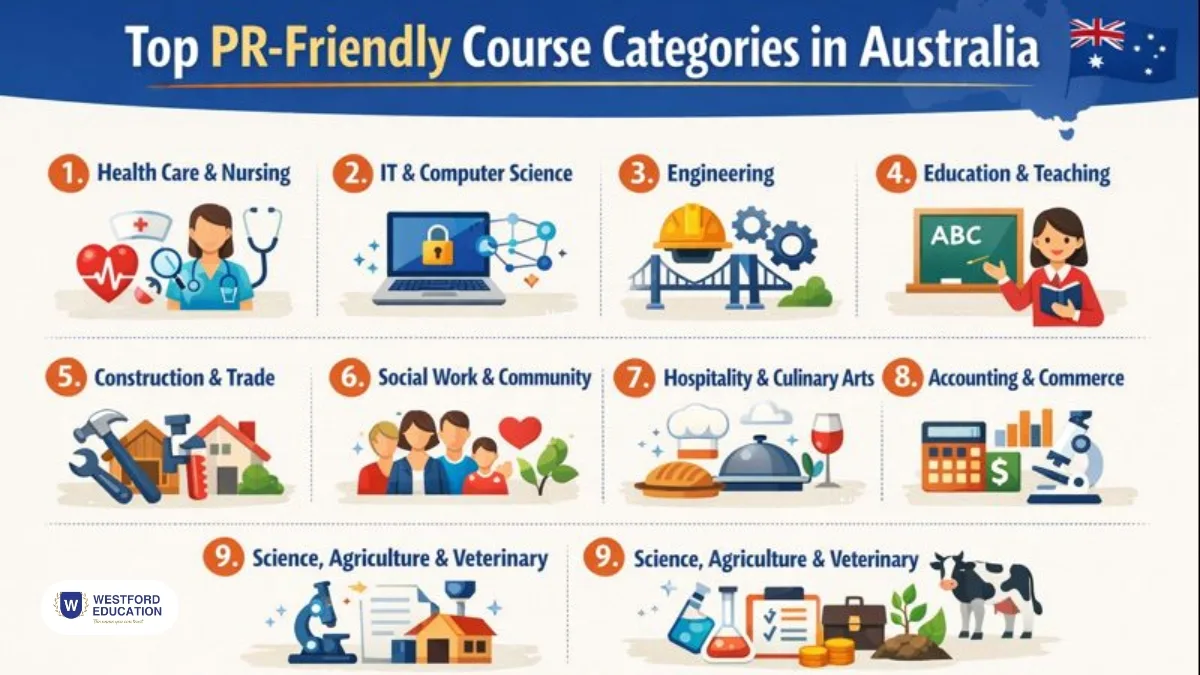
Australia offers many PR-friendly courses across different fields, giving Nepalese students multiple options to align their studies with career growth and permanent residency goals. These courses are designed to meet skill shortages and improve both job prospects and PR eligibility.
Below are the most sought‑after PR‑friendly courses in Australia that Nepalese students commonly choose to maximize both career prospects and PR chances:
1. Health Care and Nursing
The healthcare field is always one of the best places to study public relations in Australia. Healthcare jobs, especially nursing and allied health jobs, are always in demand across the country and are often on the MLTSSL.
Key Courses:
- Bachelor’s or master’s degree in nursing
- Allied Health programs (Physiotherapy, Occupational Therapy)
- Public Health and Aged Care certifications
In‑Demand Roles:
- Registered Nurse
- Physiotherapist
- Occupational Therapist
- Aged‑care Specialist
Why It’s PR‑Friendly:
There will always be a need for nurses and other healthcare workers in Australia because the population is getting older and the need for healthcare is growing. Graduates can apply for skilled migration visas, such as subclasses 189, 190, and 491, which can help them get permanent residency.
Recommended Read: Australian Visa Interview Questions and Answers
2. Information Technology (IT) & Computer Science
Australia’s digital economy is still growing quickly, so IT and computing are still two of the best fields for students on the PR track. People in many fields agree that IT skills are important and often put them at the top of their lists.
Key Courses:
- Bachelor’s degree in IT or Computer Science
- Master of Cybersecurity
- Master of Data Science
- Specializations in Networking & Software Engineering
Roles in Demand:
- Software Engineer / Developer
- Data Analyst
- Network Engineer
- Cybersecurity Specialist
Why It’s PR‑Friendly:
IT occupations are numerously listed on Australia’s skilled occupation frameworks, and graduates often qualify for points‑tested visas or state nomination.
3. Engineering
Engineering graduates enjoy strong job prospects and clear PR pathways. Almost all major disciplines — civil, mechanical, electrical, etc. are recognized as critical skills for Australia’s infrastructure and technology sectors.
Top Specializations:
- Civil Engineering
- Mechanical Engineering
- Electrical & Electronics Engineering
- Environmental & Mining Engineering
Why It’s PR‑Friendly:
Australian infrastructure development and industrial expansion mean that engineers are always needed. These roles usually appear on the MLTSSL, improving your skilled migration eligibility and point score.
4. Education and Teaching
If you are passionate about shaping future generations, teaching and education courses offer both fulfilling careers and strong PR options.
Recommended Courses:
- Bachelor’s/Master’s of Teaching
- Early Childhood Education
- TESOL & Secondary Education
Why It’s PR‑Friendly:
Australia continuously needs qualified educators, especially in early childhood education and regional schools, making it a valuable choice for migration pathways.
Recommended Read: Best Consultancy For Australia in Nepal
5. Construction and Trade Courses
Trade and construction skills are vital for Australia’s infrastructure and housing sectors. Vocational Education and Training (VET) pathways are especially effective for hands‑on learners.
Popular Courses:
- Certificate III/IV in Carpentry, Plumbing, and Electrical
- Diploma of Building and Construction
- Automotive Technology (Mechanic)
Why It’s PR‑Friendly:
Trades are very common on the MLTSSL and other lists, especially in regional Australia. This helps graduates get a state nomination, which is a great way to get PR.
6. Social Work & Community Services

Social workers and community service professionals are essential to Australia’s social infrastructure, making related courses solid choices for PR.
Recommended Programs:
- Bachelor’s/Master’s of Social Work
- Community Services & Counseling
In‑Demand Roles:
- Welfare officer
- Family support worker
- Aged care and rehabilitation services
Why It’s PR‑Friendly:
Social work is frequently needed across urban and regional centres, with occupations regularly recognized in migration planning.
Recommended Read: Document Checklist for Student Australian Visa
7. Hospitality & Culinary Arts
The hospitality industry is always changing, and there are practical, skills-based courses that can lead to good jobs and the chance to get a PR, especially in regional areas.
Key Courses:
- Diploma in Hospitality Management
- Certificate in Commercial Cookery
In‑Demand Roles:
- Chef
- Restaurant Manager
- Event Coordinator
Why It’s PR‑Friendly:
While the hospitality pathway can be competitive, many roles, such as commercial cookery, are listed as skilled occupations, especially in regional zones.
8. Accounting & Commerce
International students can still find good jobs in accounting and finance, which are both fields that are very similar to PR.
Courses to Consider:
- Bachelor’s / Master’s of Accounting
- Master of Finance
Roles in Demand:
- Accountant
- Taxation Analyst
- Auditor
Why It’s PR‑Friendly:
Accounting is often included on Australia’s skilled occupation listings and yields strong employment options, especially when combined with professional certifications like CPA or CA Australia.
Recommended Read: How to Find the Right Consultancy to Apply Australia?
9. Science, Agriculture & Veterinary Services
Science and agriculture are crucial for Australia’s rural economies and food security, making certain specialities excellent options for PR‑aligned study, especially if coupled with regional study plans.
Sample Courses:
- Veterinary Science
- Agricultural Science
- Horticulture
Why It’s PR‑Friendly:
Jobs in agriculture and veterinary services are often in demand in regional centres. They can also help people move to other places by sponsoring them through local streams.
Planning to study in Australia for PR? Get personalized advice on PR-friendly courses, visas, and regional study options with Westford’s expert team.
Apply with confidence — Contact Westford Education Now!
How to Choose the Right PR Course for Nepalese Students?

Choosing the right PR-friendly course in Australia starts with clearly defining your career and PR goals. Choose a course that fits your skills, interests, and long-term plans for moving, and make sure it leads to a job that is in demand.
Always check course recognition and curriculum to ensure the qualification is accredited and accepted for skills assessment in Australia. You should also think about the learning style, length of the course, and total cost, since some PR-aligned programs need more time and money to complete.
Equally important is the quality of education and support you receive. Evaluate faculty experience and industry exposure, as practical training, internships, and real-world projects improve employability.
Finally, look for alumni success and strong career support services, such as job placement assistance and industry connections, which can significantly strengthen your chances of securing skilled work and progressing toward permanent residency.
Key Considerations for Your PR Pathway
When planning your Australia PR journey, it’s important to understand how the points-based migration system works. Factors such as age, English language proficiency, educational background, and skilled work experience directly affect your PR score, so improving these areas can significantly strengthen your application.
- Age Factor
- English Language
- Educational Qualification
- Skilled Work Experience
- Points-Based Migration System
- Regional Study Advantage
- State Nomination Opportunities
- Temporary Graduate Visa (Subclass 485)
- Occupation Demand List
- Long-Term PR Planning
Steps to Maximize PR Points After Graduation:
- Complete a PR-friendly Bachelor’s or Master’s degree
- Gain relevant work experience on Subclass 485
- Improve English scores (IELTS/PTE)
- Choose a regional study or employment
- Apply for state nomination if eligible
Final Thoughts
PR-friendly courses in Australia offer Nepalese students more than just an internationally recognized qualification. They provide a clear pathway to skilled migration by aligning education with occupations in demand, improving PR points, enabling post-study work opportunities, and offering extra advantages through regional study. By choosing the right course in fields such as healthcare, IT, engineering, education, trades, or agriculture, students can build strong careers while steadily working toward permanent residency.
Since PR rules, occupation lists, and state requirements can change, consulting an experienced education or migration expert is highly recommended. Professional guidance can help you select the most suitable PR-friendly course based on your background, goals, and budget, ensuring you make informed decisions and maximize your chances of long-term success in Australia. Contact Westford Education Today!
FAQs
What are PR-friendly courses in Australia?
PR-friendly courses are study programs that lead to occupations in high demand in Australia, making graduates eligible for skilled migration and permanent residency pathways.
Which courses give the highest chance for PR?
Courses in healthcare, IT, engineering, teaching, and skilled trades usually offer stronger PR chances because these fields face ongoing skill shortages.
Does studying in regional Australia improve PR points?
Yes, studying in regional areas can provide extra migration points and better access to state nomination and regional visa options.
How long should I work after graduation for PR eligibility?
Most students need at least 1–2 years of relevant skilled work experience after graduation to strengthen their PR application.
Are all nursing and IT courses PR-friendly?
No, only courses that are accredited and aligned with skilled occupation lists and skills assessment requirements are considered PR-friendly.