

MD-115: Australia’s New Student Visa Directive
The Australian Government introduced MD‑115 in November 2024, and it will officially take effect on 14 November 2025. This new rule replaces the older Ministerial Direction 111, which used to guide how student visas were processed. The update is part of the government’s bigger plan to manage the growing number of international student applications while making sure Australia’s education system stays fair, transparent, and trustworthy.
Under MD-115, the government has introduced a three-tier system that gives priority to education providers with a strong record of compliance and genuine student outcomes. This means that universities and colleges with better performance and integrity will have their students’ visa applications processed faster.
The main goal of MD-115 is to make the visa process more transparent, fair, and efficient, while ensuring that genuine international students are supported and that Australia’s education system maintains its global reputation.
In simple words, MD-115 is Australia’s new way of managing student visa applications — focusing on trust, accountability, and quality among education providers.
What Is MD-115?
Ministerial Direction 115 (MD-115) is an official guideline introduced by the Australian Department of Home Affairs (DHA) that explains how student visa applications are prioritized and processed. In simple words, it’s a new system that tells immigration officers which applications to look at first and how they should be handled.
It helps the Department of Home Affairs decide the order and manner in which student and student guardian visas are processed. The goal is to make the system clearer, fairer, and more consistent for both students and education providers.
Why This Directive Matters for International Students?

MD‑115 changes the way student visa applications are handled, putting more focus on the education provider rather than just the student. Starting 14 November 2025, applications lodged offshore are processed based on a three-tier system linked to the provider’s performance.
If your chosen university or college is well within its allocated number of new international students, your application may fall into Priority 1, which usually means faster processing. Providers approaching or exceeding their limits may place students in Priority 2 or 3, where processing could take longer.
This doesn’t mean your visa will be rejected, every application is still carefully assessed based on your finances, English skills, and meeting the Genuine Temporary Entrant (GTE) requirements. However, it does show why picking a reliable, high-quality provider matters, because the institution you choose can affect how quickly your visa is processed.
In short, MD‑115 encourages students to pick reputable institutions and helps Australia maintain a fair, transparent, and efficient visa system that supports genuine international students.
Want a better counselling for abroad studies? Westford Education will provide you guidance and help you in your visa process.
MD‑111 vs MD‑115: What’s Different?
The Australian Government updated its student visa rules. MD‑111 is being replaced by MD‑115. Under MD‑111 the focus was more on the student’s background and risk. Under MD‑115 the focus shifts to the education provider and how well they comply with regulations and meet enrolment thresholds. This change affects how fast visa applications are processed and why choosing the right institution is more important than ever.
Feature | MD‑111 | MD‑115 |
Effective Date | Introduced 19 Dec 2024 for offshore Subclass 500 visa applications. | Comes into effect on 14 November 2025. |
Focus | Mainly on student risk and balancing new student commencements across providers. | Mainly on education provider performance (allocation of new overseas student commencements, compliance, etc.). |
Priority Structure | Two-tier: High priority until provider reaches about 80% of its allocation, then standard priority. | Three‑tier: Priority 1 (fast), Priority 2 (standard), Priority 3 (slow) based on provider meeting thresholds. |
Transparency | Moderate. Some thresholds publicly discussed, but fewer layers. | Higher transparency: clear rules about “indicative allocations”, thresholds (e.g., under ~80%, between ~80‑115%, over ~115%). |
Provider Accountability | Growing emphasis, but less detailed pathways for provider performance. | Strong emphasis: compliance, integrity, meeting allocations, and student‑outcome metrics matter. |
Impact on Students | Processing priority depended mostly on student’s profile and provider’s new student commencement status up to ~80%. | Processing priority depends heavily on which provider you choose, and whether that provider is under or over its allocation thresholds. |
Goal / Purpose | To manage the growth of international students and increase fairness across providers following previous directions. | To further strengthen the integrity and sustainability of Australia’s international education sector, ensure providers meet allocations, and roll out the “managed growth” model. |
Don’t be late! Prepare now to study in Australia. For proper guide, rely on Westford Education.
The MD‑115 Three-Tier Student Visa Processing System
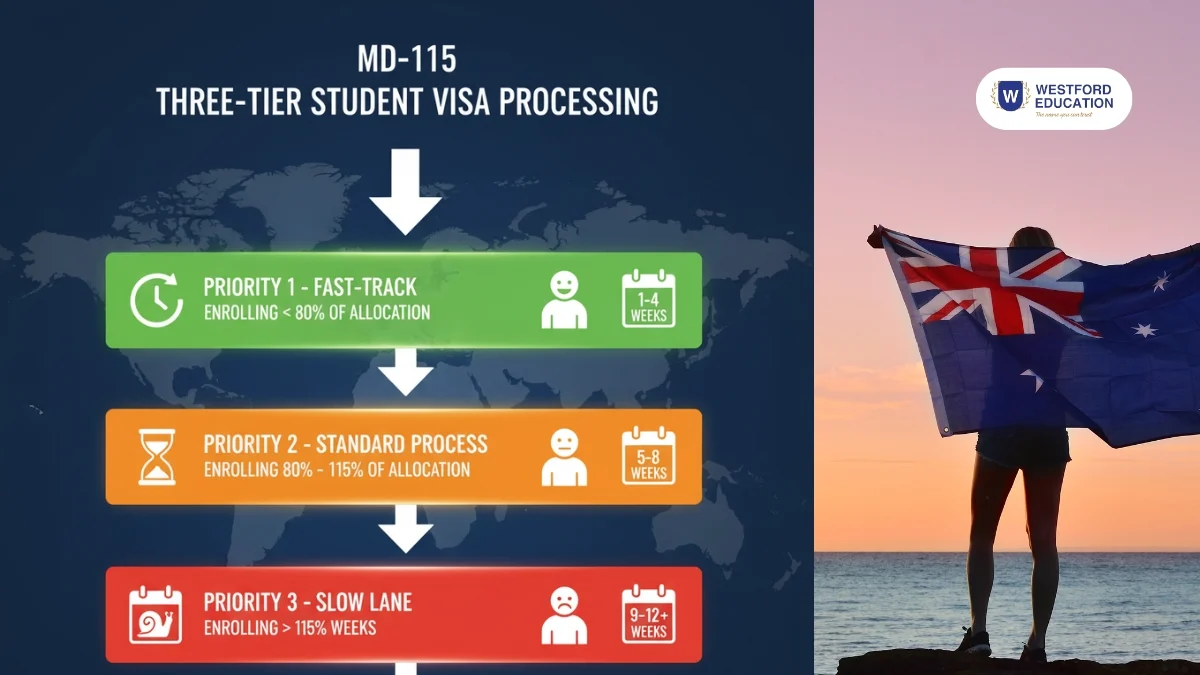
MD‑115 sorts student visa applications into three tiers based on how many new students a provider has enrolled relative to its allocated limit:
Priority 1 – Fast-Track
- Providers enrolling less than 80% of their allocation fall into this tier.
- Students applying through these providers may have their visas processed faster.
- Industry estimate for processing: 1–4 weeks
Priority 2 – Standard Process
- Providers enrolling 80% to 115% of their allocation fall here.
- Visa processing is standard and may take longer than Priority 1.
- Industry estimate: 5–8 weeks
Priority 3 – Slow Lane
- Providers exceeding 115% of their allocation are in Priority 3.
- Visa applications may be processed more slowly.
- Industry estimate: 9–12+ weeks
What it means for students:
- Choosing a Priority 1 provider could get your visa processed faster.
- Priority 3 doesn’t mean your visa will be rejected; it just takes longer.
- Always make sure you fulfill all conditions for a visa, including financial capability, English proficiency, and health examinations.
Key Objectives of MD‑115
MD-115 is more than just guidelines; it reflects the Australian Government’s aims for regulating international students and education providers. Here’s what it attempts to achieve in simple terms.
- Strengthen the integrity of Australia’s international education sector: The government wishes to guarantee that students, educators, and agents all behave appropriately. This protects students from dishonest behaviors and makes the system fair for all.
- Reward compliant providers: Universities and colleges that follow regulations, provide high-quality education, and manage student numbers properly are given priority. Students enrolling in these institutions may have their visa applications processed faster
- Ensure faster visa outcomes for genuine students: MD-115 intends to speed up visa processing for legitimate students who choose reliable suppliers. Choosing the appropriate institution can make a significant impact in how quickly your visa is issued.
- Support managed growth of international education: Instead of letting student numbers grow without control, MD‑115 helps Australia manage the growth of its international education sector. This ensures that resources, student support, and quality standards remain strong for everyone
How MD‑115 Impacts International Students?

For students from Nepal and other South Asian countries planning to study in Australia, MD‑115 brings some important changes. Here’s what you should know
- Check your chosen provider: Before applying, find out how your university or college is performing. Ask about how many new international students they are enrolling and how many places they are allocated. This helps you estimate which priority tier you might fall into.
- Prefer Priority 1 providers: If possible, choose a provider likely to fall under Priority 1. Students at these institutions generally have faster visa processing, which can save time and stress.
- Prepare your documentation carefully: Because the system now expects higher standards, make sure your paperwork is complete and accurate. This includes:
- Proof of enrolment (Confirmation of Enrolment or COE)
- Financial documents showing you can support yourself (bank statements, scholarships)
- English language test results
- Proof that you fit the requirements for being a Genuine Temporary Entrant (GTE)
- Choosing a “Priority 1” institution: The government doesn’t publish a public list of which provider is in which tier. You can ask your education consultant or the provider directly about their student allocation and enrolment status. Transparency here can make a big difference for your visa process.
Documentation and compliance tips
- Have your offer letter and COE ready as soon as possible
- Keep your financial proof updated and clear
- Make sure you meet English language and course requirements
- Be honest and transparent in your visa application — MD‑115 means the system is watching provider compliance more closely than before
Recommended Read: Document Checklist for Australian Student Visa
What’s Next for Australia’s Education Policy?
The Australian Government calls its approach to international education a plan for “managed growth”, not unlimited expansion. The goal is to balance welcoming students with maintaining high quality and good outcomes.
Key developments to know
- The government has set a National Planning Level (NPL) of 295,000 new overseas student commencements for 2026.
- All active providers will receive at least the same number of student places as in 2025.
- Additional growth will be given to providers who meet certain priorities, such as engaging with Southeast Asia or investing in student housing.
- Upcoming reforms may focus on student housing, regional campus support, and transnational education, which allows students to study partly in their home country.
- The aim is to ensure a good student experience while keeping international education sustainable.
What this means for students
- Your choice of provider is more important than ever.
- Institutions meeting government priorities are likely to be favoured for faster visa processing.
- Providers investing in student housing or strong regional campus support may offer better student experiences.
- Even though the NPL sets a planning target, it is not a strict limit on enrolling genuine international students.
- Providers must meet higher standards to grow and maintain quality education.
Final Thoughts
So, what does MD-115 mean for you?
MD‑115 marks a big shift in how Australia processes student visas. Unlike the old MD‑111, it focuses more on the education provider than just the student. This means the university or college you choose can affect how quickly your visa is processed and the overall support you receive.
The three-tier system, key objectives, and managed growth policy all aim to ensure high-quality education, fair access, and smooth visa processing for genuine students. Choosing a trusted, compliant provider has never been more important.
Get in touch with Westford Education right now for individualized advice on navigating MD-115 and locating the ideal Australian university. Our staff can support you in making wise decisions and confidently planning your academic path.
FAQs
What does MD‑115 stand for?
MD‑115 stands for Ministerial Direction No. 115. It is the Australian Government’s latest rule for processing international student visas and focuses on the performance of education providers.
When did MD‑115 come into effect?
MD‑115 became effective on 14 November 2025.
What are the three tiers of MD‑115?
MD‑115 uses a three-tier system to prioritize visa applications based on provider performance:
- Priority 1 – Fast-track: Providers with less than 80% of their allocated student intake. Applications are processed quickly.
- Priority 2 – Standard: Providers with 80%–115% of their allocation. Processing is moderate.
- Priority 3 – Slow lane: Providers exceeding 115% of their allocation. Applications may take longer.
How does MD‑115 differ from MD‑111?
MD‑115 introduces a third tier, links visa priority explicitly to provider performance, and sets clear thresholds for intake (80% and 115%). MD‑111 focused mainly on student risk rather than provider compliance.
Who does MD‑115 apply to?
It applies to all education providers for international students in Australia, including universities, colleges, and vocational education (VET) providers. It affects offshore student visa applications (Subclass 500).
How will MD‑115 impact Nepali students applying to Australia?
Students from Nepal should choose their provider carefully. If your institution falls under Priority 1, your visa is likely to be processed faster. Providers in lower tiers may mean longer processing times.
Will MD‑115 speed up visa processing times?
For students enrolled in Priority 1 providers, visa processing is expected to be quicker. For Priority 2 and 3 providers, processing may take longer than under the old MD‑111 rules.
Where can I find official MD‑115 documents?
Official information can be found on the Australian Government’s Department of Home Affairs and Department of Education websites, including media releases and guidance on MD‑115.