
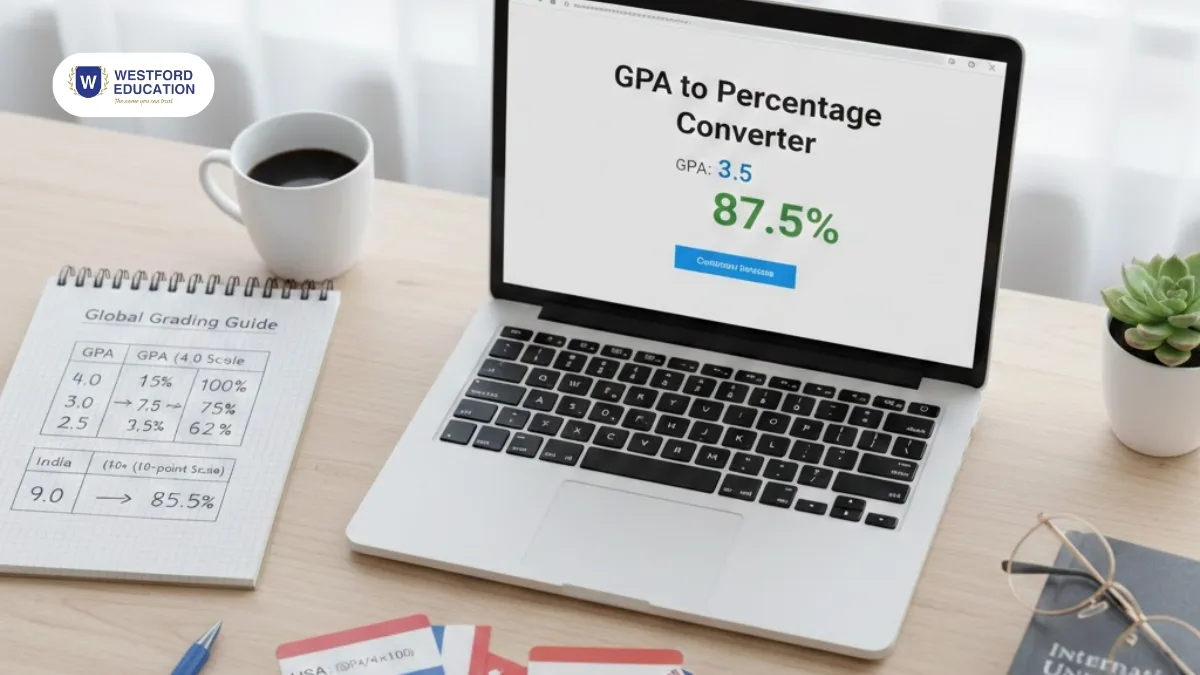

A Comprehensive Guide to Convert GPA to Percentage
Converting GPA to percentage basically means taking your Grade Point Average and turning it into a score out of 100, so people in different schools can actually tell how you’re doing. A lot of the time, you have to do this for college applications or if you’re trying to get a scholarship, especially if the place you’re applying to uses percentages instead of points.
So, you need to convert your GPA to a percentage. Perhaps you’re trying to compare your marks to someone who uses a completely different system, or perhaps you’re applying to a university that employs percentages. Whatever the reason, it’s actually very basic once you grasp the method.
The truth is, there’s no single universal method for GPA to percentage conversion because different countries, boards, and institutions adopt different grading standards. But don’t worry, this guide will walk you through the most common methods so you can easily identify which one applies to your situation.
What is GPA?
GPA stands for Grade Point Average. It’s basically a numerical representation of your academic success, usually evaluated on a scale. Depending on where you studied, the most popular scales are 4.0, 5.0, or 10.0.
For instance, the majority of US institutions employ a 4.0 scale, where an A is 4.0, a B is 3.0, a C is 2.0, and so forth. A 10-point system or something entirely different may be used in other nations.That’s why knowing your scale is step one.
Why Convert GPA to a Percentage?
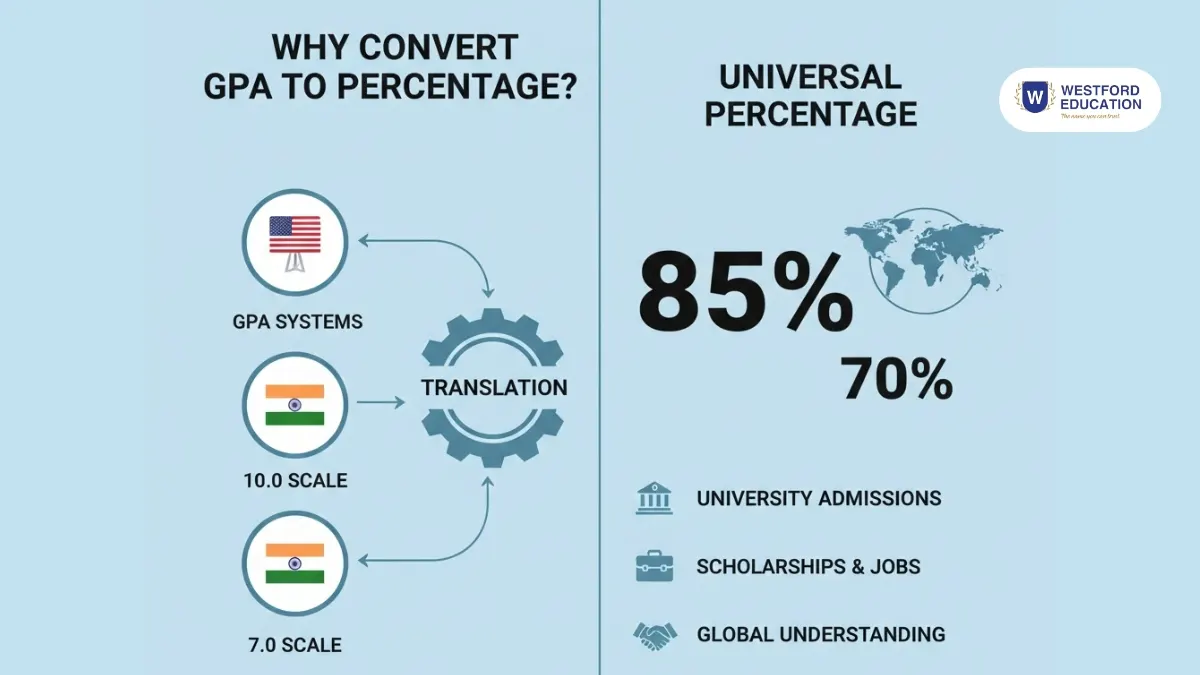
Converting GPA to a percentage is simply about translating your academic performance into a grading format that others can easily understand.
Honestly, it’s mostly about making your grades understandable across different systems. Universities in some countries prefer percentages, so if you studied somewhere that uses GPA and you’re applying to a school that wants percentages, you’ll need to convert. Otherwise, they won’t really know what your 3.7 GPA means in their system.
Plus, sometimes employers or scholarship programs ask for percentages instead of GPA. It’s just about speaking the same language, grade-wise.
Planning to study abroad but unsure how your GPA translates to percentages for admissions? Contact Westford Education Consultancy today and let our experts help you with GPA conversion and university applications.
How to Convert GPA into Percentage?
Converting GPA to percentage involves using standard formulas or institution-specific conversion scales to translate your Grade Point Average into a percentage score. Basically, since schools and countries all have their own ways of doing things, there isn’t just one magic way to do it. You usually have to use a specific math formula, check out a chart, or just follow the rules your school sets.
Here’s where things get real. There are a few different formulas floating around, and which one you use depends on your specific situation.
Recommended Read: Best Cities in Australia For Nepalese Students
Method 1: The Simple Multiplication Formula (For 4.0 Scale)
This is probably the most common method, especially if you’re on a 4.0 scale.
GPA to percentage formula:
Percentage = (GPA ÷ 4.0) × 100
So if your GPA is 3.5, you’d do this:
(3.5 ÷ 4.0) × 100 = 87.5%
Pretty simple, right?
This approach works on the idea that a 4.0 GPA is the same as 100%. A lot of people utilize it, but it’s not necessarily right for every school. It still works as a rough estimate when you need a quick answer.
Method 2: The Indian Standard Formula
In India and some other countries, there’s a slightly different approach that’s become pretty standard.
Formula:
Percentage = GPA × 9.5
Using the same 3.5 GPA example:
3.5 × 9.5 = 33.25%
Wait, that seems really low, right? That’s because this formula is typically used when your GPA is already on a 10-point scale, not a 4.0 scale.
If you’re converting from a 10-point GPA system and you have, say, a 9.2 GPA:
9.2 × 9.5 = 87.4%
That makes way more sense.
Recommended Read: Complete Guide to Study in Australia
Method 3: Direct Percentage Conversion (For 10.0 Scale)

Some schools make it even easier. If you’re on a 10-point scale, they just multiply by 10.
Formula:
Percentage = GPA × 10
So a 9.0 GPA becomes 90%. Simple as that.
Honestly, check with your school first because some institutions have their own specific conversion charts. I’ve seen places that use completely different multipliers, so you don’t want to assume.
GPA to Percentage Conversion Chart
Here’s a quick reference table for the 4.0 scale using the standard multiplication method:
GPA | Percentage |
4.0 | 100% |
3.9 | 97.5% |
3.8 | 95% |
3.7 | 92.5% |
3.6 | 90% |
3.5 | 87.5% |
3.4 | 85% |
3.3 | 82.5% |
3.2 | 80% |
3.0 | 75% |
2.8 | 70% |
2.5 | 62.5% |
2.0 | 50% |
And for the 10-point scale (using the ×9.5 method):
GPA | Percentage |
10.0 | 95% |
9.5 | 90.25% |
9.0 | 85.5% |
8.5 | 80.75% |
8.0 | 76% |
7.5 | 71.25% |
7.0 | 66.5% |
6.5 | 61.75% |
6.0 | 57% |
These charts give you a rough idea, but always verify with your specific institution’s guidelines.
Recommended Read: Education Loans in Nepal For Study Abroad
GPA to Percentage Conversion for Different Countries
The conversion method can change based on where you’re applying. It’s kind of annoying, but here’s a quick breakdown:
United States
India
India typically uses the 10-point scale with the ×9.5 multiplier. This is especially common for engineering and technical programs.
Some Indian universities also accept direct 10× conversion, so it varies. When in doubt, ask the university directly.
UK and Europe
In the UK, they often use a different grading system altogether like first class, upper second class, lower second, and so on. Converting GPA to a percentage for UK schools can be tricky.
Many European universities use the ECTS grading scale, which is yet another system. You might need to convert GPA to ECTS first, then to a percentage. It’s a bit of a pain.
Australia
Australian universities that use GPA typically follow either a 4-point scale or a 7-point scale. The approximate percentage equivalents are:
4-Point GPA | 7-Point GPA | Percentage (%) |
4 | 7 | 85 – 100 |
3 | 6 – 6.99 | 75 – 84 |
2 | 5 – 5.99 | 65 – 74 |
1 | 4 – 4.99 | 50 – 64 |
0 | 0 – 3.99 | 0 – 49 |
Canada

Canadian GPA systems vary by province. Here’s a simplified view of the main systems:
- Alberta Grading System
Letter Grade | GPA Points |
A+ | 4.3 |
A | 4.0 |
A- | 3.7 |
B+ | 3.3 |
B | 3.0 |
B- | 2.7 |
C+ | 2.3 |
C | 2.0 |
C- | 1.7 |
D | 1.3 |
- Ontario Grading System
Letter Grade | Percentage (%) | GPA Points |
A+ | 95 – 100 | 10 |
A | 87 – 94 | 9 |
A- | 80 – 86 | 8 |
B+ | 77 – 79 | 7 |
B | 73 – 76 | 6 |
B- | 70 – 72 | 6 |
C+ | 67 – 69 | 5 |
C | 63 – 66 | 4 |
C- | 60 – 62 | 4 |
D+ | 57 – 59 | 3 |
D | 53 – 56 | 2 |
E | 50 – 52 | 1 |
F | 0 – 49 | 0 |
- British Columbia Grading System
Letter Grade | Percentage (%) |
A | 86 – 100 |
B | 73 – 85 |
C+ | 67 – 72 |
C | 60 – 66 |
C- | 50 – 59 |
F | 0 – 49 |
Other marks:
- I – Incomplete assignments (0–49%)
- W – Withdrawn
- P – Passed but grade not available
- Saskatchewan Grading System
Letter Grade | Percentage (%) | Interpretation |
A+ | 90 – 100 | Exceptional |
A | 80 – 89 | Excellent |
B | 70 – 79 | Good |
C | 60 – 69 | Satisfactory |
D | 50 – 59 | Barely acceptable |
F | 0 – 49 | Unacceptable |
By knowing how these grading systems work, students can accurately turn their GPA into percentage representations. It just makes things way easier when you’re applying to different schools, trying to get scholarships, or looking at professional programs. Plus, it helps everyone stay on the same page when they’re looking at applications from all over the world.
Recommended Read: Study in Canada
How to obtain a high GPA score?
If you’re wondering how to obtain a high GPA score, there are several strategies you can follow to improve your academic performance and maximize your grades:
- Stay organized and manage your time – Plan your study schedule, meet deadlines, and avoid last-minute cramming.
- Attend classes and participate actively – Regular attendance and engagement help you understand concepts better and perform well in exams.
- Focus on understanding, not just memorizing – Deep comprehension of subjects ensures long-term retention and better grades.
- Seek help when needed – Don’t hesitate to ask teachers, peers, or tutors if you’re struggling with a topic.
- Review and revise regularly – Consistent revision reinforces learning and prepares you for exams effectively.
Following these tips can help students raise their GPA and do better on GPA to percentage conversion tests when they apply to schools outside the US.
Want personalized guidance to boost your GPA and improve your chances for top universities abroad? Connect with Westford Education Consultancy today and get expert support tailored to your goals.
Final Thoughts
Converting GPA to percentage isn’t rocket science, but it does require paying attention to the details. The biggest thing is knowing which scale you’re working with and which formula applies to your situation. Get that right, and you’re basically done.
Honestly, the safest move is to check with the specific institution you’re dealing with. Most universities have clear guidelines somewhere on their website, and some will even do the conversion for you. Don’t stress too much about getting it perfect on your own if there’s official help available. Use it.
At the end of the day, grades are just one part of your application or profile. Yeah, they matter, but they’re not everything. Focus on presenting your academic record accurately and honestly. Whether it’s a GPA or a percentage, what matters most is that you’ve put in the work and can demonstrate that clearly. The conversion is just paperwork—your actual achievements are what count.
Need help with GPA conversions, university applications, or scholarships? Westford Education Consultancy is here to guide you. Book your free consultation now and get expert advice tailored to your goals
Frequently Asked Question
What is GPA and how is it calculated?
GPA stands for Grade Point Average. It’s a numerical representation of your academic performance calculated on a scale, commonly 4.0, 5.0, or 10.0 depending on the country or institution. Each grade is assigned a numeric value, and your GPA is the average of these values across all subjects.
Why do I need to convert GPA to percentage?
Converting GPA to percentage makes it way easier for colleges or jobs to see how you actually did, especially since everyone uses different systems. Basically, it just levels the playing field so things are more fair when they’re looking at your grades.
How do I convert a 4.0 GPA to a percentage?
The most common method is the simple multiplication formula:
Percentage = (GPA ÷ 4.0) × 100
For example, a 3.5 GPA would convert to 87.5%.
How is GPA converted to percentage in India?
In India, most universities use a 10-point GPA scale. The standard conversion is:
Percentage = GPA × 9.5
So a GPA of 9.2 on a 10-point scale becomes 87.4%.
Are there different GPA to percentage conversions for different countries?
Yes. Each country may have its own GPA scale and conversion method. For example:
- USA: mostly 4.0 scale, (GPA ÷ 4.0) × 100
- India: 10-point scale, GPA × 9.5
- Australia: 4-point or 7-point scale with specific percentage ranges
- Canada: province-specific GPA systems with letter grades and points
How can I improve my GPA?
To achieve a high GPA, students should:
- Stay organized and manage time effectively
- Attend classes and participate actively
- Focus on understanding concepts, not just memorizing
- Seek help from teachers or tutors when needed
- Review and revise regularly
Is GPA to percentage conversion accurate everywhere?
Not always. Some institutions have their own conversion charts or internal methods. Always check with your school or university to ensure the correct conversion.
Can GPA conversion affect my scholarship or admission applications?
Yes. Using the correct GPA to percentage conversion ensures your academic performance is presented clearly, helping universities or scholarship committees evaluate your application accurately.