

Complete Guide to Study in Australia from Nepal
This guide is for Nepali students who want to study in Australia and need a full step-by-step plan. It explains everything from picking the right course and university, getting money ready, meeting English and visa requirements, to working during school and after you graduate. With this guide, students can plan and apply on their own without having to check a bunch of different places.
Australia is a place a lot of Nepali students go because the degrees are respected everywhere, the cities are safe, there are plenty of other Nepalis there, and it’s not too hard to find a job. Students also get to work after they graduate, go to school with people from all over, and get a degree that’s recognized globally, which helps them set up a good life later on.
This guide will help students understand every part of the process clearly. From choosing the right course and university to managing finances, applying for a visa, and preparing to live and work in Australia, it gives all the details so students can follow it step by step and avoid mistakes that could cause delays or visa rejection.
Why Study in Australia as a Nepali Student?
Australia is one of the top places where people want to go to school, especially for anyone thinking about Study in Australia from Nepal. Basically, it’s because the schools there are really good and people all over the world actually respect the degrees you get.
Australian universities are ranked high on those global lists, and honestly, bosses and other schools everywhere accept them without any issues. Choosing to Study in Australia from Nepal means you get a degree that’s worth a lot, plus you get to be part of a modern Australia education system that’s actually built for students.
Key Reasons Nepali Students Choose Australia:
- Globally recognized degrees that improve job prospects worldwide
- Post-study work opportunities through the Temporary Graduate visa
- Part-time work rights during studies to help manage living expenses
- Safe and welcoming environment with strong student support services
- Large Nepali community in major cities for cultural comfort
- Multicultural exposure that builds communication and life skills
Recommended Read: Why Study in Australia?
Along with academic excellence, Australia offers a balanced lifestyle that supports both personal and professional growth. Basically, if you look at the good schools, the jobs you can get, and how safe it is, it’s a really smart move. Plus, getting that global experience is a huge deal. It’s a solid long-term investment for anyone thinking about Study in Australia from Nepal who wants a real career and a better future.
Thinking about studying in Australia? Get expert guidance on course selection, visa requirements, and financial planning with Westford Education to start your journey the right way.
Australian Education System for Nepali Students
The Australia education system is famous all over the world, which is why so many people from Nepal want to go there. Honestly, it’s pretty flexible because it gives you different options depending on what you want to study or how you like to learn. You can pick from all kinds of schools and degrees that actually fit your career goals and what you’re good at.
There are different types of institutions to choose from:
- Universities – Offer programs from diplomas to PhDs and are recognized globally.
- TAFE colleges – Focus on practical, hands-on skills and vocational training.
- Private colleges – Provide specialized courses and flexible study options.
Students can also choose from different degree levels. If you choose the best consultancy for Australia in Nepal, they will guide you on these:
- Diploma – Short programs giving practical knowledge.
- Bachelor’s – Undergraduate degrees, usually 3–4 years.
- Master’s – Postgraduate degrees for specialization, usually 1–2 years.
- PhD – Research-focused degrees for academic or research careers.
This structure helps Nepali students find the right institution and degree level while earning a qualification that is recognized internationally.
Recommended Read: Before selecting a university or college, students are strongly advised to ensure the institution is listed under the Ministry Directory (MD-115) or recognized by the relevant education authorities.
Intakes in Australia for Nepali Students
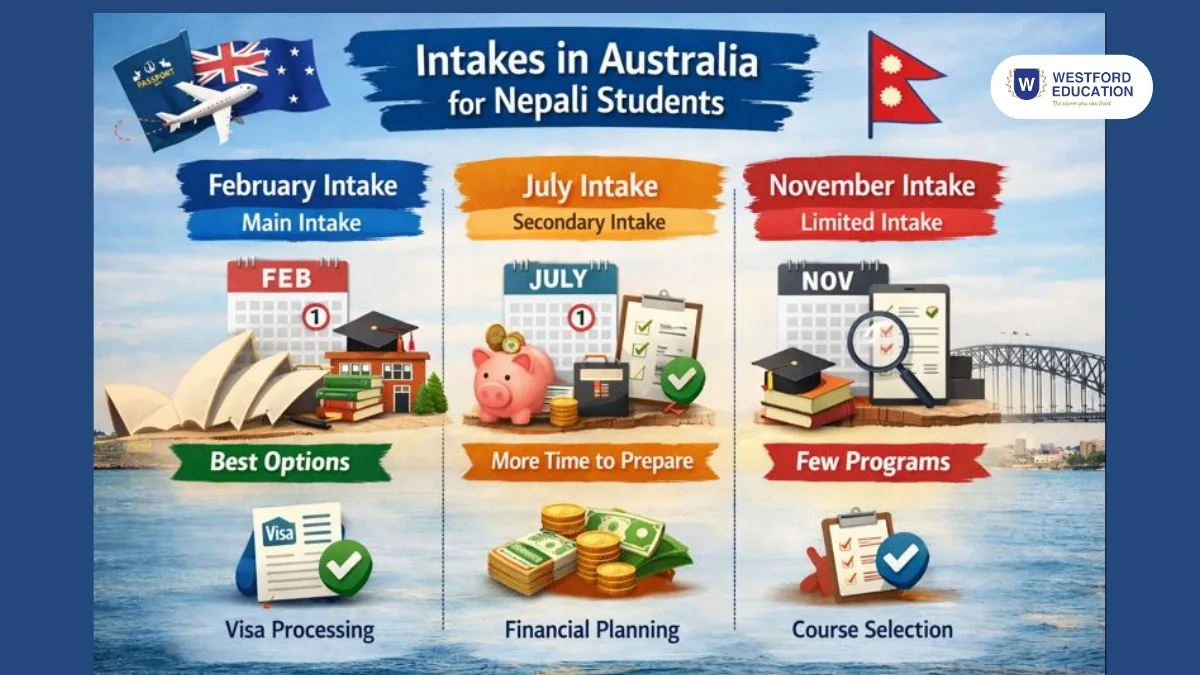
Students planning to Study in Australia from Nepal have a few different times when they can actually start their classes. It’s pretty important to pick the right one because it changes which courses are open, how long the visa takes, and when you need to have your money ready.
Most universities there have three main intakes every year, so it’s nice because it gives you some extra flexibility to plan everything ou
The major intakes for Nepali students are:
- February (Primary) –This is the main intake and it’s definitely the most popular choice. Since it’s the start of the actual academic year, basically every course and university is fully open. That makes it a lot easier for students to get in and get their programs started without any drama.
- July (Secondary) – The second intake is good for anyone who needs a bit more time to get their money together or finish up their paperwork.Some courses may have limited seats.
- November (Limited) – It’s a smaller intake and doesn’t have as many programs. Basically, it’s mostly for certain courses or specific universities, and students have to be really careful with their planning to make sure they hit the deadlines.
Selecting the right intake helps Nepali students manage visa timelines, finances, and course selection, ensuring a smoother start to studying in Australia.
Which is the Best Intake for Nepal Applicants to study in Australia?
Honestly, for Nepali students, the February intake is the way to go. It’s the one with the most courses available, and getting your visa processed is usually a lot smoother too. Plus, it gives you plenty of time to get your money and paperwork ready, which is super important now that Nepal is under Assessment Level 3 and things are being checked way more closely.
The July intake is a solid backup if you need a bit more time for your IELTS/PTE scores, or if you’re still getting your finances and documents in order. On the other hand, the November intake is pretty small and really only works for certain courses.
At the end of the day, picking the February intake helps Nepali students avoid visa delays and start their studies in Australia feeling way more prepared, which also means a much better chance of getting that visa approved.
Eligibility Requirements to Study in Australia from Nepal
To get an Australian student visa, Nepali students have to meet a bunch of academic, English, and age rules. Honestly, knowing all these eligibility details is super important if you want to avoid delays or getting your visa rejected.
These rules are basically the main part of the Australian student visa requirements Nepal and you really have to follow them closely.
Academic Requirements:
- For a Bachelor’s degree – Minimum GPA of 2.8 or equivalent from previous studies.
- For Master’s degree – Minimum GPA of 3.0 or equivalent.
English Language Requirements:
Students have to show they’re good at English by taking one of these approved tests. Basically, you’ve got quite a few choices now:
- IELTS (Academic) – Minimum overall scores: Bachelor’s 6.0 (no band <5.5), Master’s 6.5 (no band <6.0).
- PTE Academic – Accepted as an alternative to IELTS.
Age Limit for Australian Student Visa:
- Maximum age for applicants: 35 years.
You can move on to the next parts of the application without any problems if you meet these requirements for the Australia student visa from Nepal.
Recommended Read: How to Prepare IELTS at Home?
Step-by-Step Process to Study in Australia from Nepal
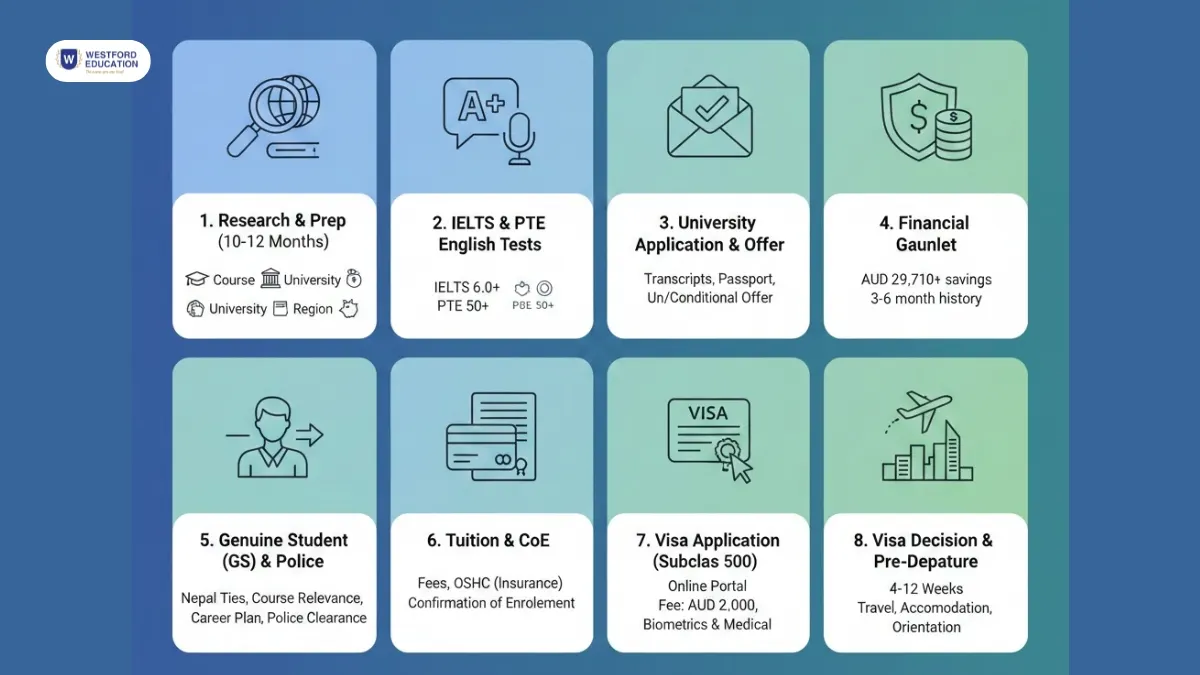
Applying to study in Australia from Nepal is now a highly regulated process because Nepal is classified under Evidence Level 3, which is considered high-risk. Every document, from academic records to bank statements, is manually verified by immigration officers. This makes the application process very strict, and even small mistakes can cause delays or visa rejection.
Preparing may seem easy at first, but it is actually time-consuming and requires careful planning. Following this Complete Guide to Study in Australia, Nepali students can prepare every step properly, stay organized, and apply confidently without missing any important requirements.
Step 1 – Research & Preparation (10–12 Months Before) (40)
The first step in the Complete Guide to Study in Australia is all about doing your homework and getting prepared. If you’re planning to Study in Australia from Nepal, you really should start getting things ready about 10 to 12 months before your course actually begins.
Starting early is super important because picking a university, waiting for your visa to process, and figuring out your money all take way longer than you’d think. This part basically builds the foundation for your whole application. It also helps you avoid making silly mistakes that could end up slowing everything down or even getting your visa rejected.
Key tasks during this stage include:
- Course selection – Decide what subject or career path you want to pursue. Consider your interests, previous studies, and long-term goals. Picking the right course is critical because it affects your visa approval and career opportunities.
- University shortlisting –Look into the different universities that have the course you want, and definitely take a look at their rankings, how good the classes are, where they’re located, and what you actually need to get in. Honestly, shortlisting a few universities is a smart move because it makes sure you still have other options if one of your applications ends up being delayed or even rejected.
- Region selection – Pick the city or state where you actually want to live and study. You should definitely think about things like living costs, the climate, how safe it is, and if there’s a big local Nepali community nearby. Plus, remember that different regions might have different courses available and various kinds of student support services too.
- Financial planning – Estimate tuition fees, living expenses, travel costs, and show money requirements. Planning finances early helps avoid last-minute problems and ensures you meet the strict Australia student visa from Nepal financial rules.
Tip: Take help from a consultancy like Westford Education to shortlist universities and courses. This guidance helps students avoid common mistakes that could lead to visa refusal and makes the application process smoother.
Recommended Read: PR-Friendly Courses in Australia
Need Help Shortlisting Courses & Universities?
Westford Education can guide you to pick the best course and university to avoid visa mistakes. Book a Free Consultation Now!!



 Trustindex verifies that the original source of the review is Google.
  Trustindex verifies that the original source of the review is Google.
  Trustindex verifies that the original source of the review is Google.
  Trustindex verifies that the original source of the review is Google.
  Trustindex verifies that the original source of the review is Google.
  Trustindex verifies that the original source of the review is Google.
  Trustindex verifies that the original source of the review is Google.
  Trustindex verifies that the original source of the review is Google.
  Trustindex verifies that the original source of the review is Google.
  Trustindex verifies that the original source of the review is Google.
 Step 2 – IELTS & PTE Requirements for Australia from Nepal
One of the biggest parts of getting ready to study in Australia from Nepal is proving you’re actually good at English by doing proper IELTS or PTE preparation. You have to do this because Australian universities and the people handling visas need to be sure that students can understand their lectures, get their assignments done, and just live on their own in an English-speaking country.
Meeting this language requirement is also a huge part of the Australian student visa requirements Nepal, so starting your test prep early really makes a difference in whether your visa gets approved or not.
Students can choose from the following accepted English tests:
- IELTS Academic – The most widely recognized test.
- PTE Academic – Accepted by most universities as an alternative to IELTS.
Minimum score requirements:
For Bachelor’s Degree:
- IELTS Academic: Overall 6.0, with no band less than 5.5
- PTE Academic: Overall score 50–57, with no communicative skill below the required level
For Master’s Degree:
- IELTS Academic: Overall 6.5, with no band less than 6.0
- PTE Academic: Overall score 58–64, with no communicative skill below the required level
Proper preparation for these tests is essential because failing to meet the minimum scores can delay your university application and visa approval.
Important: Online or at-home tests are not accepted for visa purposes. Only scores from official test centers are valid. This rule ensures compliance with both the IELTS requirement for Australia Nepal and the Australian student visa requirements Nepal.
Preparing for IELTS or PTE? Get expert-led IELTS and PTE preparation support at Westford Education with structured classes, mock tests, and score-focused strategies to meet Australia’s visa and university requirements.
Step 3 – University Application and Offer Letter
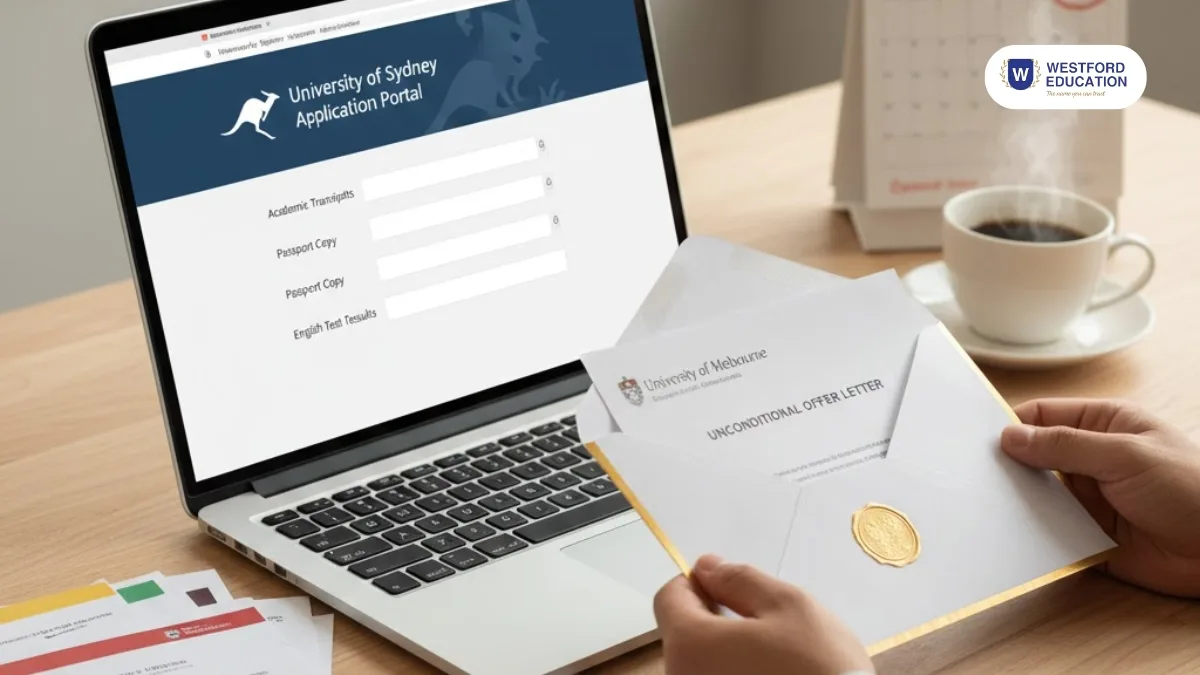
The next big step to studying in Australia from Nepal is to actually apply to the universities after you pass your English test. You have to send in all of your papers to get an official offer letter from the school. A lot of universities also give out scholarships during this part, which is awesome because it can really help lower your tuition costs.
Steps for the university application:
Submit University Application – Apply directly through the university portal or through authorized agents.
Academic transcripts – Include all records from SEE/Year 10 to the latest qualification.
Passport copy – Required for identification and visa purposes.
English test results – Provide your IELTS or PTE scores as proof of language proficiency.
Types of Offer Letters:
Unconditional Offer Letter – Admission is confirmed, and all requirements are met.
Conditional Offer Letter – Admission depends on meeting certain requirements, such as submitting pending documents or achieving specific grades.
It is important to carefully review the offer letter and understand any conditions. Scholarships offered by universities may reduce tuition fees or provide additional benefits.
Properly applying and securing an offer letter is a key step in the offer letter from Australia university process and ensures that you know how to apply to Australian universities from Nepal efficiently.
Step 4 – Financial Preparation and Documentation (“Financial Gauntlet”)
For Nepali students, getting your money stuff sorted is easily one of the most important things when you’re applying to study in Australia from Nepal. Since Nepal is now under Evidence Level 3, immigration officers are going to look over every single financial document you have really, really closely.
People often call this the “Financial Gauntlet” because even a small mistake or something that doesn’t quite match up can end with your visa being delayed or just flat-out rejected. You basically have to plan everything out and verify it all to meet the Australia student visa financial requirements and prove you can actually afford to live there while you study.
Show Money Requirement:
- Living cost: AUD 29,710
- Tuition (first year): AUD 20,000–45,000
- Travel cost: AUD 2,200
Financial History Rules:
- Funds must be clean and fully verifiable.
- Money should be held for 3–6 months before applying.
- Sudden large deposits can raise red flags with visa officers.
Sponsorship Structure:
- Primary sponsors: Usually parents.
- Secondary sponsors: Siblings, grandparents, or uncles can also contribute.
You can use a mix of your bank balance and an education loan to cover the show money for Australia student visa and your tuition. Planning your money carefully is a big deal if you want to manage the cost of studying in Australia from Nepal without getting stressed.
Taking out an education loan for Australia from Nepal is a good way to pay for those big tuition bills, but you’ve got to make sure all your paperwork is perfect if you want the visa to be approved.
Recommended Read: Document Checklist for Australian Student Visa
Step 5 – Genuine Student (GS) Requirement

The Genuine Student (GS) requirement is a key part of the Australian student visa requirements Nepal. It replaced the old Genuine Temporary Entrant (GTE) rule and is designed to check whether a student truly intends to study in Australia and return to Nepal after completing their course. This step ensures that only genuine students are granted visas, especially since Nepal is classified under Evidence Level 3.
What the GS Test involves:
- Replaces the GTE: All applicants must now meet GS criteria instead of the old GTE requirement.
- Evidence-based answers: Students need to provide clear, documented explanations for their study plans.
Key GS Evaluation Areas:
- Ties to Nepal: Family, property, and long-term commitments in Nepal.
- Course relevance: How the chosen course aligns with previous education and career goals.
- Career outcomes after return: Plans to use the skills and knowledge gained in Australia to advance a career in Nepal.
A strong GS statement is essential for visa approval. Students should provide detailed and truthful information, supported by documents where possible, to meet the GS requirement Australia Nepal. Failing to provide convincing answers can lead to visa refusal.
Character Requirement (Police Clearance)
Nepali students who want to get a Subclass 500 student visa must pass a character test to meet Australia’s legal and safety standards. Most students need a police clearance certificate from Nepal that shows they don’t have a serious criminal record.
The character check is assessed along with:
- Medical clearance – Confirms fitness to live and study in Australia.
- Genuine Student (GS) criteria – Confirms intent to study and return to Nepal.
It’s really important to make sure the certificate is actually valid and looks the way it’s supposed to. If you follow the Australian student visa requirements Nepal and really get the difference between GS and GTE, it’ll help you put together the right documents and avoid getting your visa rejected.
Basically, GS is the new way they check if you’re a real student, while GTE was the old version that mostly focused on you leaving after your studies.
Australian embassay or universities might take your interview so prepare yourself with our published Australian student visa interview questions and answers
Step 6 – Tuition Payment and Confirmation of Enrolment (CoE)
Paying your tuition and getting the Confirmation of Enrolment (CoE) is one of the most important steps in applying to study in Australia from Nepal. This part is basically visa-critical because you can’t even lodge your Subclass 500 visa without showing proof that your tuition and health cover are paid. It’s just how it works.
Required Payments:
- Initial tuition fee – Usually the first year of your course.
- Overseas Student Health Cover (OSHC) – Insurance required for all international students.
- Cost: Depends on provider and coverage (AUD + NPR).
- Coverage & exclusions: Check what’s included for medical treatment, hospitalization, and emergencies.
- Provider selection: Can be university-arranged or self-purchased.
Confirmation of Enrolment (CoE):
- Issued after payment approval.
- Mandatory for submitting your student visa application.
Properly completing these steps ensures compliance with Australian student visa requirements Nepal. Students should carefully check OSHC coverage and confirm their CoE before moving to the next stage. Knowing what is CoE Australia and the OSHC requirement for Nepali students helps avoid delays in the visa process.
Step 7 – Student Visa Application (Subclass 500)

The next step is to apply for an Australian student visa from Nepal after you get your Confirmation of Enrollment (CoE) and pay for your tuition and health insurance. The official way to apply for the Subclass 500 visa is this, and you need to pay close attention to the details.
Visa Application Process:
- Apply online – Submit your application through the Department of Home Affairs portal.
- Visa Application Fee – AUD 2,000 (as of July 2025).
- Biometrics and Medical Examination:
- Complete your medical examination and submit results via the Health Assessment Portal (HAP).
- Biometrics must be submitted after visa lodgement as instructed.
Doing all the steps the right way is basically how you make sure you meet the Australian student visa requirements Nepal. Plus, knowing the visa fee Australia student visa and the actual way to submit everything for the Australia student visa subclass 500 Nepal just helps you avoid any annoying delays or getting rejected at the last minute.
Step 8 – Visa Decision and Pre-Departure Preparation
Once you submit your Australia student visa from Nepal application, your documents are manually verified, and the visa decision is made. The processing time can take 4–12 weeks, so it’s important to plan travel and accommodation in advance.
Travel and Accommodation Options:
- On-campus housing – University-managed hostels or dorms for easy access to facilities.
- Managed student accommodation – Private apartments with student-focused services.
- Private rentals – Independent housing for more freedom and flexibility.
Orientation Week :
- Attend campus orientation to learn about university services.
- Understand your student rights and support services in Australia.
Ready to Apply for Your Student Visa?
Westford Education offers a full checklist and review to maximize your Australia student visa success.
Planning with the right consultancy and ahead helps Nepali students avoid stress and ensures a smooth start to their studies. Knowing the Australia student visa processing time Nepal and accommodation options helps students successfully study in Australia from Nepal.
Work Rights for Nepali Students in Australia (Critical Reminder)
Students from Nepal who are studying in Australia can work, but they have to follow some rules. Knowing your work rights can help you make more money while still following the rules of your visa.
Work Rules:
- During semesters: Maximum of 48 hours per fortnight.
- During holidays: Work hours are unlimited.
- Minimum wage: AUD 24.95 per hour (as of July 2025).
Following these rules ensures students meet work rights for Nepali students in Australia while balancing study and part-time employment safely.
Detailed Financial Requirements and Loans to Study in Australia from Nepal

Studying in Australia from Nepal requires careful financial planning because of strict Level 3 scrutiny. Students must meet requirements for tuition, living costs, sponsor income, and loans to ensure a smooth visa application. Planning ahead and keeping documents clean and verifiable is essential for success.
Tuition Fees in Australia for Nepali Students
The degree determines the cost of tuition in Australia. Here is a brief synopsis for students from Nepal:
Degree Level | Estimated Tuition (AUD) | Estimated Tuition (NPR) |
Bachelor’s | 20,000 – 35,000 | 17.6 – 30.8 Lakhs |
Master’s | 25,000 – 45,000 | 22 – 39.6 Lakhs |
This helps students understand the cost of studying in Australia from Nepal.
Total Show Money Requirement
Nepali students need to show AUD 45,000 – 70,000 (~NPR 40–65 Lakhs) to cover tuition, living expenses, and travel costs. Funds must be clean, verifiable, and maintained for 3–6 months due to Level 3 manual verification.
Expense Type | Amount (AUD) | Amount (NPR) | Notes |
Tuition (1st year) | 20,000–45,000 | 17.6–39.6 Lakhs | Depending on the course |
Living Expenses | 29,710 | 26.2 Lakhs | Minimum required |
Travel Costs | 2,200 | 1.9 Lakhs | Airfare estimate |
Total Show Money | 45,000–70,000 | 40–65 Lakhs | Must be verifiable for 3–6 months |
This ensures you meet the Show money for Australia student visa requirement.
Bank Statement Requirements
For Nepali students, providing a proper bank statement is very important to meet the Australia student visa financial requirements. The bank statement shows that the student has enough money to cover tuition, living costs, and travel expenses. It also proves that the funds are clean, stable, and verifiable, which is closely checked under Level 3 scrutiny.
Key points to follow:
- Duration: Statements should cover 3–6 months, though 6–12 months is recommended.
- Transaction History: Must be clean and consistent without sudden large deposits.
- Verification: Properly maintained statements reduce the risk of visa delays or refusal.
Your financial documents will pass the manual verification procedure with ease if you adhere to these guidelines.
Education Loan for Study in Australia from Nepal
Nepali students who need financial support to study in Australia can take an education loan. Usually, you’re looking at a minimum loan of around NPR 65 Lakhs to cover your tuition, living costs, and travel. You can get these loans from preferred banks, but you’ve got to have all your paperwork ready to make sure the verification goes through without any issues.
Required Loan Documents:
- Loan sanction or approval letter from the bank
- Mortgage deed if property is used as collateral
- Collateral valuation report
- Proof of a SWIFT transfer showing money sent to the university
Bank Balance vs Education Loan:
Nepali students can use an education loan or a bank account to demonstrate their ability to pay for their studies in Australia. A bank balance is easier to verify but needs to be clean and consistent for three to six months, whereas an education loan is suitable for larger amounts but requires more paperwork and collateral.A comparison of the two choices is shown below:
Option | Pros | Cons |
Bank Balance | Simple proof if funds are available | Sudden deposits may trigger red flags |
Education Loan | Meets high financial threshold | Requires collateral & loan papers |
Recommended Read: Education Loan for Students to Study in Abroad
Annual Income Requirement for Australia Student Visa (Nepal)

The minimum sponsor income required to apply for a student visa to Australia from Nepal is NPR 20 lakhs or more annually. To satisfy Australia’s financial standards, the sponsor’s income must be verified and appropriately documented, regardless of its source.
Accepted Income Sources:
- Job salary – Full-time employment income
- Business profits – Profits from registered business
- Rental/lease income – Earnings from property rentals
- Agricultural income – Income from land or farming
Required Verification Documents:
- Job: Appointment letter, salary slips, bank statements, tax certificate
- Business: Business registration certificate, VAT/PAN, tax clearance
- Lease: Lease agreement, property ownership documents, tax receipts
- Agriculture: Land ownership proof, agricultural income declaration
Providing clear proof of annual income helps ensure that the student meets the Australia student visa financial requirements and reduces the risk of visa delays or refusal.
Sponsorship Rules for Nepali Students
Students from Nepal who wish to apply for a student visa to Australia must have sponsors who can attest to their relationship and financial stability. Parents are typically the primary sponsors, but siblings, grandparents, and uncles can also serve as secondary sponsors. To demonstrate that the sponsor can cover the student’s living expenses and tuition, the necessary paperwork is needed.
Required Sponsorship Documents:
- Relationship certificate – Proof of relation between student and sponsor
- Financial affidavit – Document tying the student’s education to the sponsor’s funding
Meeting these sponsorship rules ensures compliance with Australia student visa financial requirements and increases the chances of smooth visa approval.
Recommended Read: How Easy is it to Study Abroad from Nepal?
Post-Study Work Opportunities After Studying in Australia

After finishing studies in Australia, Nepali students have the chance to stay and work for some time. This is a great way to gain international experience, earn money, and improve career prospects. Post-study work options are one of the reasons Australia is popular among Nepali students.
Temporary Graduate Visa (Subclass 485)
The Temporary Graduate Visa (Subclass 485) lets students remain in Australia after graduation to work in their field. The duration of this visa depends on the degree level, and applicants must meet certain eligibility requirements, such as completing an eligible course and holding a valid student visa. This visa allows Nepali students to gain real work experience in an international setting.
Job Opportunities for Nepali Graduates
Depending on their subject of study, Nepali graduates can look into employment opportunities in a variety of sectors:
- Healthcare – Nursing, medical research, allied health roles
- IT – Software development, data analysis, cybersecurity
- Engineering – Civil, mechanical, electrical, and other engineering fields
- Accounting – Finance, auditing, taxation, bookkeeping
These opportunities help Nepali students gain valuable work experience, strengthen their skills, and improve their career prospects in Australia and globally.
Plan Your Career in Australia Successfully
Let Westford Education’s expert team help you choose the right course that opens doors for jobs and post-study work visas.
Common Reasons for Australia Student Visa Refusal (Nepal)
Applying for an Australian student visa can be tricky, especially since Nepal is now in Evidence Level 3, which is basically the highest risk category. Lots of applications get rejected because of simple mistakes that you can avoid if you just plan things out and get your documents right.
Understanding why people get refused is the best way to make sure your own application is actually strong enough to get approved.
- Weak GS Statement – Your Genuine Student statement must clearly show why you chose the course, its relevance, and your plans after returning to Nepal.
- Poor Financial History – Funds must be clean, consistent, and verifiable for 3–6 months. Sudden deposits or unclear sources can lead to rejection.
- Unclear Career Path – The course should match your previous education and career goals to prove genuine study intent.
- Sudden Bank Deposits – Large unexplained deposits are a red flag for visa officers.
Avoiding these mistakes by preparing a strong GS statement, clean financial records, and a logical career plan greatly increases the chances of visa approval.
Tips to Increase Australia Student Visa Success Rate from Nepal
Getting an Australian student visa from Nepal can be a bit of a headache if you’re not totally ready for it. You really have to plan ahead, keep your paperwork clean, and just follow the rules to make everything go a lot smoother. Honestly, if you just stay on top of your money stuff, pick a course that actually makes sense for you, and have a clear plan for the future, you’ll have a much better shot at getting that approval.
- Early Preparation – Plan your course, finances, and documents well in advance.
- Clean Financial History – Keep funds consistent and verifiable for 3–6 months.
- Logical Course Progression – Pick a course that matches your previous studies and career goals.
- Strong Nepal Return Plan – Show clear ties to Nepal and your plans after graduation.
By preparing early, keeping finances clear, and showing a logical study plan, Nepali students can improve their chances of getting an Australian student visa. Clear documentation and strong future plans make the application process smoother and more successful.
Recommended Read: Best Consultany in Kathmandu for Abroad Studies
Final Thoughts
Australia is still one of the best places to go if you want to study in Australia from Nepal. It’s super popular because you get degrees that people all over the world actually respect, plus the cities are safe and there are tons of great jobs you can get after you graduate. Honestly, the multicultural vibe and the huge Nepali community there make it way easier to settle in, so you can focus on your classes and work without feeling too homesick.
To get a student visa successfully, preparation, financial transparency, and meeting the Genuine Student (GS) requirements are now essential. Early planning, keeping documents and finances clear, and having a logical study plan can greatly improve visa approval chances and make the application process much smoother.
Start Your Australian Study Journey Today!
Talk to Westford Education experts to shortlist your course and university, and get personalized visa guidance.
FAQs
What is the minimum GPA required to study in Australia from Nepal?
Nepali students need a minimum GPA of 2.8 for bachelor’s programs and 3.0 for master’s programs. Meeting this academic requirement is essential to qualify for university admission and ensure smooth processing of the student visa application.
What English test is accepted for Australia student visa from Nepal?
Accepted tests include IELTS Academic and PTE Academic. Online or at-home tests are not valid. Minimum band scores must be met: IELTS 6.0 for bachelor’s and 6.5 for master’s, with no band below the required limit.
What replaced the GTE requirement for Australia?
The Genuine Student (GS) requirement has replaced the old Genuine Temporary Entrant (GTE) rule. It verifies that the student genuinely intends to study in Australia and return to Nepal after completing the course, focusing on ties, course relevance, and career plans.
What is the new minimum living cost requirement for Australia student visa?
The Australian student visa requires students to show a minimum living cost of AUD 29,710 per year. This covers accommodation, food, transportation, and daily expenses while studying. Maintaining clean and verifiable funds is crucial.
How much show money is required for Australia from Nepal?
Nepali students must demonstrate total funds of AUD 45,000–70,000 (~NPR 40–65 lakhs). This includes tuition for the first year, living expenses, and travel costs, all of which must be verifiable and maintained for at least 3–6 months.
What is the age limit for Australian student visa?
The maximum age to apply for a student visa is 35 years. Students above this age may face additional scrutiny, and proper documentation is essential to avoid delays or rejection.
Can Nepali students work while studying in Australia?
Yes, students can work up to 48 hours per fortnight during academic sessions and unlimited hours during holidays. The current minimum wage is AUD 24.95 per hour (as of July 2025), helping students support their living expenses.
How much education loan is required to study in Australia from Nepal?
Most students require a minimum loan of around NPR 65 lakhs to cover tuition, living costs, and travel. Loan documents, collateral, and bank verification are mandatory for approval, especially under Level 3 scrutiny.