

What to Bring on Your IELTS Test Day: Complete Checklist
If you’re wondering what to bring on IELTS test day, you need to carry your original valid passport or national ID (the same one used during registration), your confirmation email or admit card, and a transparent water bottle with no labels.
That covers the essentials. A few extras, such as pens, glasses, and a parental consent form if you’re a minor, may also apply depending on your test format and center.
Most students already know this much. What trips people up is the detail: which ID counts, what’s banned inside the room, and what happens if something goes wrong at the gate. Many Nepali students spend weeks preparing for the listening, reading, writing, and speaking sections, only to feel unsure about what to bring on IELTS test day and what happens once they actually reach the test center.
This guide walks you through exactly what to pack, what to leave at home, and what to expect once you walk in, so you can focus on the test itself instead of worrying about logistics.
Quick Checklist: What to Bring on IELTS Test Day
Here is the short version. Keep this in mind as you pack the night before.
- Your original, valid passport or national ID (same one used during registration)
- Printed or digital admit card / confirmation email
- Signed parental consent form (only if you are under 18)
- Transparent water bottle with no labels
- Black ballpoint pen (for paper-based tests, where allowed)
- A face mask, if your test centre requires one
- No phones, watches, wallets, or bags; these stay outside the test room
This is the core of your IELTS exam day checklist. Now let’s go through each part in detail, because a few of these rules trip up even well-prepared students.
Documents You Must Bring to Your IELTS Exam
When planning what to bring on IELTS test day, this is the one part students cannot afford to get wrong. The documents required for the IELTS exam are limited in number but strict in how they are checked.
Original valid ID
Bring the same passport or national identity card you used when you registered for the test. This is one of the most important IELTS ID requirements to remember. The name, date of birth, and photo on your ID must match your registration details exactly. If your passport is close to expiry or the photo looks outdated, contact your test center beforehand to confirm it will still be accepted.
Admit card or Confirmation Email
Keep a printed copy or a saved digital version of your IELTS registration confirmation email. This is not always mandatory, but it speeds up your check-in significantly, especially at busy centers in Kathmandu where queues can build up close to the test time.
Recommended Read: How to Register for the IELTS Test
Parental Consent Form
If you are under 18, your signed parental consent form needs to be submitted before test day. Many younger Nepali students preparing for early study abroad applications miss this step simply because no one mentioned it to them. Check with your test center in advance if this applies to you.
What ID Do You Need for IELTS Test Day?
You need to bring the same original passport or national identity card you used to register for your IELTS test. This document must match the details in your registration and is required for every part of the exam, including the Speaking test, where the examiner will verify your identity again.
Whether you booked your test through IDP IELTS or the British Council, you must present the same original ID you used during registration. The accepted document is usually a passport or a national identity card, depending on your test center’s registration requirements. Driving licenses, photocopies of citizenship certificates, residence permits, and other forms of identification are generally not accepted, so don’t rely on them as a backup.
What You're Allowed to Bring to Your IELTS Exam
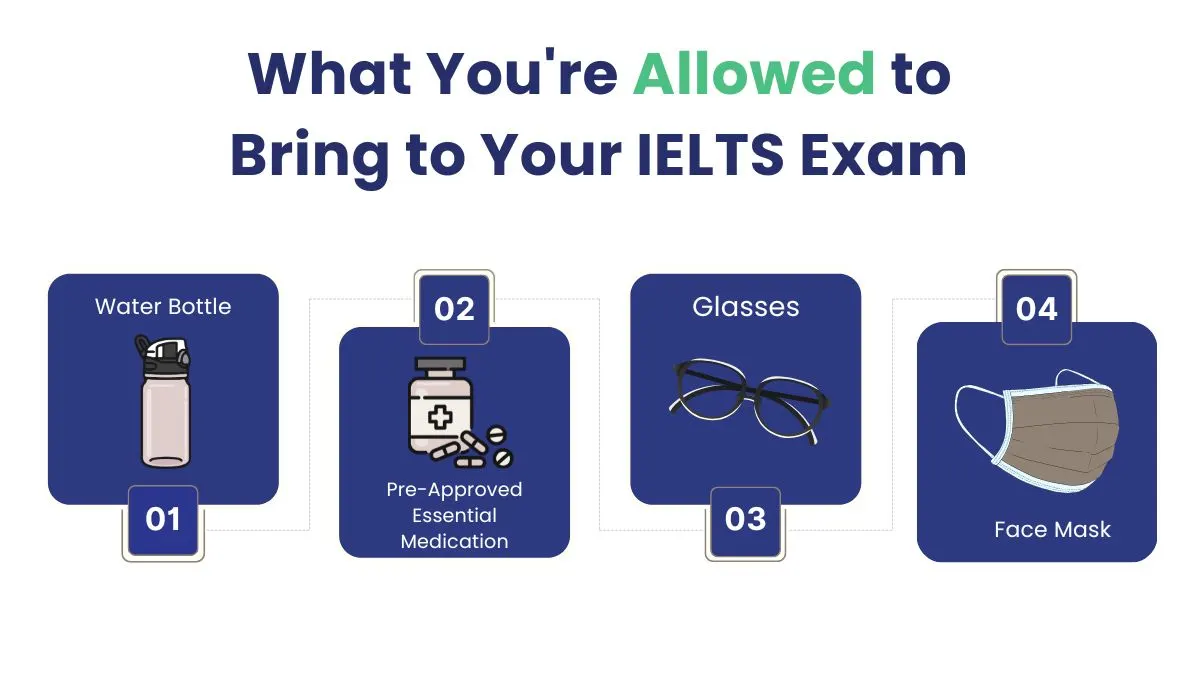
Once your documents are sorted, here is what to carry for IELTS exam beyond your ID.
- Water bottle: Transparent, with no labels or wrapping. Staff may ask you to remove any sticker before you enter.
- Pre-Approved Essential Medication: If you have a medical condition requiring medication during the test (such as an inhaler or prescription medicine), you may bring it into the exam room, provided it has been approved in advance by your test center.
- Glasses: Allowed in, but the case stays outside with your other belongings.
- Face mask: May be required or optional, depending on current guidelines at your center.
None of these items need advance approval, but each one has a small rule attached to it. Knowing them ahead of time means one less thing to think about at the door.
What You're Not Allowed to Bring to Your IELTS Exam
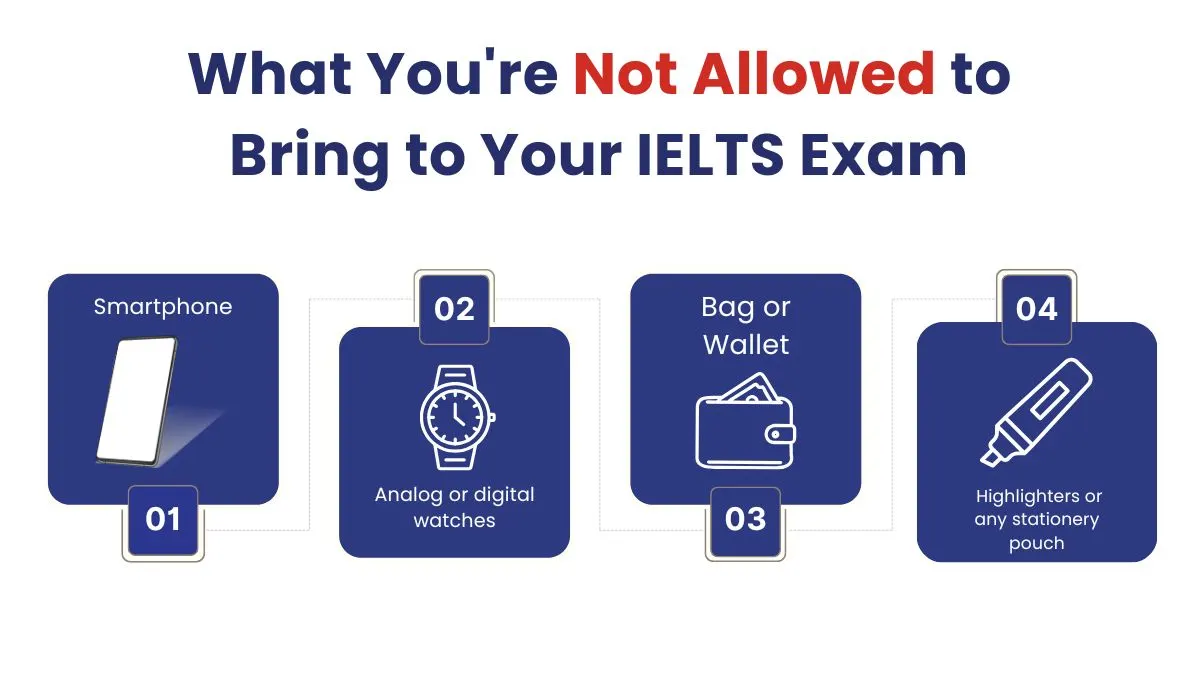
The exam room does not allow mobile phones, watches, bags, personal notes, or your own stationery case. Everything except your ID, water bottle, and any test-approved writing tool stays outside with the supervisor.
- Mobile phones, smartwatches, and tablets
- Bags, wallets, and personal notes
- Analog or digital watches (a wall clock or on-screen timer is provided instead)
- Pencil cases, highlighters, correction fluid, or any stationery pouch
- Food, or drinks other than the approved water bottle
These rules exist to keep the test fair and secure for everyone, not to make things difficult for you. Once you know them, they’re easy to plan around.
IELTS Test Day Checklist for Computer-Based Tests
Your checklist changes slightly depending on which format you booked. Here are the IELTS test day requirements broken down by type.
Computer-Based / Online Test Checklist
For online IELTS test requirements, the list looks a little different since most writing materials are provided:
- Original, Valid ID: Passport or national ID.
- Confirmation Email / Admit Card.
- Clear Water Bottle.
- Stationery: Do not bring your own. Scratch paper and pencils/pens for rough notes are supplied directly at your workstation.
- A system that meets the required specifications, if testing from an approved location
- Any required software downloaded and tested in advance
Either way, your ID and confirmation details stay non-negotiable. The format you chose only changes what’s in your hands, not what’s checked at the door.
Looking for expert IELTS preparation from start to finish? See how Westford Education’s IELTS course helps students succeed in their exams and study abroad journey.
IELTS Test Day Tips to Stay Calm and Prepared
A good IELTS exam day checklist covers more than just what’s in your bag. Here are a few IELTS test day anxiety tips that genuinely help:
- Get a full night’s sleep. Cramming grammar rules at midnight rarely helps and often hurts your focus the next morning.
- Do a practice run to your test center a day or two before, especially if it’s in an unfamiliar part of the city.
- Keep your documents ready the night before, not the morning of.
- Avoid last-minute vocabulary lists right outside the test room. A calm mind performs better than a crammed one.
- Trust the preparation you’ve already put in. At this point, reviewing more won’t help as much as walking steadily.
None of these tips take extra effort, but together they make the difference between walking in stressed and walking in ready.
Recommended Read: Preparing for IELTS at Home
What Time Should You Arrive on IELTS Test Day?
You should arrive 45 to 60 minutes before your scheduled slot. This gives you enough time for ID verification, photo capture, and settling into your seat without rushing.
Kathmandu traffic, especially during morning hours, can eat into that buffer faster than expected. If your center is across town, plan for extra travel time the night before rather than estimating it in the morning itself.
Why Prepare for IELTS with Westford Education
Getting the checklist right is only one part of test day. The bigger factor is how ready you feel walking in, and that comes down to preparation. Here’s what studying with Westford Education looks like for IELTS candidates:
- Structured classes covering all four sections, Listening, Reading, Writing, and Speaking, with focused practice on each
- Both online and offline class options, so you can choose what fits your schedule
- Full-length mock tests that mirror the real exam format and timing
- Guidance on test-day logistics, documents, and centre-specific rules, so nothing catches you off guard
- Support that continues beyond IELTS, into your broader study abroad application and visa process
If you’re preparing for an upcoming intake and want structured guidance rather than figuring it out on your own, take a look at why we’re considered among the best IELTS consultancy in Nepal before your test date gets closer.
Final Thoughts
IELTS test day isn’t about carrying more; it’s about carrying the right things. A valid ID, your confirmation details, a clear water bottle, and a calm mindset will take you further than an overpacked bag ever could. Most students who feel unprepared on test day aren’t lacking knowledge of English; they’re unsure about the small logistics, and that uncertainty is easy to fix once you know the rules.
Once your test is behind you, it helps to know how long your IELTS score stays valid so you can plan your university applications and visa timeline around it.
If you’re preparing for IELTS as part of your study abroad plans, whether that’s for a September, January, or May intake, it helps to have someone guide you through both the test and what comes after it. Feel free to reach out to Westford Education if you’d like support with your IELTS preparation or your next steps toward studying abroad.
Ready to take the next step toward studying abroad? Contact Westford Education today for expert IELTS and admission support
Frequently Asked Questions
What should I bring on the day of my IELTS test?
Your original valid ID, confirmation email or admit card, and a transparent water bottle. Leave phones, watches, and bags outside the test room.
Can I bring a water bottle to the IELTS exam?
Yes, but it must be transparent with all labels removed. Staff check this before you enter the room.
What pens can I use in the IELTS writing test?
Usually a black ballpoint pen for paper-based tests, though some centers provide their own. Computer-based tests supply pencils and paper for rough notes.
Can I bring my phone to the IELTS exam?
Yes, but it stays outside the exam room, switched off, with your wallet and bag. Even leaving it on silent can count as a violation.
What happens if I forget my ID or arrive late?
Most centers won’t let you sit the test without your original ID, and there’s usually no exception. Late arrivals risk the same, so leave earlier than you think you need to.
Do I need a passport photo for IELTS?
No, your photo is taken during check-in or registration. Only bring your own if your center specifically asks for one.