


How to Register for the IELTS Test?
To book your IELTS test, first decide whether you need the Academic or General Training version, then look for an available test centre and suitable exam date. After selecting your options, create your account, provide the required personal information, make the payment, and your test booking will be confirmed once everything is processed.
Registering for the IELTS test is a simple process, but it must be done carefully to avoid mistakes that could delay your exam date. Students who want to study abroad, professionals who want to move to a new country for work, and people who want to work in the UK, Australia, Canada, or New Zealand all need to take the IELTS exam.
This guide has everything you need to know to book your IELTS test without making any mistakes. It includes a step-by-step guide to registering for the test, clear rules about who can take it, and online and offline booking options. This guide will help you register for your test, whether it’s your first time or you’re taking it again. Westford Education can help you to register your IELTS test without any delay.
Eligibility Requirements for IELTS Registration
Before starting the IELTS exam registration online, you should make sure that you meet all of the official requirements. Even though the rules are easy to understand, a lot of students still make mistakes, especially when it comes to passport information. This can cause extra stress or even cause them to cancel their exam booking.
Here are the main eligibility requirements:
Minimum Age Requirement
- You must be at least 16 years old to take the IELTS test.
- Students below 16 may only take it in special cases
Required ID Document (Most Important)
- Passport is mandatory for IELTS registration.
- Your name, spelling, date of birth, and passport number must match exactly during booking and on exam day.
Important Notes
- If your passport is expired, your exam may be cancelled.
- If you are renewing your passport, wait until the new passport is issued before registering.
- Minors (under 18) must submit a consent form.
- Retaking candidates must register again with the same valid passport.
These guidelines help protect your identity, maintain test security, and prevent booking complications. Many students lose money or face delays simply because of small ID mistakes, so paying attention at this stage saves you from unnecessary problems later.
Step-by-Step Guide: How to Register for the IELTS Test Online

Registering for the IELTS test online is straightforward, but it must be done carefully. A simple typo can delay your exam, cause issues with your results, or force you to rebook. This step-by-step guide walks you through the entire digital booking process so you can secure your test seat smoothly and avoid common mistakes.
Step 1: Create an Account on the Official IELTS Website
The first step is to create a candidate profile on an official registration platform. This account will allow you to manage your booking, access practice portals, and download your final results.
In Nepal, you can register through either of these official administrators:
- IDP IELTS Nepal (Metropark Mall, Lazimpat, Kathmandu)
- British Council Nepal (Lainchaur, Kathmandu)
Both providers are fully authorized, certified, and universally accepted by universities and immigration boards worldwide. Choose the provider that offers a convenient test location in your city and has open slots that match your timeline.
Before registering for test, IELTS Preparation is very important. It won’t let your money and time go in vain.
Step 2: Choose Your Preferred Test Type
Next, select the specific test module required for your international goals:
- IELTS Academic: Built for students planning to study at universities abroad, apply for scholarships, or secure professional registration in an English-speaking country.
- IELTS General Training: Geared toward individuals migrating for work, training programs, or permanent residency in the UK, Australia, Canada, or New Zealand.
Pro-Tip: Double-check your university or visa checklist before booking. Selecting the wrong module will waste your registration fee, as modules cannot be changed at the last minute.
IELTS Update (2026)
- Paper tests are discontinued globally: Paper-based tests officially ended in mid-2026; all core test components are now entirely computer-delivered.
- Writing on Paper is a restricted hybrid option: You can handwrite the Writing section while taking Listening/Reading on a computer, but this is only available at selected test centers and is barred for UKVI exams.
- UKVI tests are strictly digital: Secure English Language Tests (SELT) for UK Visas and Immigration are 100% digital, and the One Skill Retake (OSR) option cannot be applied to UKVI tests.
- One Skill Retake has strict delivery rules: You can redo a single section within 60 days, but your retake format must match your original exam format.
- Free AI-driven prep features mock scoring: Official Prepare Hubs now include complete digital test simulations that provide instant, diagnostic AI band scoring.
- Results are delivered in 1 to 5 days: Moving away from the old 13-day paper timeline, computer-based results are now processed and delivered rapidly.
- AI quality checks protect human scoring: Human examiners still grade the Writing and Speaking sections, but a backend AI quality assurance system is used to flag scoring inconsistencies.
- IELTS scores remain valid for 2 years: Test results maintain their 2-year validity window and global recognition from over 12,000 organizations.
Step 4: Select a Test Centre & Available Test Date
IELTS computer exams run multiple times a week across Nepal, including major hubs like Kathmandu, Pokhara, Chitwan, Butwal, and Biratnagar. When picking your slot, consider:
- Seat Availability: Peak intake seasons (June–September and December–January) fill up incredibly fast. Book at least 3 to 4 weeks in advance.
- Speaking Test Alignment: Your speaking test may be scheduled on the same day or within a few days of your written components. Choose a window where you are fully free.
- Results Speed: Standard computer-based test results are delivered rapidly within 2 to 5 days, making it ideal if you are racing against a tight university deadline.
Step 5: Fill in Your Personal Details & ID
Your personal profile must mirror your official documentation exactly. In Nepal, a valid passport is mandatory for IELTS registration; citizenship cards or driver’s licenses are not accepted.
Carefully type out your:
- Full name (exactly as spelled on your passport data page)
- Date of birth, gender, and nationality
- Passport number, along with its issue and expiry dates
- Active contact number and email address
Passport Upload: You will need to upload a clear, high-resolution color scan or photograph of your passport’s information page. Ensure all four corners are visible, text is readable, and there is no camera flash glare over your photo or signature.
Step 6: Confirm Your Booking Details
Before advancing to the final payment portal, take a moment to carefully review your application dashboard. Confirm that:
- The test module is correct (Academic vs. General).
- Your name spelling and passport number do not have typos.
- The test center location and date align with your plans.
Once you click submit, errors on your profile can be difficult or costly to correct through official support channels.
Step 7: Complete the Examination Payment
Your seat will only be locked in once payment goes through. The test fee for the standard IELTS on computer in Nepal is NPR 33,000 (fees vary slightly for specialized modules like UKVI).
You can complete your transaction through several secure payment pathways:
- Online Gateways: Direct digital wallets (like eSewa or Khalti) or credit/debit cards during the checkout prompt.
- Bank Transfers: Direct bank deposits or IPS transfers to the official accounts of IDP Education Nepal or British Council Services Nepal (Standard Chartered Bank, Nabil Bank, or Nepal Investment Mega Bank). If you choose a manual bank drop-off, you must email a clear screenshot of your deposit slip and reference number to the provider to confirm your seat.
Offline Registration Method (If Available in Your City)

Offline or walk-in registration is available in many cities through IDP offices or British Council partners.
What you need to bring
Before starting your offline IELTS registration, you’ll need to carry a few essential documents to complete the process without any issues. Make sure you have the following items ready:
- Original passport
- Passport photocopy
- Passport-size photos
- Payment (cash or bank slip)
How offline booking works
The offline booking process is simple and can be completed in just a few steps at your nearest IELTS registration office. Here’s how the walk-in registration works:
- Visit the nearest office.
- Fill out the application form.
- Choose test date and centre.
- Make the payment.
- Receive confirmation slip.
Who should choose offline method?
The offline registration method is especially helpful for certain types of candidates who benefit from in-person support and guidance. You should consider choosing the offline option if:
- Students with poor internet access
- Candidates needing direct guidance
- Students who want help with speaking slot selection
Recommended Read: MD-115 Visa Update
What Happens After You Register for IELTS?
Once your IELTS booking process is complete, you’ll receive:
1. Booking Confirmation Email
After registering, the first thing you’ll receive is a booking confirmation email. This email contains all the essential details you need to know about your IELTS test.
Booking Confirmation Email includes:
- Test date
- Test time
- Test centre details
- Candidate number
- Speaking test information
2. Access to IELTS Preparation Materials
Once your registration is complete, you’ll also gain access to official IELTS preparation materials. These resources help you get familiar with the test format and practice effectively before your exam.
Access to IELTS Preparation Materials includes:
- Free practice tests
- Study guides
- Sample writing tasks
- Listening and reading samples
3. Instructions for Exam Day
A few days before your IELTS test, you’ll receive detailed instructions for exam day. These guidelines help ensure you know exactly what to do and what to avoid, so your test day goes smoothly.
Instructions for Exam Day include:
- What to bring
- What NOT to bring
- Test centre rules
4. Speaking Test Confirmation
Sometimes the speaking test is scheduled on a different day from the main IELTS exam. You will receive a confirmation with all the necessary details to ensure you are fully prepared.
Speaking Test Confirmation includes:
- Exact speaking time
- Location
- Candidate number
Keep checking your email regularly to make sure you don’t miss any updates regarding your speaking test.
Recommended Read: Recent Change in UK PR Rule 2025
Important Tips to Make IELTS Registration Easier
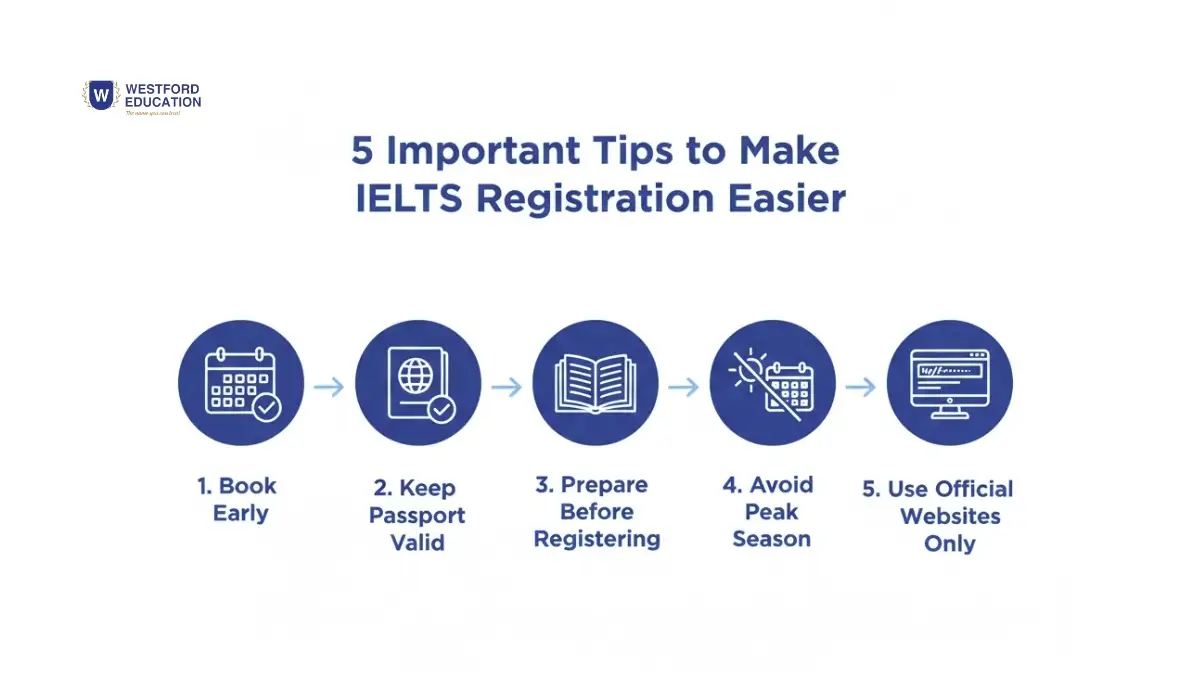
Following a few simple tips can make your IELTS registration process much smoother and less stressful. Paying attention to these details can save you time, prevent mistakes, and help you secure your preferred test date.
Important Tips to Make IELTS Registration Easier:
- Book early
- Keep your passport valid
- Prepare before registering
- Avoid peak season
- Use official websites only
Common Mistakes Students Make During IELTS Registration
Students often make several mistakes during IELTS registration that can lead to serious problems later. These include choosing the wrong test module, entering incorrect personal details, misspelling information as it appears on the passport, booking the test at the last minute, relying on unofficial agents, forgetting to confirm the speaking test schedule, or uploading unclear passport photos.
Many of these issues are difficult or sometimes impossible to correct afterward, so paying close attention and double-checking everything during registration is extremely important.
Here are some common mistakes students make during IELTS registration:
- Choosing the wrong test module
- Entering incorrect personal information
- Misspelling details from the passport
- Booking the test at the last minute
- Using unofficial or unverified agents
- Forgetting to confirm the speaking test time
- Uploading blurry or unclear passport photos
Recommended Read: Top AI Tools for Students
Final Checklist Before You Hit Submit
Before final submission, make sure:
- Your name matches your passport
- Your passport is valid
- You chose the correct test type
- Your test centre is convenient
- Your speaking slot is confirmed
- Your payment went through
- You saved the confirmation email
- You took a screenshot of your booking page
Final Thoughts
A smooth IELTS registration is crucial for a stress-free exam experience, and Westford Education can guide you every step of the way. From choosing the right test center and module to meeting eligibility requirements and planning your study abroad journey, our experts help you avoid last-minute cancellations, scheduling conflicts, and unnecessary stress.
With personalized guidance and practical advice, you can focus entirely on improving your English skills and achieving your desired score. Contact Westford Education today to get expert support and make your IELTS registration process simple and efficient.
FAQs
How much is the IELTS exam fee in Nepal?
The standard IELTS on computer fee in Nepal is NPR 33,000. Fees can vary slightly depending on specialized modules, such as IELTS for UKVI. The fee must be paid in full at the time of registration to secure your seat.
What documents do I need for the IELTS exam?
To register and sit for the IELTS test in Nepal, you need a valid, original passport. IDP and the British Council do not accept alternative documents like citizenship cards or driver’s licenses. The details you enter online must match your passport exactly.
How many courses are in IELTS?
IELTS is not a course but a language proficiency exam divided into four core subtests (modules): Listening, Reading, Writing, and Speaking. All four sections must be completed to receive an overall band score.
How many times can I take IELTS?
There is no limit to how many times you can take the IELTS exam. You can register and retake the test as frequently as you need to achieve your target score, provided you pay the registration fee for each attempt.
What is A1, A2, B1, B2 in IELTS?
These letters represent proficiency bands from the Common European Framework of Reference for Languages (CEFR). Your IELTS band scores align directly with these levels (for example, an IELTS score of 5.0–6.5 generally equates to a B2 upper-intermediate level).
How long is an IELTS score valid?
Your IELTS test report form (TRF) is valid for 2 years from your exact test date. Once this two-year window expires, the score can no longer be verified by universities or immigration departments, and you will need to retake the test.
Which type of essay is most asked in IELTS?
In IELTS Academic Writing Task 2, you will typically face one of four essay structures: Opinion essays (agree/disagree), discussion essays (discuss both views), problem and solution essays, or advantages vs. disadvantages essays.