

F1 Student Visa in Nepal 2026: Complete Step-by-Step Guide
Every year, thousands of Nepali students make the journey to study in the United States one of the best decisions you can make for your academic and professional future. But between getting your university admission letter and actually landing at a US airport, there is one critical step that determines everything: the F1 student visa.
If you are a Nepali student preparing to study in USA from Nepal 2026, this complete F1 student visa Nepal 2026 guide walks you through the entire process from eligibility to the embassy interview with honest, up-to-date information that actually reflects what you will face at the US Embassy in Kathmandu today.
Planning to study in the USA in 2026? Explore your options with Westford Education and find the right university for your goals.
What Is the F1 Student Visa?
The F1 visa is the standard US non-immigrant visa for international students who want to study full-time at an accredited American university or college. It is specifically designed for academic programs: bachelor’s, master’s, doctoral, and certain language programs.
With an F1 visa, you can:
- Enroll full-time in a SEVP-certified (Student and Exchange Visitor Program) US institution
- Work on campus up to 20 hours per week during the semester
- Apply for Curricular Practical Training (CPT) and Optional Practical Training (OPT). The OPT extension is particularly valuable if you graduate in a STEM field, offering up to 36 months of US work authorization
- Transfer between universities while maintaining your status
One thing to keep in mind: The F1 is a non-immigrant visa. This means you are expected to return to Nepal after completing your studies. Proving that intent is the single most important thing at your interview.
F1 Visa Requirements for Nepali Students
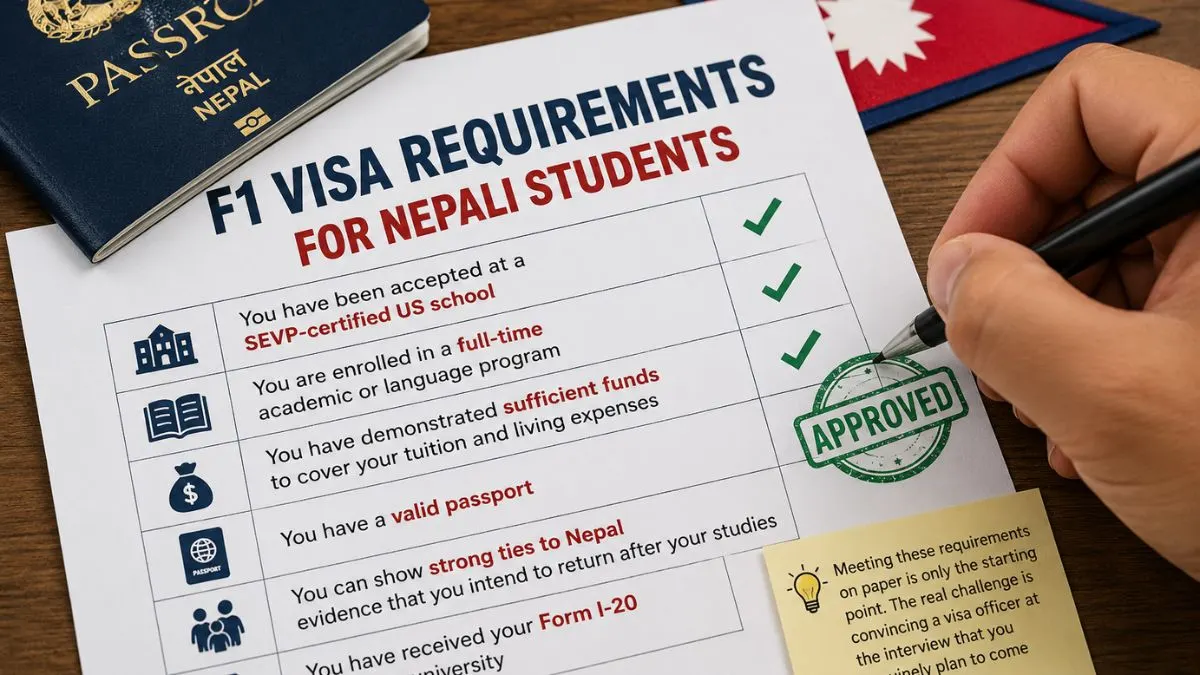
Before you begin your F1 student visa Nepal 2026 application, make sure you meet the basic F1 visa requirements for Nepali students.
- You have been accepted at a SEVP-certified US school
- You are enrolled in a full-time academic or language program
- You have demonstrated sufficient funds to cover your tuition and living expenses
- You have a valid passport
- You can show strong ties to Nepal evidence that you intend to return after your studies
- You have received your Form I-20 from your university
Meeting these requirements on paper is only the starting point. The real challenge is convincing a visa officer at the interview that you genuinely plan to come back to Nepal.
2026 Updates Every Nepali Student Must Know
The F1 student visa Nepal 2026 environment is significantly different from what it was even a year ago. There are three major changes that directly affect Nepali F1 applicants.
The Visitor Bond and What It Signals for Students
Starting January 21, 2026, Nepal was added to the list of countries where B1/B2 visa applicants must post a refundable bond of USD 5,000–15,000 before their visa is issued.
This bond does not directly apply to F1 applicants. But it sends a clear signal: the US government has officially categorized Nepal as a “high overstay risk” country. So under Section 214(b), F1 applicants will face stronger scrutiny. You need to prove your intent to return to Nepal more convincingly than ever before.
Social Media Vetting Is Now Mandatory
Since June 2025, all F, M, and J visa applicants must set their social media accounts to public before the interview. This is not optional.
You must list all handles used in the past 5 years on your DS-160, including dormant accounts. Officers review your online presence and look for anything that contradicts your stated study purpose. Keep your profiles clean, consistent, and professional before you apply.
Stronger Proof of Intent to Return
Given Nepal’s classification as a high overstay risk country, visa officers in 2026 are scrutinizing return intent more carefully than before. Vague answers like “I will come back to Nepal after graduation” are no longer sufficient. You need concrete evidence: family property, family business, employment prospects in your field back home, and community ties.
If you are confused about all the steps, feel free to contact Westford Education Consultancy through online or by vising the office situated in Putalisadak.
How to Apply for F1 Visa: Step-by-Step
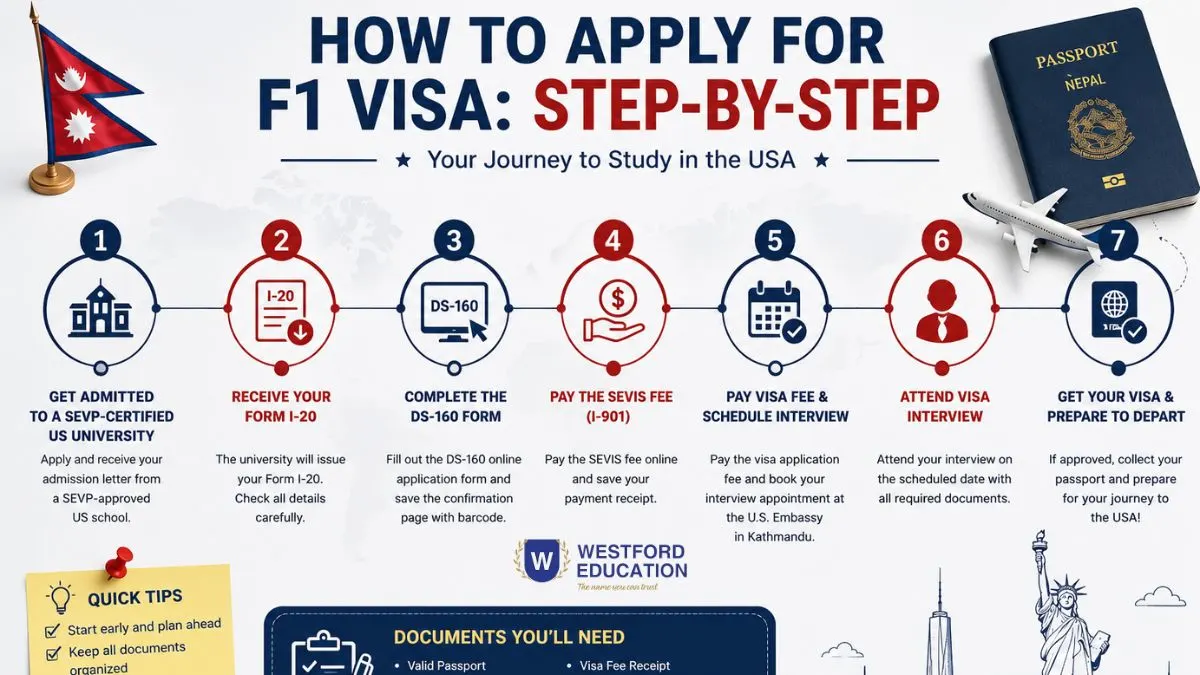
The F1 student visa Nepal 2026 application is not a single form you fill out overnight. It is a sequence of steps, each one building on the previous, and skipping or rushing any of them can delay your entire plan.
Here is the complete process for how to apply for F1 visa, in the correct sequence. Follow each step carefully and you will walk into your embassy interview fully prepared.
Step 1: Get Admitted to a SEVP-Certified US University
Your F1 journey begins before you ever contact the embassy. Not sure which university to apply to? Working with a best consultancy for USA in Nepal can help you find the right fit. Common intake windows are September (fall), January (spring), and May (summer). Fall is the most popular choice for Nepali students.
Once admitted and enrolled, your university’s Designated School Official (DSO) will issue your Form I-20.
Step 2: Receive and Review Your Form I-20
Form I-20 for Nepali students is the foundational document for the entire visa process. Issued by your university after admission, it contains:
- Your SEVIS ID number (starts with “N”)
- Your program start and end dates
- Estimated cost of attendance (tuition + living expenses)
- Your financial sponsor details
- Your DSO’s signature
Check every detail carefully. If anything is wrong, like a misspelled name, incorrect program date, or wrong financial amount, contact your university’s international student office immediately and get it corrected before moving forward.
Step 3: Pay the SEVIS Fee
Before applying for the visa, you must complete SEVIS fee payment. In Nepal, do this by visiting the official website at fmjfee.com and only that site.
- Current SEVIS I-901 fee: USD 350
- You will need your SEVIS ID from your I-20
- Pay using an international debit or credit card (most Nepali bank cards with international transactions enabled will work)
- Save and print your receipt; you will need it at the embassy
- Pay at least 3 business days before your interview
Do not use any third-party service for this payment. Only fmjfee.com.
Step 4: Complete the DS-160 Online Visa Application
The DS-160 is the official US non-immigrant visa application form, completed online at ceac.state.gov. It is detailed; set aside enough time to fill it carefully.
You will need to provide:
- Personal and passport information (exactly as in your passport)
- Educational history
- Employment history (if any)
- Travel history for the past 5 years
- All social media handles used in the past 5 years
- Security and background questions
A few important tips:
- Save frequently using your application ID; there is no recovery without it
- The form expires after 30 days of inactivity
- Upload a photo that meets US visa photo requirements
- Be completely honest; any mismatch between your DS-160 and interview answers is a serious red flag
- Double-check everything before submitting
Once submitted, print the confirmation page with the barcode. Bring it to your interview.
Step 5: Pay the Visa Application Fee
The non-refundable MRV fee is currently USD 185. This must be paid before you can book your interview. In Nepal, payment is accepted at designated Nabil Bank branches or through online methods listed on the US Embassy Kathmandu website.
Keep your payment receipt.
Recommended Read: USA Scholarship For Nepalese Students
Step 6: Schedule Your Visa Interview
Book your interview slot through the US Embassy Kathmandu appointment portal at ustraveldocs.com.
Keep these points in mind:
- Peak season is roughly April to August; slots fill up fast
- Book as early as possible, ideally right after you have your I-20 and DS-160 confirmation
- You can apply up to 120 days before your program start date
- Leave at least 6–8 weeks before your intended departure for any unexpected delays
- Embassy processing after a successful interview typically takes 3–5 business days
Step 7: Gather Your Documents
This is where careful preparation makes the real difference. Organized, complete documents tell the visa officer you are serious. Missing or mismatched papers can send you back to start over.
US Student Visa Documents Checklist Nepal
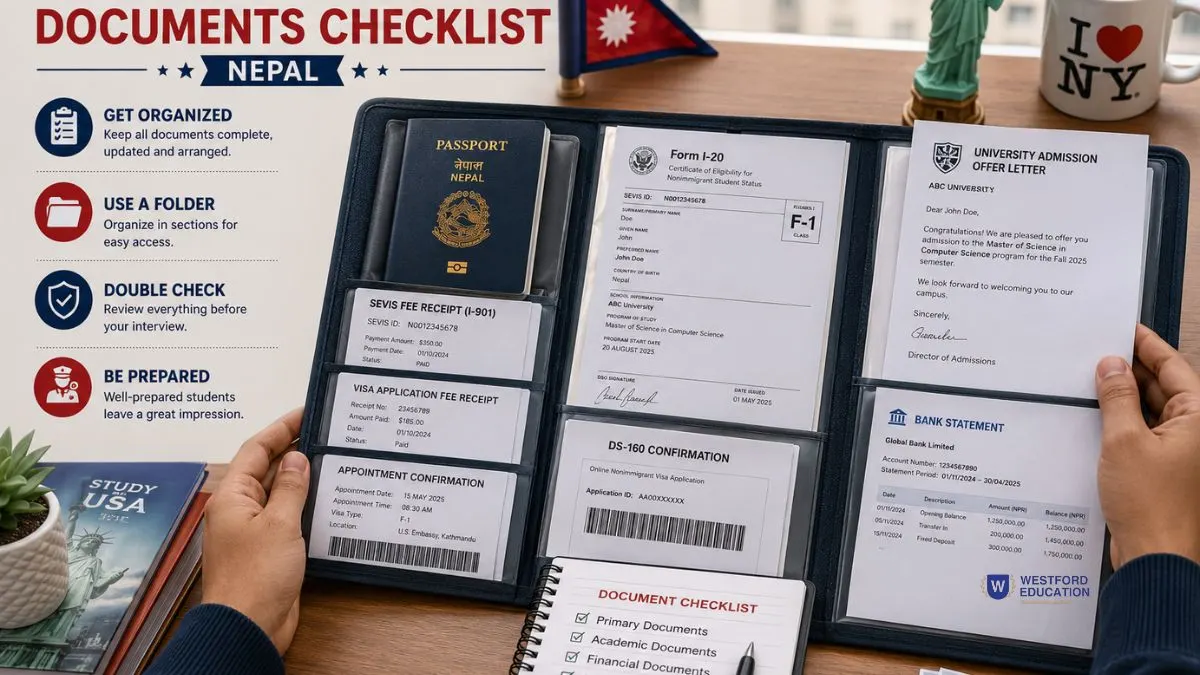
Getting your documents right is just as important as preparing for the interview. Missing even one paper can delay your visa or send you back to collect more, so use this checklist and tick everything off before your appointment.
Bring all of the following to your interview, organized neatly in a folder.
Primary Documents
- Valid passport (must be valid at least 6 months beyond your intended stay in the US)
- Original Form I-20 (signed by you and your DSO)
- DS-160 confirmation page with barcode
- SEVIS fee payment receipt (I-901)
- Visa application fee payment receipt
- Appointment confirmation letter
- Passport-sized photo (if not already uploaded)
Academic Documents
- University admission offer letter
- Academic transcripts from all previous institutions (SEE, +2, bachelor’s if applicable)
- Standardized test score reports (IELTS/TOEFL,GRE, SAT and GMAT preparation in Nepal whichever your university requires)
- Mark sheets and certificates
- Scholarship or assistantship award letters (if applicable)
Financial Documents
- Bank statements for the past 6-12 months (showing consistent balance, not sudden large deposits)
- Bank balance letter on official letterhead
- Fixed deposit receipts (if applicable)
- Education loans in Nepal for abroad study; sanction letter if you have taken a loan
- Sponsor’s tax returns and income documents
- Sponsor’s employment letter and salary certificate
- Property ownership documents (land/house certificates help demonstrate ties to Nepal)
- Affidavit of support from parents (if parents are sponsoring)
Supporting Documents
- Personal statement or study plan explaining why you chose this program and university
- Resume or CV
- Evidence of family ties in Nepal (family photos, property documents)
- If previously rejected: bring documentation showing what has changed since your last application
One practical tip: Organize your documents in the order they are likely to be asked for, with a simple cover sheet listing what is inside. Visa officers appreciate applicants who are prepared and easy to work with.
How Much Bank Balance Is Required for F1 Visa Nepal?
This is one of the most common questions Nepali students ask when preparing their F1 student visa Nepal 2026 applications. The short answer: you need to show enough funds to cover at least the first year of your program, as stated on your I-20.
The amount on your I-20 will include tuition plus estimated living expenses. For most US universities, this ranges from USD 30,000 to USD 60,000 per year (approximately NPR 40–80 lakhs, depending on current exchange rates).
What matters is not just the number in your account, but how you got there. The bank balance required for F1 visa Nepal needs to look like this:
- Funds that have been in the account for at least 3–6 months (not deposited right before applying)
- A clear and traceable source salary, rental income, business income, land sale, etc.
- Consistent monthly statements, not a suddenly inflated balance
- If taking an education loan: the loan sanction letter showing the approved amount is valuable even if funds have not yet been disbursed
A common mistake: parents suddenly transferring a large sum into an account right before the application. This raises immediate questions about where the money actually came from. Plan your financials early.
F1 Visa Interview Questions Nepal: How to Prepare
The F1 visa interview at the US Embassy in Kathmandu is typically short, just 3 to 5 minutes. But those few minutes matter enormously. The officer is not there to trick you. They simply want to understand whether you are a genuine student with a real plan.
For a deeper look at what to expect, read our full guide on detailed F1 visa interview questions Nepal applicants face at the embassy.
Here are the most common questions you should prepare for:
- Why do you want to study in the United States?
- Why did you choose this university and program?
- What are your plans after completing your degree?
- Who is sponsoring your education and how?
- What will you do after graduation?
- Do you have family in Nepal?
The key is not to memorize answers but to know your own story well. Know your university, your program, your sponsor, and your plan to return. If you can answer these questions naturally and confidently, you are already well prepared.
F1 Visa Rejection Reasons Nepal 2026
Understanding why visas get rejected helps you avoid the same mistakes. Here are the most common F1 visa rejection reasons Nepal applicants face when applying for F1 student visa Nepal 2026:
- Weak ties to Nepal: This is the number one reason. Vague answers about returning home, no family property, no concrete post-graduation plans.
- Sudden large bank deposits: If the bank balance was inflated just before the application, the officer will likely see through it. Financial history matters.
- Inconsistency between DS-160 and interview answers: If what you say at the interview does not match what you wrote in the form, it raises doubts about your honesty.
- Unclear study purpose: Choosing a program that has no logical connection to your past academics or career goals.
- Social media inconsistency: In 2026, officers review your online presence. Posts that suggest your real goal is immigration rather than study can lead to denial.
- Previous visa rejections not addressed: If you were rejected before and reapply without meaningfully changing your file, you are likely to be rejected again.
- Applying at the last minute: Not leaving enough time to address administrative processing or additional document requests.
If you have been rejected before, take it seriously. Address the underlying reason, whether it was financial documentation, ties to Nepal, or an unclear study purpose, before reapplying. Also make sure you are working with a reliable consultancy. Read our guide on how to avoid fake consultancies in Nepal before you trust anyone with your application.
A rejection is not the end of the road. Westford Education has helped many Nepali students rebuild their applications and get approved; we can help you too.
Final Thoughts
The F1 student visa Nepal 2026 process can feel overwhelming, especially when the rules are stricter and the scrutiny is higher for Nepali applicants. But with the right preparation, it is absolutely achievable.
The consular officer is not trying to catch you out. They simply want to know whether you are a genuine student with a real plan to study hard in the US and come back with something valuable. If that describes you, your job is simply to communicate it clearly and confidently.
Start early, organize your documents carefully, prepare your financial story properly, and walk into the interview knowing your program and post-graduation plan inside out. Those are the things that make the real difference.
If you have questions about your specific situation, whether it is about financial documents, your study plan, or handling a previous rejection, reach out to our counselors. We are here to help you get this right.
Still have questions about your F1 visa process? Talk to our counselors at Westford Education; we are here to help you get it right.
Frequently Asked Questions
How long does it take to get an F1 visa from Nepal?
The overall process takes around 2 to 3 months from the time you receive your I-20. Always start at least 3 months before your program start date to avoid last-minute delays.
How much bank balance is required for F1 visa Nepal?
You need to show funds covering at least the first year of your program, usually USD 30,000 to USD 60,000 (NPR 40 to 80 lakhs). The source and consistency of funds matter just as much as the amount.
Can I apply for an F1 visa without an education loan?
Yes. You can be sponsored by parents, relatives, or personal savings as long as the funds are sufficient and traceable. An education loan is helpful but not mandatory.
What happens if my F1 visa is rejected?
Identify the exact reason: weak ties, financial issues, or unclear study purpose. Address it properly and reapply. Reapplying without changing anything will likely result in another rejection.
Is the SEVIS fee refundable if my visa is rejected?
No. The SEVIS I-901 fee of USD 350 is non-refundable regardless of the outcome. Visit fmjfee.com for the latest transfer and reapplication policy.
Do I need to set my social media to public for the F1 interview?
Yes. Since June 2025, all F visa applicants must set social media accounts to public before the interview. You must also list all handles used in the past 5 years on your DS-160.
Can I work in the US on an F1 visa?
Yes, but with restrictions, on-campus work is allowed up to 20 hours per week during the semester. After graduation you can apply for OPT, which allows up to 36 months of work authorization for STEM graduates.
What is the difference between CPT and OPT?
CPT allows you to work in a field related to your studies while still enrolled. OPT is work authorization used after graduation and requires separate approval from USCIS.