


How to Plan Your Finances Before Studying Abroad in 2027-28
Most students planning to study abroad focus on tuition and forget everything that comes after it. Rent, food, transport, visa fees, insurance, flights, and the small stuff you need in your first few weeks, none of that shows up on the offer letter, but all of it hits your bank account.
That gap is where many families struggle. A student arrives with just enough for tuition and the first month’s rent, then gets hit with a security deposit, a phone connection, kitchen basics, and a bus pass, all in the same week. Nobody plans for that on purpose; it happens because the budget only ever covered the high costs.
This guide walks through how to plan your finances before studying abroad, what to actually count, how much you should have saved before you leave, and how to close the gap with scholarships or a loan without borrowing more than you need. Numbers vary by country, so treat this guide as the checklist to run against your own offer letter and destination.
Quick Summary
- Add up tuition, accommodation, living costs, visa, insurance, and travel; that’s your real total, not just the tuition figure
- Compare that total to what you already have (savings, family support, scholarships, loans) to see the actual gap
- Save for that gap, plus a separate emergency fund you don’t touch unless something goes wrong
- Start your proof-of-funds paperwork early; banks and embassies are slow, not you
- Look at scholarships and compare loan terms properly before assuming you need to borrow the full amount
How Much Does It Really Cost to Study Abroad in 2027-28?
If you ask five different students what studying abroad costs, you’ll probably get five different answers, and they’d all be right. Costs shift depending on the country, the university’s reputation, the course you pick, and even which city you land in. That said, some rough numbers help you start planning.
Destination | Approx. annual cost | Main costs to consider |
USD 45,000 – 75,000 | Tuition varies widely by state and university type; big-city living (NYC, LA) costs more than a college town. | |
£22,000 – 48,000+ | London is significantly pricier than cities like Leeds or Coventry; course length affects total spend. | |
AUD 50,000 – 80,000 | Sydney and Melbourne cost more than regional campuses; health cover (OSHC) is mandatory. | |
CAD 42,000 – 65,000+ | Toronto and Vancouver push costs higher; province-specific health insurance rules apply. | |
New Zealand | NZD 35,000 – 55,000 | Auckland costs more than smaller cities like Dunedin or Hamilton; course length varies by tuition total. |
A student doing a one-year master’s in a smaller UK city will spend very differently from one doing a four-year US undergraduate degree in a major metro. Course length, city choice, and lifestyle all move the number up or down sometimes by a lot.
What Are You Actually Budgeting For?
The total cost isn’t one lump sum; it’s a mix of different expenses that hit your account at different times. Breaking it down this way makes it much easier to plan and avoid last-minute surprises.
Expense | What it includes | When you may pay |
Tuition fees | Course fees and possible lab/material costs | At admission, then each semester or year |
Accommodation & living | Rent, food, utilities, local transport | Every month |
Visa, insurance & travel | Visa fee, health insurance, airfare | Before you leave |
Setup costs | Deposit, phone, bank account, currency exchange | First couple of weeks |
Tuition is usually the biggest expense, but it’s also the most predictable; you’ll know the exact amount before you leave. Living costs and setup expenses are where budgets usually go off track, mostly because students underestimate the small, recurring stuff.
Westford Education has been helping Nepali students with study-abroad planning since 2013. Learn more about Westford Education and see how we can help you plan your study abroad journey before you commit to a university.
A Few Things to Consider Before Creating Your Budget
- Trust your offer letter, not other information. Tuition changes yearly; the figure on your actual offer is the only number worth planning around.
- City matters more than country. London costs more than Manchester; Sydney more than a regional Australian town. Where you live shifts your budget as much as where you study.
- Visa fees and financial proof requirements change often. Check the official government website for your destination closer to your application date, not a fixed number from anywhere else.
- Budget for accommodation deposits. Most places ask for one to two months rent upfront, before you’ve even moved in.
- Don’t forget the small recurring costs. Textbooks, transport passes, a local phone plan, and currency exchange fees add up fast in the first few weeks.
- Pack for the climate you’re moving to. Weather-appropriate clothing is an easy cost to overlook if you’re heading somewhere much colder or hotter than home.
How to Plan Your Finances Before Studying Abroad, Step by Step
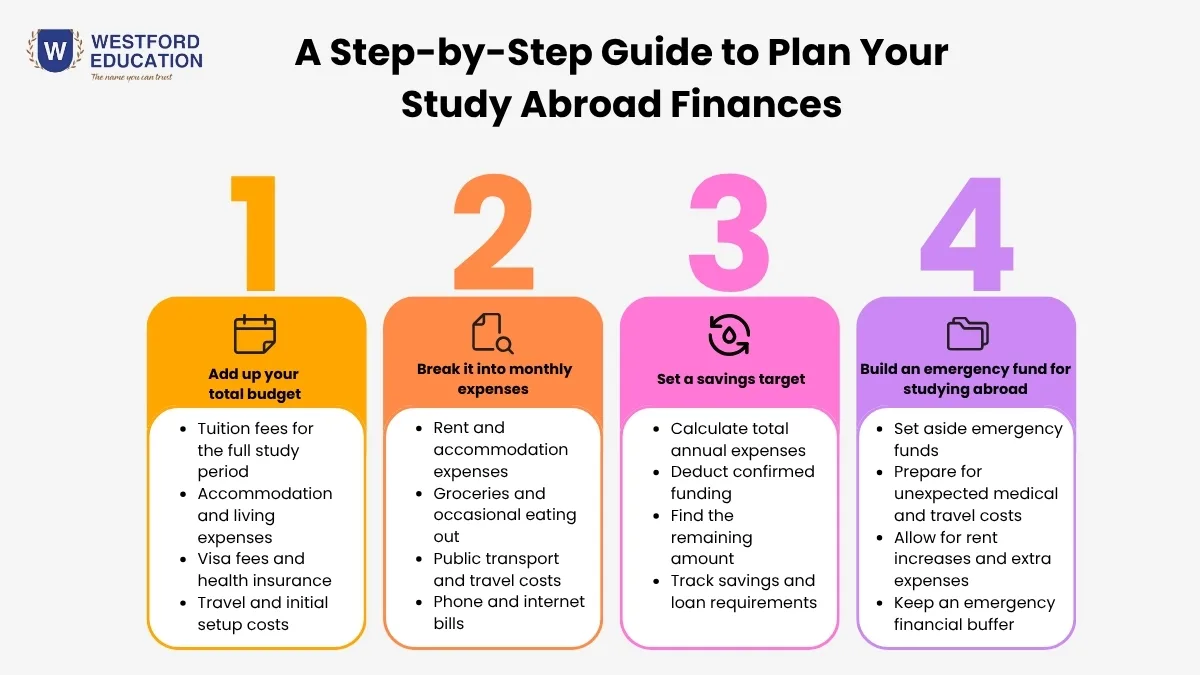
Knowing how to plan your finances before studying abroad starts with getting a clear idea of what you’ll actually need to pay. From tuition and rent to travel and unexpected costs, planning these expenses early can make the move much easier.
Step 1: Add up your total budget
Add tuition, accommodation, living costs, visa, insurance, travel, and setup costs together. This is the figure that drives everything else: your savings target, your loan amount, and what you show for proof of funds.
Step 2: Break it into monthly expenses
Once you know your rough annual number, split it into a monthly budget; that’s where it actually becomes usable.
- Rent: This eats the biggest chunk of your monthly money, no matter which country you’re in.
- Groceries vs. eating out: Cooking at home costs way less than ordering in, and over a full year, that gap turns into real savings.
- Transport: A student pass is usually cheaper than paying per ride.
- Phone and internet: Start with a prepaid plan; it’s usually the cheapest way in until you know what you actually need.
- Everything else: Clothes, nights out, random stuff you didn’t see coming. Give this category its own line, because it always ends up costing more than you expect.
Step 3: Set a savings target
Once you have your rough annual cost, subtract whatever’s already confirmed: scholarship, loan, family contribution- anything solid, not just hoped for. What’s left is the actual amount you need to save.
Say your total for the year comes to USD 60,000. You’ve got a USD 20,000 scholarship, and your family can cover USD 15,000. That leaves you with USD 25,000 to arrange yourself, whether that’s savings, a part-time job once you’re allowed to work, or an education loan.
Write this number down somewhere you’ll actually see it. It’s the figure that tells you whether you’re on track or need to start looking at other options.
Step 4: Build an emergency buffer into your financial planning for international students
A delayed flight, one unplanned trip to a doctor before your insurance kicks in, a rent increase you didn’t see coming any of these can wreck a budget that looked fine on paper. The buffer is what makes the plan actually hold up once you’re there.
How Much Should You Save Before Studying Abroad?
There isn’t a magic number here; it depends on your destination, your first tuition installment, and how much you’re already getting from family, scholarships, or a loan. Roughly speaking, most students need somewhere between $13,000 and $46,000 USD saved before departure, depending on where they’re headed. Most students need enough savings to cover:
- The first tuition payment
- The accommodation deposit
- Two to three months of living costs
- Visa, insurance, and travel expenses
- An emergency fund you keep separate and don’t touch
Save early and save consistently; even a modest monthly amount adds up faster than people expect once you’re a year or two out. Some students plan on part-time work to help once they’ve settled in, and that’s fine where the visa allows it, but don’t build your core budget around income you don’t have yet.
Where Can You Save Money on Study Abroad Costs?
Not every saving comes from cutting back; some comes from choosing better in the first place:
- Pick the destination that fits your budget, not just your first-choice ranking. Compare a few options seriously before you commit.
- Look at total cost, not just tuition: Let’s say if you’re planning to study in UK, a university in Manchester with £14,000 annual tuition fees could work out cheaper overall than one in central London charging £11,000, once accommodation, transport, and daily living expenses are included. Always compare tuition fees plus a realistic estimate of a full year’s living costs before making your decision.
- Apply for scholarships early: The deadlines are usually well before admission deadlines, and most students miss them by assuming they have more time.
- Go for shared housing or a homestay, instead of a private studio, at least for the first year.
- Use every student discount available: transport, software, entertainment, and all of it.
What Scholarship and Loan Options Can Help Fund Your Studies?
Most students end up piecing together funding from more than one source: some savings, some family help, a scholarship if they land one, and a loan for whatever’s still missing.
Scholarships worth checking:
- Many universities apply merit scholarships automatically at admission; go back through your offer letter before assuming you have to apply separately
- Chevening, Fulbright, Australia Awards, and similar government-funded ones are competitive and often want applications months before your course starts, so don’t leave these till the last minute
- If you’re in engineering, business, or a research-heavy field, check whether industry bodies in that sector fund anything; these get overlooked a lot
Loan options to compare:
- Government or public bank loans: lower interest, but banks usually want collateral once you cross a certain amount, and approval takes longer
- Private bank loans: quicker turnaround, sometimes with no collateral needed, but you’ll pay more in interest for that
- NBFC loans are easier to qualify for if you don’t tick every box a bank wants, though usually the priciest route
- International lenders: a few now work directly with students going abroad and skip the local guarantor requirement, useful if nobody back home can co-sign
Look past the monthly EMI; when comparing loans, the interest rate, total repayment amount, moratorium period, and processing fees matter more over time. Use up savings and scholarship money first, and let the loan cover only what’s genuinely left.
What Financial Documents Do You Need Before Studying Abroad?
Requirements vary by country and visa category, so please check the official immigration site for your specific case before making any assumptions. But generally, you’ll be asked for some combination of:
Document | Why it may be needed |
Proof of funds | Shows that you or your sponsor can cover the required costs. |
Bank statements | Shows your available funds and, where required, your financial history. |
Sponsorship letter | Confirms that a parent or another person is helping pay for your studies. |
Loan sanction letter | Shows that your education loan has been approved. |
Scholarship confirmation letter | Confirms the financial support you’ll receive from a scholarship. |
Fixed deposit/investment proof | May be accepted as financial evidence in some cases. |
Start gathering these early. Bank certificates and translations take longer than you’d think, and you don’t want to be chasing paperwork the week before your visa interview. Keep it all in one folder, physical or digital, so you’re not searching for a document at the worst possible moment.
How to Manage Money in Your First Few Months
Budget for what you’ll actually spend, not just tuition and rent on a spreadsheet. Your first month abroad is almost always pricier than every month after it; you’re paying a deposit, buying things for your room, and probably spending more on transport while you figure out how the city works.
Here’s what actually helps once you land:
- Open a local bank account fast: Most universities point you to student-friendly accounts with low or no fees. Do this in your first week, since currency conversion fees add up quickly if you’re still relying on your home account.
- Track spending for the first month, even loosely: You won’t know your real monthly cost until you’ve lived it once. A simple notes app or spreadsheet is enough; you’re just trying to catch surprises before they become a pattern.
- Don’t front-load big purchases: Furnish your room, buy winter clothes, and set up a phone plan space these out over a few weeks instead of buying everything on day one. It’s easier on both your wallet and your bank statement.
- Get a student transport pass immediately: In most cities this pays for itself within the first two to three weeks, and figuring out routes without one just means overpaying on individual fares.
- Keep a small cash or card buffer separate from your main budget: Something will come up that you didn’t plan for, like a lost item, a medical visit, or an unexpected fee. Having this set aside means it doesn’t derail your whole month.
It’s also worth checking the cost of living before you pick a university, not after. Two universities can charge nearly identical tuition and still leave you with very different monthly bills depending on the city, so factor this in at the decision stage, not once you’ve already committed.
Final Thoughts
To plan your finances before studying abroad, you need to know your full costs upfront, save early, and keep an emergency fund that’s genuinely separate from everyday spending. Check what scholarships and loans are actually available before assuming you need to borrow the maximum, and pick a destination you can afford, not just one you like the sound of.
If you want help working through your study abroad budget, talk to our education counsellors about your destination, university, and financial options before you make your decision.
Frequently Asked Questions
How do I plan my finances before studying abroad?
First, figure out what you’re actually going to spend. Start with tuition, rent, food, transport, visa, insurance, and your flight. Then see how much you already have from savings, family support, scholarships, or a loan. That will give you a much clearer idea of how much more you need.
How much money should I save before studying abroad?
At the very least, try to have your first tuition payment, accommodation deposit, and a few months of living expenses ready. It’s also a good idea to keep some money aside for things you can’t predict. The amount you’ll need will depend a lot on where you’re going and what financial support you have.
What expenses should I budget for when studying abroad?
Don’t stop at tuition and rent. You’ll also need to think about food, transport, visa fees, insurance, flights, phone costs, study materials, and things you need when you first arrive. These smaller expenses can add up pretty quickly.
What are the hidden costs of studying abroad?
The first few weeks can be expensive because you’re buying things you don’t normally think about. You might have to pay an accommodation deposit, set up your phone and internet, buy course materials, pay currency exchange fees, or get a transport pass.
How much emergency money should an international student have?
There’s no exact amount that every student needs. Keeping a few weeks’ worth of basic living expenses aside is a sensible starting point. Try not to use this money for normal spending because you may need it when something unexpected comes up.
What financial documents do I need before studying abroad?
The documents depend on the country and your visa, so don’t rely on an old checklist from someone else. You may need bank statements, proof of funds, a sponsorship letter, a loan sanction letter, or a scholarship letter. Check the current visa requirements before you prepare everything.
How much does it cost to study abroad in 2027-28?
It really depends on the country, university, and city you choose. Add your tuition and expected living costs first, then include your visa, insurance, flight, and other upfront expenses. That’s a much better way to work out your actual cost than using one average figure.