

Top Tips for GRE Sentence Equivalence Questions (Easy + Proven Strategies)
If you’re planning to study abroad or preparing on your own, this guide will show you clear, proven ways to solve GRE sentence equivalence questions faster and with more confidence. These questions may look confusing at first, but once you understand how Educational Testing Service(ETS) designs them, things start to click.
Quick Summary
Here are smart strategies that work better than simple memorization:
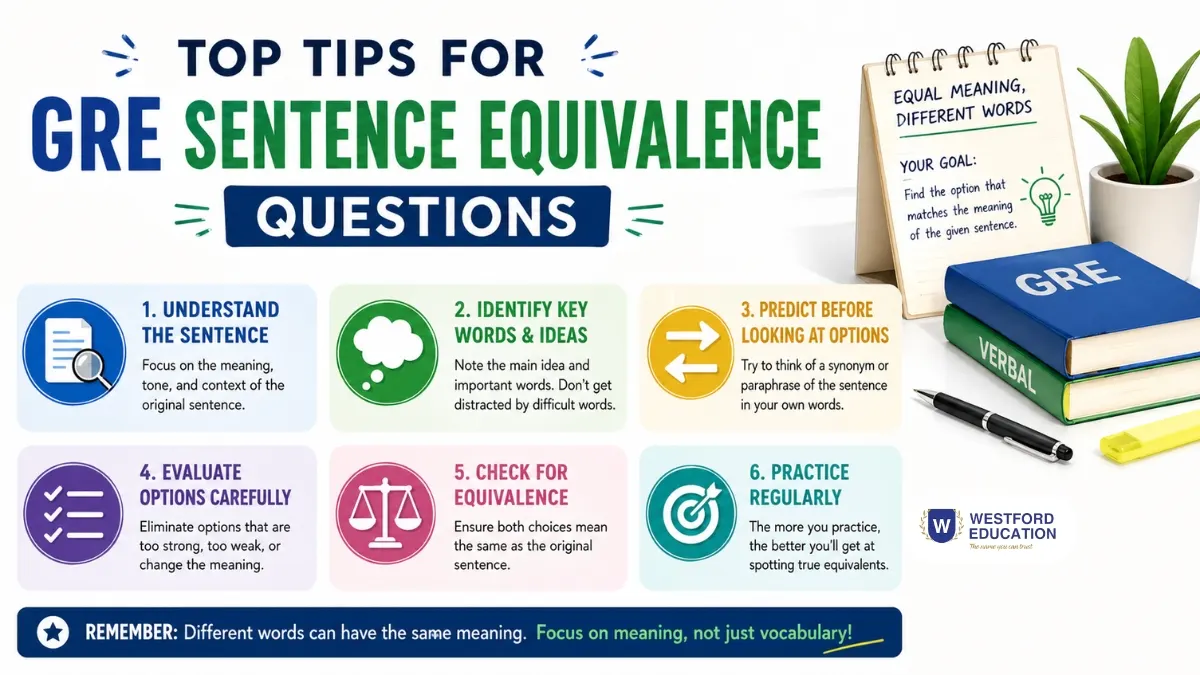
- Predict the answer first: Try to guess the word before checking options. This keeps you on the right track.
- Find synonym pairs: Don’t just pick good words; pick two words with similar meanings.
- Focus on tone and context: Words like “however” or “although” can change the whole meaning.
- Remove “orphan” options: If a word has no matching pair, it’s almost always wrong.
- Practice daily: Solving 4–5 questions every day builds pattern recognition over time.
Want a personalized GRE study plan? Book a free strategy session with Westford Education and get expert guidance tailored to your target score
What Are GRE Sentence Equivalence Questions? (Simple Explanation)
GRE sentence equivalence questions give you a single sentence with one blank and six answer choices. Your job is to select two words that both complete the sentence and produce sentences that have the same overall meaning. Both answers must be correct; choosing only one gives you zero points.
Here’s what makes them tricky:
- The two correct words are synonyms, but rarely obvious ones.
- Several options may seem to fit individually but don’t form a pair.
- ETS deliberately places related words that subtly shift the sentence’s meaning
These questions test vocabulary and logic together. Knowing definitions isn’t enough, you need to understand how a word changes the meaning of the full sentence.
The Three Traps ETS Uses (And How to Avoid Them)
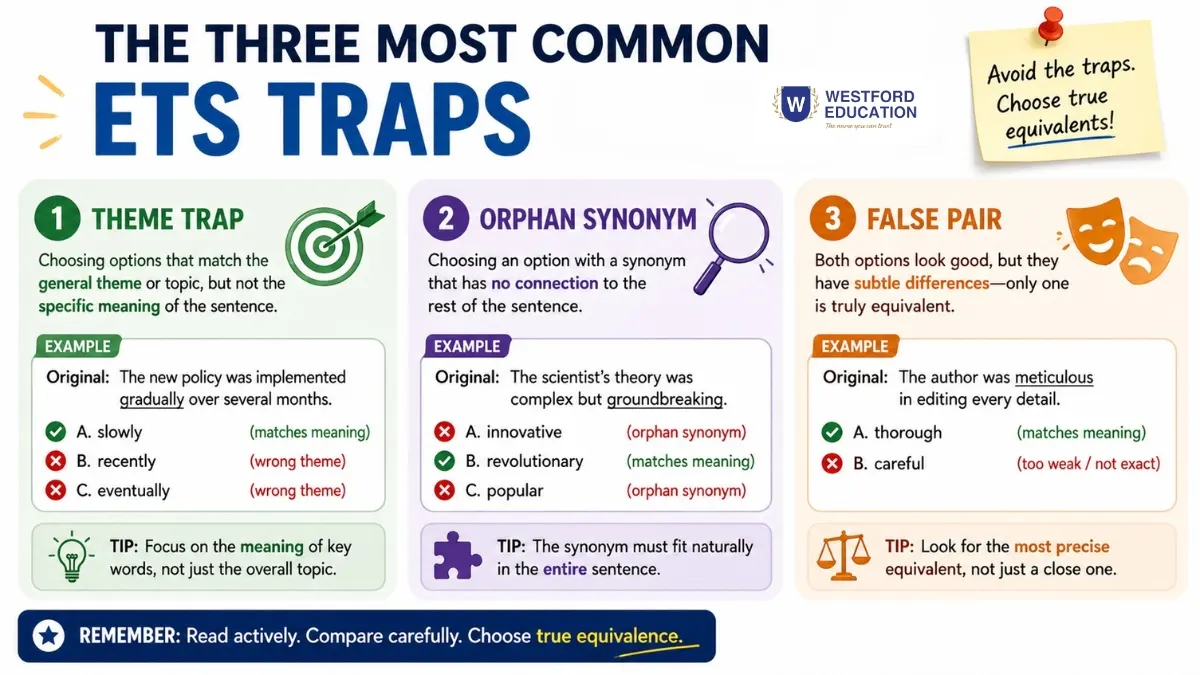
Every wrong answer option exists for a reason. ETS designs distractors to exploit specific reading habits. The three most common ETS traps are the theme trap, orphan synonym, and false pair.
Trap 1: The Theme Trap
The sentence topic pulls you toward related words that don’t actually fit the blank. A sentence about a cautious politician might include “reckless” and “bold”; they fit the political theme, but they contradict the sentence’s meaning.
Fix: Focus on what the blank must mean, not what the sentence is about.
Trap 2: The Orphan Synonym
One option fits the blank perfectly but has no synonym partner among the other five. No partner means it can never be the right answer, no matter how well it fits.
Fix: Before committing to any word, scan all six options for its synonym. No match = eliminate it.
Trap 3: The False Pair
Two words look like synonyms in isolation, but plugged into the sentence, they produce different meanings. “Sad” and “melancholic” are close, but “melancholic” carries a deeper, more reflective quality that changes certain sentences entirely.
Fix: Plug both words into the sentence separately. If the two sentences don’t mean essentially the same thing, it’s a false pair.
Struggling with ETS traps? Westford Education’s expert tutors help you spot and avoid every pattern before test day. Talk to a GRE expert for free →
Why Flashcard Cramming Fails for GRE Sentence Equivalence?
Flashcards aren’t useless, but they’re not enough. Here’s why flashcard-only prep consistently lets students down:
- One definition per word; GRE words often carry multiple meanings. “Sanction” means both to approve and to penalize. One flashcard can actively mislead you.
- No synonym training; you need to identify synonym pairs under time pressure, not recall isolated definitions.
- Zero sentence logic; blanks exist inside sentences with tone, direction, and cause-effect signals. Flashcards never train you to read them.
- False confidence; students who memorize 1,000 words often score lower than those who genuinely understand 500 words used in context.
The real fix is learning words in context, through practice sentences, root word study, and synonym grouping. That’s the approach Westford Education uses for GRE verbal prep.
10 Proven Tips to Master GRE Sentence Equivalence Questions
These aren’t generic GRE sentence equivalence study tips. Each one addresses a specific pattern that shows up in actual GRE sentence equivalence questions.
Tip 1: Predict Before You Peek
Cover the answer choices. Read the sentence. Think of a word or phrase that fits the blank. Then look at the options. Predictions act as filters; they help you resist attractive-but-wrong choices.
Tip 2: Hunt for Synonym Pairs First
Scan all six options and group them by meaning. If you see two words that are rough synonyms, test both in the sentence. This shortcut alone can cut your decision time in half.
Tip 3: Use Structural Clues to Predict Tone
Words like “although,” “despite,” “because,” “since,” and “however” tell you whether the blank should agree or contrast with the rest of the sentence. These direction signals are your best friends in sentence equivalence.
Tip 4: Eliminate Orphan Words Immediately
If a word has no synonym partner among the six choices, cross it out. It doesn’t matter how perfectly it fits; it can’t be part of the answer pair.
Tip 5: Watch for Extreme vs. Moderate Language
Some blanks need a strong word (“devastated”); others need a moderate one (“disappointed”). Context determines intensity. Don’t pick a word that’s too dramatic or too mild for the sentence’s tone.
Recommended Read: Want real, practical GRE preparation tips from students who scored high? Check out our GRE Preparation Tips from Top Scorers. It shares simple strategies that can help you boost your score and move one step closer to your dream of studying abroad.
Tip 6: Learn GRE's Favourite Synonym Pairs
ETS reuses certain synonym families: laud/extol, garrulous/verbose, laconic/terse, and equivocal/ambiguous. Learning 30–40 high-frequency synonym pairs gives you an edge that pure vocabulary study doesn’t.
Tip 7: Never Pick Based on Grammar Alone
All six options are grammatically correct; that’s by design. Grammar can’t help you narrow down the answer. Meaning and logic are your only tools.
Tip 8: Plug Both Answers Back In
Before finalizing, always read the sentence twice, once with each chosen word. If the two resulting sentences don’t mean the same thing, you’ve picked a false pair. Go back.
Tip 9: Know Your Negative Prefixes
GRE questions often hinge on whether a word has a negative prefix. Un-, dis-, im-, in-, ir-: A student who confuses “partial” with “impartial” will choose the wrong pair. Prefix awareness prevents these costly errors.
Tip 10: Time Yourself During Practice
Target under 90 seconds per sentence-equivalence question. If you’re regularly going over 2 minutes, it means you’re re-reading too much. Practice with a timer from day one, not just in mock tests.
Want strategies tailored to your weak areas? Westford Education’s GRE preparation course offers personalized coaching, expert guidance, and targeted practice to help you achieve a competitive GRE score for top universities abroad.
Step-by-Step Method to Solve GRE Sentence Equivalence Questions
Here are some methods to solve GRE sentence equivalence questions to remove guesswork and keep your process consistent under exam pressure.
Step 1: Understand the Full Sentence First
Read the sentence without the blank. Identify the subject, what’s happening, and any contrast or support signals (but, although, because, therefore). Know what the blank must do before you look at a single option.
Step 2: Predict the Word Before Looking at Options
Write or think of your own word for the blank. If the sentence says “the politician’s speech was _____, drawing applause from everyone,” your prediction might be “inspiring” or “stirring.” It doesn’t need to be a GRE word; it just needs the right meaning and tone.
Step 3: Find Synonym Pairs
Group the six options by meaning. Identify the strongest synonym pair and test it against your prediction. If the pair aligns with your prediction and produces equivalent sentences, you’re done.
Step 4: Check That Meaning Matches the Sentence
Plug each word in separately. Read both full sentences. Ask, “Do these mean essentially the same thing?” If yes, finalize. If not, go back to Step 3 and test the next pair.
Practice Questions with Detailed Explanations (Easy to Hard)
Work through these questions to apply what you’ve learned. Each example includes full reasoning, not just the answer.
Easy Level Example
Question: The professor’s lecture was so _____ that several students fell asleep before the class ended.
Options: A) riveting B) tedious C) provocative D) monotonous E) engaging F) brief
Answer: B and D – tedious, monotonous
The sentence tells us students fell asleep; this signals the lecture was boring, not engaging. “Riveting,” “provocative,” and “engaging” all contradict this. “Brief” doesn’t explain why students fell asleep. “Tedious” and “monotonous” are near synonyms meaning dull and repetitive; both produce equivalent sentences and match the context clue perfectly.
Medium Level Example
Question: Despite the mayor’s attempts to _____ tensions in the city, protests continued to grow in size and intensity.
Options: A) inflame B) mitigate C) exacerbate D) alleviate E) publicize F) document
Answer: B and D – mitigate, alleviate
“Despite” signals contrast; the mayor tried to reduce tensions but failed. “Inflame” and “exacerbate” mean to worsen, which contradicts “despite.” “Publicize” and “document” are irrelevant to tension management. “Mitigate” (reduce) and “alleviate” (ease) are synonyms that both create equivalent, logical sentences.
Hard Level Example
Question: The critic praised the novel’s _____ prose, noting that the author conveyed complex ideas without resorting to unnecessary elaboration.
Options: A) prolix B) terse C) laconic D) verbose E) ornate F) discursive
Answer: B and C – terse, laconic
The phrase “without unnecessary elaboration” is the key clue; it means the prose was concise. “Prolix,” “verbose,” “ornate,” and “discursive” all mean overly elaborate or wordy, which directly contradicts the clue. “Terse” and “laconic” both mean brief and to the point; they form a true synonym pair and align precisely with the sentence’s meaning.
Want more practice questions with clear, expert explanations? Join Westford Education’s GRE prep program for full verbal drill sets and guided practice. Get in touch tody →
Time Management Tips for GRE Sentence Equivalence Questions
Each GRE verbal section gives you 30 minutes for 20 questions. Sentence equivalence questions should take 60–90 seconds each, not more. Here’s how to stay on track:
- Set a 90-second rule: If you can’t decide in 90 seconds, make your best guess and move on. Coming back wastes more time than a calculated guess.
- Don’t re-read more than twice: If you’re re-reading more than twice, you skipped the prediction step. Go back to structural clues.
- Trust your synonym group: Once you’ve identified a strong synonym pair, commit. Overthinking burns time and introduces doubt.
- Skip strategically: Flag tough questions and return only if time allows. One question is never worth 3 minutes.
- Timer from day one: Full-mock timing only isn’t enough. Build speed through daily timed practice.
GRE Sentence Equivalence Preparation Guide for Nepali Students
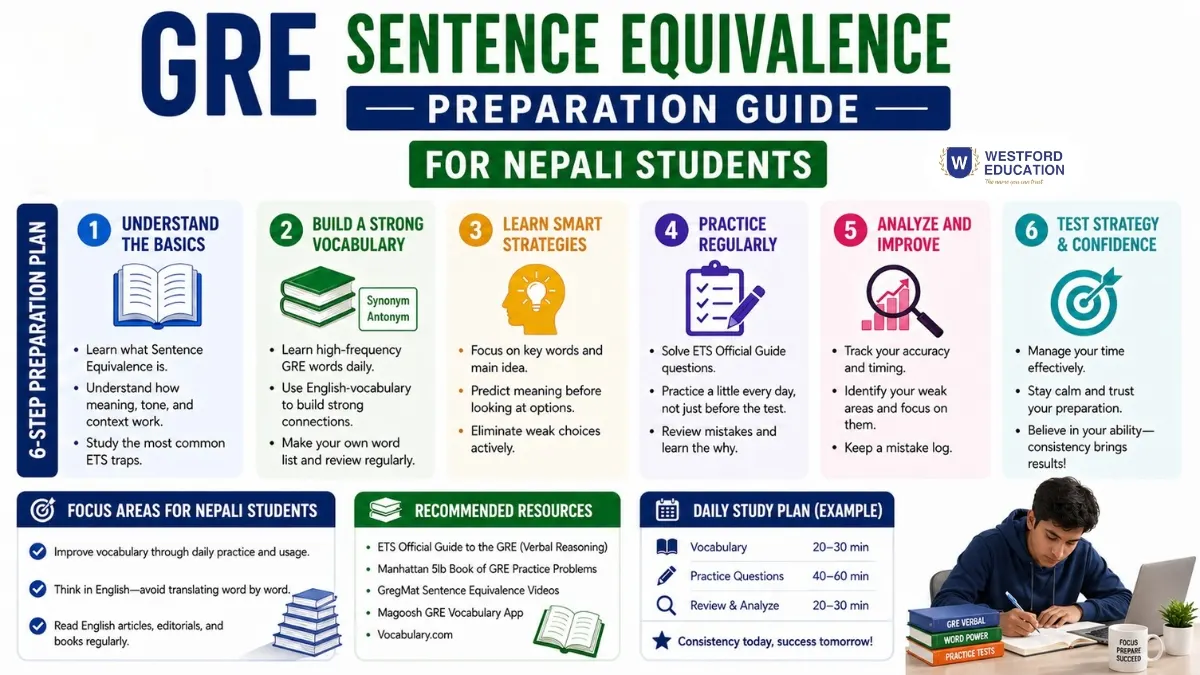
For students in Nepal, the core challenge is that formal written English isn’t part of daily life, and GRE sentence equivalence is built around formal, nuanced vocabulary. Here’s a GRE sentence equivalence preparation approach tailored to the Nepali students:
- Read quality English daily: Sources like The Guardian, BBC Analysis, or TIME Magazine expose you to the kind of nuanced vocabulary ETS uses. Aim for 20–30 minutes a day.
- Learn root words: Many GRE words share Greek and Latin roots. Learning roots like “bene” (good), “mal” (bad), “luc” (light), and “voc” (voice) unlocks dozens of words at once.
- Keep a synonym journal: For every new GRE word you learn, write 2–3 synonyms. This directly trains the pairing skill sentence equivalence tests.
- Get structured coaching: Self-study works, but expert feedback helps you fix bad habits faster.
- Use ETS official prep materials first: The Official GRE Verbal Reasoning Practice Questions Book is your most reliable source. Third-party questions often differ in style from what ETS actually tests.
If you’re in Nepal and aiming for universities in the US, UK, Canada, or Australia, Westford Education offers GRE coaching built for Nepali students covering verbal strategy, mock tests, and full study abroad guidance.
Best Resources to Practice GRE Sentence Equivalence
Some of the best resources to practice GRE sentence equivalence are:
- ETS Official Guide to GRE Verbal Reasoning – start here, always
- Manhattan Prep GRE – excellent for context-based vocabulary building
- Magoosh GRE – strong video explanations for visual learners
- Quizlet or Anki – use for synonym pair decks, not just individual words
- PowerPrep II (Free from ETS) – the closest simulation of real test conditions
For guided prep with mock tests and a personalized study plan: Explore Westford’s GRE program →
Final Thoughts
GRE sentence equivalence questions are learnable, but only if you treat the GRE as a reasoning test that requires vocabulary, not as a vocabulary test that requires reasoning. That shift in thinking changes everything about how you prepare.
The best strategy for GRE sentence equivalence questions is to read the full sentence, predict a word that fits the blank, and then find two answer choices that are synonyms of each other and match your prediction. Always plug both words back into the sentence to confirm they produce equivalent meanings. Avoid choosing words based on topic relevance alone; focus on logic and context.
If you’re preparing from Nepal and want a plan built around your actual weaknesses, Westford Education offers free GRE strategy sessions where you can get personalized guidance on exactly where to focus. Claim your free session →
Frequently Asked Questions About GRE Sentence Equivalence Questions
Are GRE Sentence Equivalence and Text Completion the same?
No. Both appear in GRE Verbal Reasoning but test different skills. Sentence equivalence asks you to choose two words that create the same meaning; it focuses on synonym recognition. Text completion asks you to fill one or more blanks based on overall sentence logic. Sentence equivalence is about matching meaning; text completion is about building it.
How many sentence equivalence questions are in the GRE?
Each GRE verbal section typically contains 4–6 sentence equivalence questions. The exact number may vary since the GRE is section-adaptive, but they are a consistent part of your verbal score and worth preparing for specifically.
Why are sentence equivalence questions difficult?
These questions are tricky because they test vocabulary and contextual logic at the same time. You must identify two correct answers that produce sentences with the same meaning, and ETS deliberately includes plausible single-word fits that have no synonym partner among the other choices.
How can I improve my GRE vocabulary quickly?
Learn GRE words in synonym pairs rather than individually. Study root words to unlock multiple related words at once. Use spaced repetition tools like Anki or Quizlet for daily review. Most importantly, read GRE-level English text daily: editorial writing, academic articles, and long-form journalism all build the vocabulary exposure and sentence equivalence demands.
Where can I prepare for the GRE in Nepal?
You can use online platforms like Magoosh, Kaplan, and the official ETS PowerPrep tool for self-study. For guided preparation with expert feedback and a structured study plan, Westford Education offers GRE coaching specifically designed for Nepali students pursuing study abroad, covering verbal strategies, mock tests, and full admissions support.