

How to Write an SOP for a Student Visa? (With Nepal-Specific Tips)
An SOP for a student visa is more than just a personal statement, it is your opportunity to convince a visa officer that you are a genuine student with clear academic goals, a realistic study plan, sufficient financial support, and strong reasons to return to Nepal after graduation. A well-written SOP connects your academic background, course selection, university choice, career ambitions, and future plans into a compelling narrative that strengthens your visa application.
If you’re preparing your application through a consultancy for abroad study in Kathmandu, Pokhara, Biratnagar, or anywhere in Nepal, you’ve likely heard that your SOP can determine the outcome of your student visa application. That isn’t just a saying. Even students with strong academic records and sufficient financial support can face visa refusals if their SOP lacks clarity, credibility, or a genuine purpose.
This guide explains how to write a compelling SOP for student visa applications, what visa officers actually evaluate, and the common mistakes Nepali students should avoid. You’ll find practical, actionable advice not generic tips or copy-paste templates.
Quick Answer
- An SOP for student visa explains your academics, course choice, funding plan, career goals, and ties to Nepal.
- Most countries expect 800–1,200 words; Australia uses a 4-question format capped at 150 words each.
- The biggest rejection triggers are generic language, weak financial proof, and unclear return intent.
- Your SOP must match your bank statements, transcripts, and offer letter exactly no contradictions.
- Each country weighs different things: UK checks CAS alignment, USA checks interview consistency, Canada checks financial transparency, Australia uses the structured GS questionnaire instead of a free-form essay.
What Is an SOP for a Student Visa?

An SOP for student visa is a written statement where you explain, in your own words, why you want to study a specific course at a specific university in a specific country and why you plan to return to Nepal afterward.
This is different from a personal essay. A visa officer reading your SOP is not judging your writing style. They are checking whether your story is consistent, believable, and backed by your documents.
Keep in mind, this SOP is submitted as part of your visa file, separate from any statement you may have already written for university admission. We will get into that difference later.
Why Does an SOP for a Student Visa Matter So Much?
It matters because it is the one document where the visa officer hears your reasoning directly, in your voice, rather than through transcripts or bank statements.
Everything else in your file is a number or a certificate. The SOP is where you connect the dots: why this course fits your background, why you can afford it, and why you will come back to Nepal once you finish.
One thing to note: officers read a large volume of SOPs, day after day. Generic lines like “I want to study abroad for better opportunities” get flagged instantly because they say nothing specific about you.
What Should an SOP for a Student Visa Include?
A strong SOP for student visa covers five core areas. Each one answers a question the officer is silently asking while reading.
Academic Background
Briefly walk through your education so far, and connect it to the course you are applying for. If there is a gap year or a change in field, explain it in one or two honest sentences rather than avoiding it.
Example: “After completing my +2 in management, I worked for a year at a local trading firm before deciding to pursue a bachelor’s in business administration, which gave me practical exposure to the field I now want to study formally.”
Course and University Selection
Explain why this exact course, at this exact university, makes sense for you. Mention specific modules, practical training, or facilities if you can. Avoid copying lines straight from the university website.
Example: “I chose this university’s Bachelor of IT program because of its industry placement component, which will let me gain practical experience alongside my coursework, something not widely available in similar programs in Nepal.”
Financial Ties and Funding Plan
State clearly who is funding your education, whether it is family income, a loan, or a combination. Your SOP should match your bank statements and sponsor documents exactly. Any mismatch here is one of the fastest ways to get flagged.
If a bank loan is part of your funding plan, our guide to education loans in Nepal for abroad study breaks down how to document this correctly.
Example: “My father runs a retail business in Pokhara and will fund my first-year tuition, supported by an education loan from a Nepali bank against our family property.”
Career Goals (Short-Term and Long-Term)
Describe what you plan to do right after graduating and where you see yourself in five to ten years. Keep this realistic and tied to the industry back home, not a vague dream.
Example: “In the short term, I plan to work with a construction firm in Kathmandu; in the long term, I aim to start my own consultancy focused on sustainable infrastructure in Nepal.”
Ties to Nepal / Return Intent
This section carries the most weight for Nepali applicants. You need to show, with specifics, why you intend to return: family responsibilities, a family business, a clear job market back home in your field, or property and long-term plans in Nepal.
Example: “My family runs a growing electronics distribution business in Biratnagar that I plan to join and help expand using the supply chain management skills I gain from this course.”
What Is the SOP Format for Student Visa Applications?
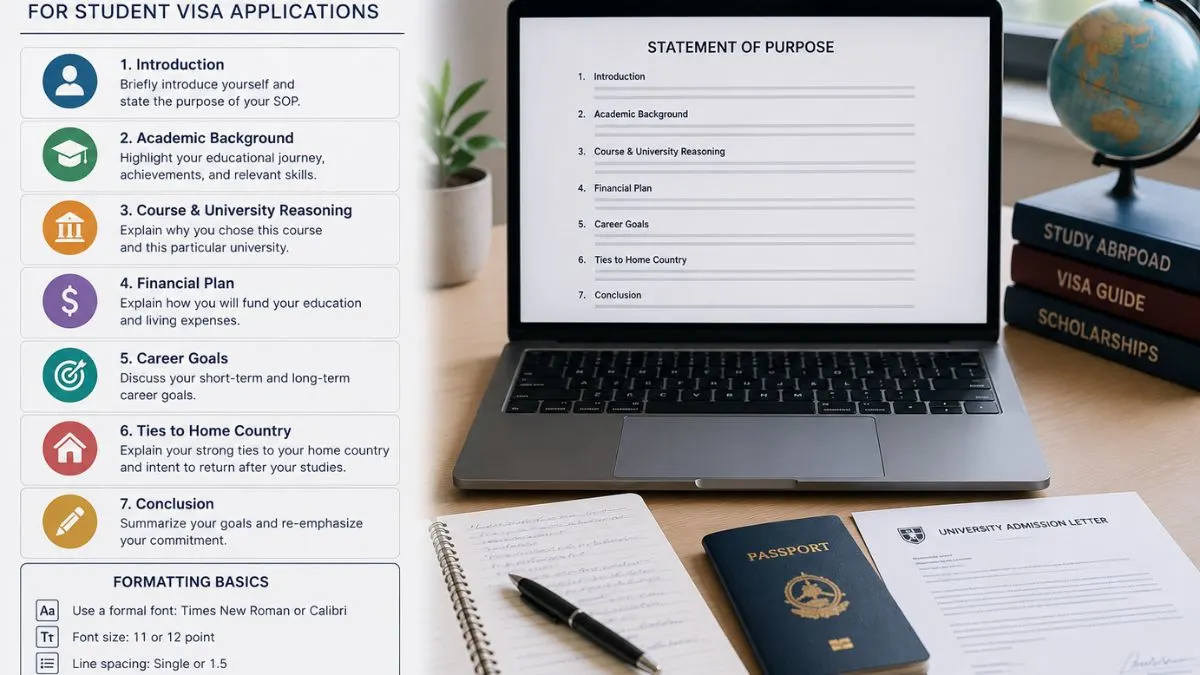
The SOP format for student visa documents generally follows this order: introduction, academic background, course and university reasoning, financial plan, career goals, ties to home country, and a short conclusion.
Some countries, like Australia, now use a structured questionnaire instead of a free-flowing essay, which we cover in the country-specific section below.
Formatting basics matter too: use a formal font like Times New Roman or Calibri, 11 or 12 point size, and single or 1.5 line spacing, and avoid bullet points unless the visa authority specifically allows them.
How Long Should a Student Visa SOP Be?
For most countries, the SOP for student visa word count falls between 800 and 1,200 words, unless the embassy or university specifies otherwise. Australia is the strict exception, Its Genuine Student (GS) requirement uses a series of targeted, short-answer questions embedded directly into the online application form, with each response capped at a strict 150-word limit.
While you can still prepare a traditional, long-form SOP to submit to Australian universities for admission or to attach as additional evidence, your online visa form responses must be incredibly direct, concise, and punchy to fit the portal’s system constraints.
How to Write an SOP for a Student Visa From Nepal
To write an SOP for a student visa from Nepal, follow the standard structure, but pay extra attention to your financial sourcing, your return-intent reasoning, and matching every detail to your Nepal-based documents; these are where Nepali applications get flagged most.
Start with your academic and family background in one or two lines, then move quickly into your reason for choosing the course. Avoid long personal stories about childhood dreams; officers want clarity, not sentiment.
When explaining your finances, be specific about the source: whether it is your father’s business income, agricultural land, a bank loan against property, or a combination. If a family member is sponsoring you, mention their occupation and income source in one clear sentence.
For the return intent section, be concrete. Mention if your family has a business you plan to join or if your field has clear demand in Nepal’s job market right now. Vague lines like “I will come back to serve my country” read as rehearsed and rarely convince anyone.
Keep in mind the intake window you are applying for, whether it is the September, January, or May intake, since your SOP timeline should align with your offer letter and visa application schedule.
One habit worth building early: Send your first draft to a counselor before your consultancy submission deadline creeps up. Westford runs this kind of document check regularly for students applying across intakes.
How Does an SOP for a Student Visa Differ by Country?
The core SOP structure stays the same across countries, but what each visa officer weighs most heavily, and in some cases the format itself, changes from country to country.
SOP for UK Student Visa
For the SOP for UK student visa, your statement needs to align closely with the details on your Confirmation of Acceptance for Studies (CAS) letter. Any mismatch between your SOP and your CAS, such as course name, duration, or institution, can raise questions.
UK officers also expect a clear explanation of how the course connects to your career back in Nepal, since UK visas place heavy emphasis on genuine, temporary study intent.
Example: “This MSc in Data Analytics directly builds on my current role at a Nepali fintech company, and I intend to return to apply these skills as the sector grows in Nepal.”
SOP for USA Student Visa
The SOP for USA student visa, tied to the F-1 visa, is often supported by an in-person interview at the embassy. This means your written SOP and your spoken answers need to match.
US officers focus heavily on academic continuity: does this course logically follow your previous education, and does it fill a real skills gap for your career back in Nepal? Be ready to explain your funding plan clearly and confidently, since interview screening has become more detailed in recent years.
Example: “This program in data science builds directly on my bachelor’s in statistics, and after graduation I plan to return to Nepal to work in the growing analytics sector, supported by my father’s savings and a partial scholarship.”
Recommended read: F1 visa interview questions nepal
SOP for Canada Student Visa
For the SOP for Canada student visa, financial transparency and home ties carry significant weight. Canada has introduced tighter caps on study permits and stricter checks on designated learning institutions, which means officers are relying more heavily on SOP quality to tell genuine applicants apart.
Explain clearly why a Canadian education benefits your career specifically in Nepal, rather than framing the course as a general stepping stone.
Example: “A Canadian diploma in supply chain management will let me bring practices currently underused in Nepal’s logistics sector, where I plan to return and work after graduation.”
Recommended read: Studying in Canada from Nepal
SOP for Australia Student Visa
The SOP for Australia student visa used to be called the Genuine Temporary Entrant (GTE) statement, a free-form essay of around 600 to 1,000 words. This was replaced by the Genuine Student (GS) requirement, a structured questionnaire with four specific, short-answer questions.
This means old GTE samples you might find online, or that a friend used a few years ago, no longer reflect the current format. Each GS answer needs to be precise and evidence-backed rather than a broad personal narrative, so avoid reusing old templates for this one.
Recommended read: Complete guide to studying in Australia
What mistakes can lead to an SOP being rejected for a student visa?
These are the SOP for student visa mistakes to avoid, based on patterns that repeatedly come up in refusals:
- Generic, copy-pasted language that could apply to any student, any country
- Vague financial explanations, or numbers that don’t match your bank statements
- Career goals that don’t connect logically to the course you’re applying for
- Weak or missing explanation of why you will return to Nepal
- Inconsistent details across your SOP, application form, and supporting documents
- Overly emotional or dramatic writing instead of clear, factual explanation
- Conflicting or hidden migration intent: For strict “temporary stay” countries like the US, UK, or Canada, writing phrases like “I plan to settle permanently” directly contradicts basic visa conditions.
Document consistency is worth repeating here: your SOP, bank statements, transcripts, and sponsor letter all need to tell the exact same story. Even small contradictions can trigger a refusal.
SOP for Student Visa Sample (Structure Outline)
Since every SOP needs to be personalized, a generic sample won’t serve you well as a copy-paste template. What’s more useful is a structure outline you can build your own SOP around:
- Introduction
- Academic Background
- Why This Course and University
- Financial Plan
- Career Goals
- Ties to Nepal
- Conclusion
Fill each section with your own real details, not borrowed phrases, and your SOP will already stand apart from most of what visa officers read in a day.
What's the Difference Between an SOP for University and an SOP for Student Visa?
The difference between SOP for university and SOP for student visa comes down to audience and purpose.
SOP for University | SOP for Student Visa | |
Read by | Admissions committee | Immigration or consular officer |
Deciding | Whether you are academically fit and prepared for the academic program | Whether you are a genuine student who will comply with visa rules and fund their stay |
Focus | Academic passion, research interests, and extracurricular strengths | Financial proof, course-career alignment, and ties to Nepal |
Tone | Can be more personal and exploratory | Needs to be precise, factual, objective, and fully backed by documents |
Reusing your university admission SOP word-for-word for your visa application is a common mistake worth avoiding; the two documents are judged on entirely different criteria, even if some academic background naturally overlaps.
Final Thoughts
Writing a strong SOP for student visa applications isn’t about impressive vocabulary or a dramatic story. It’s about clarity, consistency, and proof, every section should work together to tell one believable story that matches the documents in your visa file.
Before you submit your student visa application, have your SOP reviewed by Westford. Whether you’re applying for the September, January, or May intake, our online and in-person counseling helps you create a clear, authentic, and well-aligned statement that strengthens your application and reflects your genuine goals.
Not sure if your SOP is strong enough to submit? Contact us to get your SOP reviewed by a Westford counselor, online or in person, before you send it in.
FAQs
Is an SOP compulsory for all student visas?
Most countries require an SOP or an equivalent statement, such as Australia’s GS questionnaire, as part of the visa assessment.
Can I mention part-time work plans in my SOP?
Yes, but frame it as support for living expenses only, not as your main reason for going abroad.
Should I hire someone to write my SOP for me?
Guidance and review are helpful, but the SOP should reflect your own voice and real details, not someone else’s writing. The better move is a second opinion, not a ghostwriter. At Westford, this means a counselor reads your draft and flags what’s weak without rewriting it in their own words.
Do embassies actually cross-check the SOP against other documents?
Yes, officers commonly ask interview questions directly based on what your SOP states, so every detail should be something you can explain.
Can I use the same SOP for multiple countries?
No, each country’s SOP should be tailored to its specific format, word count, and what that visa officer weighs most heavily.
What happens if my SOP contradicts my bank statements or transcripts?
Even small contradictions can lead to a refusal, since consistency across documents is one of the first things officers check.